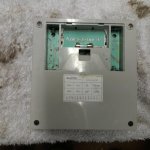
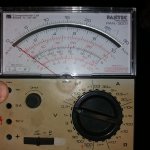
Is this a multimeter?

ltcom

Well-Known Member
Joined
27 Mar 2017
Messages
1,202
Visit site
Bought for a few quid. Nice silicone test leads, corrosion needs cleaning up. But is it for DC or only AC. Label on back suggests DC ability. Front not so sure, except for "40kOhms/V=" on left of dial. 20190410_173545.jpg20190410_173541.jpg20190410_173527.jpg
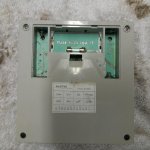
 
Unless I'm missing something, it looks like DC only, though it does have a capacitance measurement. I suggest you Google for the manual. But the most important thing, ahead of owning a multimeter, is knowing how to use one. You can do untold damage to everything if you don't know how to use it. The most common and destructive mistake is trying to measure voltage on the Amps or Ohms ranges.
 
It is a multimeter

the = symbol means DC, the ~ symbol means AC. (More usually the DC symbol has a dotted or broken lower line. The AC symbol sometimes has a dotted or broken lower line)

There are separate scales for reading AC and DC

You select AC, ~ , or DC, =, with the sliding switch. and then read the appropriate scale.
A couple of the current ranges and a couple of the voltage ranges appear to be for DC only

The DC setting is also for ohms. pF is for capacitance

I dont know what U.S.I. means

40Kohms/ volt is the impedance of the voltage ranges ... quite high meaning that the volts ranges will draw a relatively small current although much more than a digital meter
 
Last edited:
Thanks everyone. Especially LadyInBed. I could only find pictures and foreign adverts on the net. It was worth the price just for the leads to use on my digital meter. Not sure what to do with this meter. Will clean up and see if it works perhaps.
 
The 22.5V battery will probably only be needed for the higher ohm ranges, and maybe the curious signal generator.
The AA batteries will do the low ohm ranges.
It will work as an ammeter or volt meter with no batteries in, or I will be very surprised!
Sometimes it's nice to have a moving coil meter, even if just to check the batteries on the DMM. Moving coil meters can show when voltages aren't steady and give some indication of pulsing voltages that are too quick to read with a DVM.
 
The 22.5V battery will probably only be needed for the higher ohm ranges, and maybe the curious signal generator.
The AA batteries will do the low ohm ranges.
It will work as an ammeter or volt meter with no batteries in, or I will be very surprised!
Sometimes it's nice to have a moving coil meter, even if just to check the batteries on the DMM. Moving coil meters can show when voltages aren't steady and give some indication of pulsing voltages that are too quick to read with a DVM.
Thanks. That is the other reason I bought it because I thought I read on here once that analogue meters had advantages over digital. Thanks to MontyMariner I can see that this one is the basic model that does not need a 22volt battery. I have 3 digital ones of ascending price. My favourite cost only £10 because it is simple to use and has sound for contiuity. And now i have silicone test leads for it. Yeh!
 
The OP's title reminds me of the old angling chesnut.

" While fishing in a local gravel pit I hooked and landed a flat black plastic disc, small hole in the middle, both sides covered in very small grooves. Is this a Record? "
 
Thanks. That is the other reason I bought it because I thought I read on here once that analogue meters had advantages over digital. Thanks to MontyMariner I can see that this one is the basic model that does not need a 22volt battery. I have 3 digital ones of ascending price. My favourite cost only £10 because it is simple to use and has sound for contiuity. And now i have silicone test leads for it. Yeh!

While they may have advantages, they have a major disadvantage - the internal resistance when used as a volt-meter is low compared with modern electronic multimeters, That means that voltage measurements where there is a high resistance in the circuit will be inaccurate. Not a problem in the usual boaty applications, but a problem when dealing with electronics. An analogue multimeter always measures current; what is does to measure volts is measure the current through a very high resistance. The size of the resistor depends on the sensitivity of the meter - the bigger, the more accurate, but requires the measurement of a smaller current. In days of old, a measure of the quality of a multimeter was the internal resistance on the volts scale.
 
Top