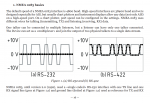
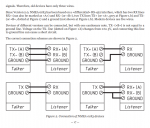
Is there an NMEA signal on my wires?

Who said connecting signal and ground ? Do that and kiss item goodbye.

That is also untrue. If you have a battery powered talker, for example a handheld GPS, connected to your boat system powered listener, like a VHF radio, you could connect either side of the signal to boat ground and it would still work because...

1) there is no common ground between the 2 device
2) the receiver circuit of a NMEA0183 device is required to be opto-isolated.

However, the standard says don't, for signal quality reasons. They don't specifically mention it for the fun of it. There are devices that require you to do just that though. I can feed a differential NMEA0183 signal into my handheld Garmin GPS for route upload and I have to connect the NMEA0183 B line straight to the device's ground pin, but being an isolated system with no common ground, it all works safely.

Every RS232 or RS422 line driver I have ever used has short circuit protection. I've never known one be killed by shorting a signal line to ground. Manufacturers specify short circuit survivability as part of their design acceptance tests, for example...

https://www.ti.com/lit/an/slla070d/slla070d.pdf?ts=1592336672365&ref_url=https%3A%2F%2Fwww.google.com%2F

When you connect up your RS232 .... NMEA ..... whatever GPS Puck etc. - the power -ve provides that 'ground' necessary to have not only power circuit - but also the data signal circuit.

That's only true for NMEA0183 devices that use the now very old early standard versions that were deprecated in about 1986. My Garmin GPS45 from that era is like that, as are cheap GPS pucks now (but they are not compliant with any version of NMEA0183, they just pump out a NMEA0183-like message). The later NMEA0183 standard versions specify differential signalling based on RS422 with compulsory opto-isolation, and that's what pretty much all marine kit has used for decades. The receiver circuit in this kit (and in my YAPP designs) will accept either old style single ended or new style differential NMEA0183 through an opto-isolator. You can call the RS422/NMEA0183 v2.3 and later signal return line ground if you like, but in a differential comms line terminology, you will be wrong.
 
Last edited:
NMEA0183 correctly is RS-422 electrically with differential pairs although will generally work as RS-232 if common ground on both devices. Standard Horizon and Garmin both use a bastard version with an all-purpose ground, so more like RS-232.
Lots of answers to OP but without PC or similar on board, the radio itself is probably best indicator. Check the wiring connections, especially ground wire. Is it all secure? Those thin wires can break inside.
How do you know GPS receiver is alive? Does it have an indicator LED? Is it flashing when it should?
If you have a chart plotter, it may have an NMEA diagnostic screen where you can see received data. Hookup the GPS receiver to check output.

I have gone over the wiring and can't see a problem, It was working yesterday (I had the VHF on and was listening whilst tied up) but not today. Nothing happened between yesterday and today.

The BR-355 flashes when it has a signal. It had a signal. I also have a Yakker connected and it was showing up on the mobile as an available network (but no tablet so not sure AIS was being transmitted from it). No plotter. This is a simple set up at present - just the VHF, the GPS puck and the Yakker with an android tablet hosting VMH charts.

Pottering off tomorrow for a couple of days, so will be able to tell if tablet is getting AIS signals from the VHF.
 
I have gone over the wiring and can't see a problem, It was working yesterday (I had the VHF on and was listening whilst tied up) but not today. Nothing happened between yesterday and today.

The BR-355 flashes when it has a signal. It had a signal. I also have a Yakker connected and it was showing up on the mobile as an available network (but no tablet so not sure AIS was being transmitted from it). No plotter. This is a simple set up at present - just the VHF, the GPS puck and the Yakker with an android tablet hosting VMH charts.

Pottering off tomorrow for a couple of days, so will be able to tell if tablet is getting AIS signals from the VHF.

The BR-355 puts out RS232 electrical signals so if you get a cheapo RS232 to USB converter and connect it as described earlier in this thread, download PuTTY and open a connection as a serial terminal (it defaults to SSH, you have to select serial) at 4800 you should be able to see if there's anything coming out of your BR-355.
 
Have you had any near lightning strikes recently?
Just a thought this might have taken out your gps signal? We have had a fair bit in North Wales moving over your way? Try getting hold of another GPS source or radio and test you haven't had a local strike take out the sensitive electronics in either component. Is the radio still receiving and transmitting? Some thing must have happened to cause the malfunction!
 
The VHF will still get AIS without position and the Yakker LED will flash. Use the Yakker NMEA viewer and look for sentences with GLL, RMB etc near start. You'll see something like a lat and long buried in there as well. If Yakker is 2 port, disconnect VHF and see if data LED is still flashing. If single port, connect GPS directly, change the baud rate to 4800 and try it. You may also be able to set VHF output to GPS info only, can't remember.
Did you get to the bit of the cable where the GPS lead connects to power and data?
 
The VHF will still get AIS without position and the Yakker LED will flash. Use the Yakker NMEA viewer and look for sentences with GLL, RMB etc near start. You'll see something like a lat and long buried in there as well. If Yakker is 2 port, disconnect VHF and see if data LED is still flashing. If single port, connect GPS directly, change the baud rate to 4800 and try it. You may also be able to set VHF output to GPS info only, can't remember.
Did you get to the bit of the cable where the GPS lead connects to power and data?

Just moved boat (going down to Strangford and my mooring is half tide) so no time for wire testing but can see AIS on my tablet. I have a spare GPS puck and a spare Yapp thingy to power the puck. Will have a look later.
 
Just looked. Voltages on all data and power to puck, yakker and vhf (5.5v). I think it must be the VHF which is suspect.
 
Pottering down the coast. Will do Yakker later.

If you're getting AIS from VHF that suggests it's OK. Have you got Yakker app on tablet to look at incoming NMEA? Can you arrange it so only GPS is connected to Yakker?
 
I have gone over the wiring and can't see a problem, It was working yesterday (I had the VHF on and was listening whilst tied up) but not today. Nothing happened between yesterday and today.

The BR-355 flashes when it has a signal. It had a signal. I also have a Yakker connected and it was showing up on the mobile as an available network (but no tablet so not sure AIS was being transmitted from it). No plotter. This is a simple set up at present - just the VHF, the GPS puck and the Yakker with an android tablet hosting VMH charts.

Pottering off tomorrow for a couple of days, so will be able to tell if tablet is getting AIS signals from the VHF.
Did you ever resolve this?
 
Did you ever resolve this?

Apologies. Should have got back. The magic of electrons seemed to resolve themselves.

I went over everything, checking connections and still no function. Then, two days later, switched on house batteries and the GPS input to VHF worked. I did nothing in between so I put it down to an elf coming aboard at midnight.
 
Your experience is interesting. I dont have an explanation for our different results.

Perhaps the update rate on some multimeters is too slow to display the pulse? This seems unlikely given that even cheap multimeters are very capable, but it is a possibility.

I have always seen a signal on a good dgital multimeter over several systems.
The only NMEA 0183 device on our new yacht is a GPS feeding the VHF (the rest is NMEA 2000) and it shows a very nice and distinctive pulse on my multimeter.

Our NMEA 0183 GPS was initially wired up to our 12v converter. it can generate an error code on start up due to a voltage spike and this falure to generate a position is obvious when observing the multimeter.
I can always see a pulse on my digi meter
 
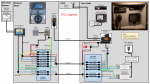
Incidentally, because NMEA0183 permits multiple listeners I built two 9-pin D-Sub serial ports into the panel by my chart table, they are on the bottom right of the diagram, pin numbers are correct.

I use a dual serial to USB Adapter to view the data on a laptop.

The top one is Rx only for AIS data at 38,4 K baud, the bottom one is Tx and Rx for all the other nav related data from my plotter at 4800 baud .

It doesn't look like that any more but it worked superbly with OpenCPN when I built it in 2012. I could view and trace all the NMEA sentences in the OpenCPN debug window to see which ones were there and what the contents were.

1599315091993.png
 
Top