Is it wise to bonding bolts in a cockpit floor with epoxy , so that the hex-head bolts/studs are encapsulated in order to avoid leaks ?

aidancoughlan

Well-Known Member
Joined
24 Jun 2002
Messages
548
Location
co.Wicklow, Ireland
Visit site
Hi Folks,

I'm hoping to get some advice on bedding M8 Hex bolts/studs (or some more suitable alternative fastener) in epoxy.

My cockpit floor is out to fix leaks in the engine bay & facilitate some maintenance work , and will hopefully be going back down soon.

The floor fits into a recess onto a GRP flange, and sealed with some type of tube-sealant/adhesive and bolted through the flange with washers underneath - using M8 slot-head screws on top, and nuts/washers underneath in the engine bay.
The builder had originally fixed the floor to the flange by cutting nearly dozen plugs in the Teak sole panel to allow slot-head M8 set screws to go down through the flange, filled with Teak plugs afterwards from top.

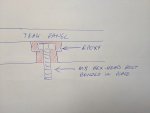
I have a new Teak Panel ordered to fit into the recess designed for this purpose, and rather than cut holes in it to through-bolt the set screws using the same approach, I am considering an alternative of permanently bonding the set screws (or Hex-head bolts as a replacement) in epoxy so that I don't have to cut holes in the nice new panel, and in order to eliminate the possibility of leaks via a dozen holes in the floor surface.

The original approach was this ...
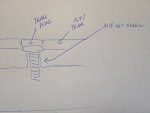
Teak Plugs (Copy).jpg

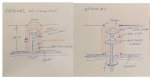
I am considering this...

Hex Bolts in Epoxy (Copy).jpg

The core is 20mm deep (ply core I think + GRP ).

I found some links online - in particular, the West system hardware bonding articles seem to be referenced a lot, and they have a detailed PDF online .....but I found nothing exactly matching my scenario.

I was planning on
  1. filling the existing holes temporarily to give something to drill into, centred on the old hole
  2. then drilling an over-sized hole maybe 20mm diameter & just to the depth of the Hex head to let it sit flush with the surface - perhaps 5mm or 6mm into the 20mm core of the cockpit sole.
  3. drilling a smaller hole for the M8 studs to go though (a little oversized to allow 2-3mm of epoxy around the edges.
  4. Wet the edges with un-thickened epoxy
  5. With the floor in place, put the Hex-head bolts in and fill the whole space around them with thickened Epoxy mix (yet to figure out exactly what)
Does this sound like a reasonable approach, are there any pitfalls to watch out for ?
  • One downside I can think of is that with all the bolts permanently embedded in the floor, when it is re-installed after removal in future, it would have to be replaced in a manner which leaves it fairly level as it is lowered, or the fixed studs may not line up 100% with the holes underneath and cause it to bind making replacement trickier. I don't plan to remove/refit it that often of course, and I'm not sure if that would be much of a problem in practise . Widening the holes in the flange that receives them would make it much less of an issue and hopefully a bit of wiggling would pop it into place
  • The studs will have washers/nuts tightened from underneath - I am assuming (without much doubt, but I don't know a lot about this) that the epoxy bonding is likely to be strong enough for this purpose? I won't have access to the heads to stop them turning when tightening nuts underneath, so the hex head would have to be solid in epoxy.
  • I came across "Bighead" fasteners (wide washer-style head with holes to grip epoxy) designed for embedding in epoxy for construction projects, but they only seem to be sold in large quantities, and I can't seem to find M8 versions that are 60mm long anyway. Does anyone know a source ? Would they be better than Hex heads , or are hex heads fine ?
  • There is a danger that damage to the threads would be permanent - no easy route to removing the bolt for replacement. But I'm inclined to hope that won't happen.
  • I didn't draw it in the diagram, but I suspect it would make sense to put washers under the hex head (also embedded in the epoxy) ?

Any advice welcome - will this work, what am I missing, or should I just follow the original approach ?

Aidan.


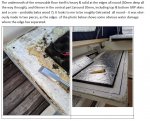
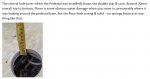
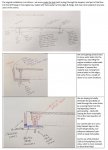
EDIT: Updated the photos below in case there is confusion about the nature of the floor /teak etc. - It's a fairly heavy structural GRP/wood floor which needs to be removed to remove the engine - it was semi-permanently fastened with mechanical fasteners & tube sealant. Its important it is secure, but equally important that it can be removed when needed without serious effort or undue damage . The teak is just a fairly thin cosmetic inlay on top.
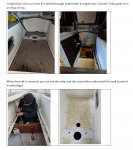
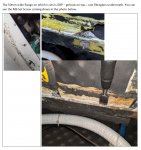
Photos-Page1.JPG


Photos-Page2.JPG
Photos-Page3.JPGPhotos-Page4.JPG

Photos-Page5.JPG
 
Last edited:
Many thanks @pvb - appreciated. I know you've been round here a long time, so that feedback is encouraging.

@BlowingOldBoots - I did come across those OK, but couldn't find any easily available in the right size. They seem very popular in construction for this purpose (embedding in epoxy), so presumably do have some advantage. However, there won't be much strain on these bolts, other than the twisting force of the nut being tightened underneath. I don't have any practical reference point since I've not used epoxy much before. I know it can be brittle, and it would be disastrous if they started to turn, but I'm presuming/hoping the relatively small hand-tightening torque force on these will be low and the shape of the hex head will be enough to prevent twisting.
 
You could then use a Sleeve Nut from the underside to make up the additional distance, with or without a washer on it for additional load bearing.

For example, here.

The ones above are M6 x 20, so use a M6 x 40 sleeve nut from the underside.

Alternative, a threaded sleeve.
 
Why do you need to fix the flooring down with screws? I have teak slats in my cockpit and they are free floating. Theres and open back on the boat so a big wave will run out fairly quickly. Anyway, I'd prefer to risk loosing the floor than have leaks into the interior. Why not do a good job filling all the holes with epoxy and gel and dry out the boat, and let the floor float If you didn't have teak ordered , Id suggest gluing down some teak effect flooring instead, some of it looks great. The new cockpit floor in teak sounds solid. you could always glue it in spots or come up with a fixing system above the floor if you are afraid of loosing the floor, if you get swamped. I hate a wet boat !
Kinsale 373
 
Hi @Kinsale373 - the question is not about the cosmetic teak flooring (that will just be bonded on top with Sikaflex 298), the mechanical fasteners are for the removable cockpit floor over the engine bay.

The main floor couldn't possibly be left free - if it lifts in a heavy roll its a deadly missile, leaves the engine bay open to the seas, and nowhere for the helmsman to stand .. which would be the least of his worries, since the steering column would be hanging over the side along with the floor dangling from the steering cables , and he's possibly sitting on a running engine at that stage ! :D

For the cosmetic flooring on top, I know lots of boats use a free floating teak grate but this floor is designed with a recess for a glue-down teak decking, and I already have a panel ordered. I;m just thinking ahead to how I'm going to handle access to the screws or bolts for the structural floor underneath it. I'd prefer to avoid cutting /plugging holes in the new teak panel if I ever need to remove/replace the floor, and I like the idea of less places to leak, which is one of the main reasons for having this up at the moment.
 
Job No1 Aidan is to seal that balsa core.
Looks like its seen a bit of moisture and you sure don't want any more in there.
It appears to be 15mm core so get a chisel or something of that width and scrap out 10 to 15mm all the way round.
Then once you're happy its dry, fill with thickened epoxy (403, 406 or 407 will be fine if using west)
Just create a dam using masking tape and syringe it in or simply use a lolly stick.

Its good practice that any time you drill through the core you seal it.
With a small hole, 5mm or something, use an allen key on a drill and remove the core, fill with epoxy and re-drill.
Same process as we did on your chain plates though with a balsa core its more important.
1, Because you need to stop the possibility of moisture getting in
2, Balsa core will not take any localised compression without damage

Would like to see a photo of the bottom of the cover before I comment on the best way to fix it down.
 
I agree with Kinsale. You are overthinking it.
Seal the teak with epoxy then bond it down on Sika 291. (fill the bolt holes whilst you are at it).
You will find that if you want the panel up again it will be a bit of a struggle, but you won't have leaks in the meantime.

You will need many less beads of adhesive than you think.

Try a test in your garage. Then, when it has set amaze yourself how much effort it needs to break the bond.
 
@convey - Many thanks for your links on the "bighead" bolts and the idea on using sleeves, I missed your earlier post. I'll have a think about that. Also, you were right about thinking M8 would be overkill - I'm not at the boat today, but I checked my notes, and they are actually M6.

@Kinsale373 + @Mercury Rising - yes, it wouldn't be the first time that happened. I do this stuff infrequently enough that you may be right about overthinking things, but I do want to make sure it doesn't leak !. I've updated the original photos in case there was confusion - the floor really has to be secured solid - the pedestal & all that hang out of it and there would potentially be a lot of force in heavy weather. Although there may be adhesive sealants that will do that job, the floor also has to remain easily removable (only way to remove the engine), so a really strong chemical bond is undesirable.

@Javelin - many thanks for chiming in - I value your experience having been at Southwold. I didn't notice, but I think you are right - the core on the large hole under the Pedestal is water damaged OK. It could probably do with the treatment you suggest. The smaller holes would be trickier to access. I have a Dremel , so might be able to use that with an appropriate bit as per Sealing Deck Penetrations To Prevent Core Rot - Marine How To. I saw you did something very similar with Holly on the chainplates to protect the core. I've attached some photos above of the underneath of the floor - if you have any comments on the fixings, appreciated. My current plan is to epoxy the bolts in place (leaving no leak points on top), and use Butyl Tape on the bottom flange. I'm partial to what I read about Butyl tape in terms of waterproof seal & ability to remove easily later. The problem with that is it's not resistant to diesel, and the fuel filler is on the floor inches away from the sealed edge, so I was planning to use white Arbokol 1000 on the vertical sides, the Arbo technical people say it's more resistant to diesel. It may be harder to remove later, but a lot less than the strong Polyurethanes.

Many thanks all.
 
Thanks. And, yes, I think Javelin makes a very good suggestion.

Personally, I'm a belts and braces kind of guy and I'd go with nuts, bolts & sealant. It's clearly structural. There's cracking around the holes and, hence, it suggests there are stresses to be aware of.

I think sleeve nuts, with the right size of penny washer around them, would be a nice solution.
 
That is ... if you can get the right length. If not, you fit from the top

Bighead bolt > then sleeve using permanent Loctite to attach it > right length bolt and penny washer from below.

I see the benefit of the Bighead bolt is it flush fits.

(Sorry, still can't re-edit posts)
 
OK, one last request here. I've done some homework and sourced some fasteners I can get actually hold of - not bighead, but using some of the ideas suggested by Convey above. I've narrowed it to two options where I can get hold of the hardware, both of which I suspect will work, and I'm ready to order to the hardware so it hopefully arrives in time for when I can get round to this.

As a reference, the floor was previously held by 18 simple M6 "screws" from the top surface down to the GRP flange underneath, with washers to spread the load. To recap, I'm proposing to embed M6 stainless steel hardware in epoxy (20mm hole to allow use of 20mm washers), widened a little under the skin & sealed with thin epoxy etc., then filled with thickened epoxy with the hardware in place.

Two Questions...
I'm not really searching for more new suggestions at this point, but looking for any last minute reasoned input on
  • "definitely don't do that" or "both will be fine" comments in terms of strength etc. of the hardware combination appreciated.
  • Washer/hole size - The M6 hex heads are 10mm across, I am thinking of 20mm holes to accomodate 20mm washers. However, 12mm washers (the next size down from the supplier) would make it a lot easier to work with smaller holes, would 12mm washers embedded in the epoxy be enough?.
I am leaning towards option #1 if it is strong enough, but will happily revert to option #2 if there is any consensus that #1 has weaknesses.

Many thanks for any input.

OPTION#1 - using a 40mm M6 hex "rod nut", with a 16mm bolt/washer on top going down 16mm into the thread - embedded in epoxy. Another (removable) 20mm M6 bolt coming up from underneath into the sleeve, with a washer on it - approx 10mm max will be "used up" by the GRP Flange & Sealant, and 10mm will bite into the sleeve.. so only 16mm + 10mm of the sleeve will be used when all is fastened.
Advantages
[+] Flush underneath, easier to refit the heavy floor after removal without fixed-in-place studs having to line up during lowering, and minimal scope for damage to threads (no exposed studs).
[+] a HEX sleeve in epoxy will resist "turning" as the hardware underneath is tightened.
Downsides
[-] Is this weakened by the fact there are two studs, only gripping 16mm + 10mm of the threads in the sleeve ?
[-] Is the single 20mm washer enough "grip" in the epoxy to prevent pulling through vertically ?

OPTION #2 - Simpler, using a standard longer 60mm M6 Hex Flanged Bolt & Washer combo embedded in epoxy , with another flanged bolt installed half way down for some "grip" (fixed in place beforehand). Add a simple Nut & washer underneath as per original installation.
Advantages
[+] Perhaps stronger - one piece of hardware?
[+] Cheaper
Downsides
[-] Studs stick down underneath as the floor is lowered, making it a bit more awkward to re-install after (very occasional) removal.
[-] Studs exposed / potential for damage to threads over time.

OPTION-1-verus-2.JPG
 
Sorry, it is other ideas. I see and like the idea of a long rod nut giving extra corners for bite

What about using a single coach bolt with a rod nut around it and a washer between it and the fibreglass of the cover, so you're compressing two washers together?

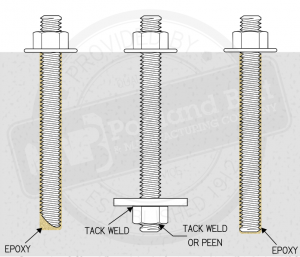
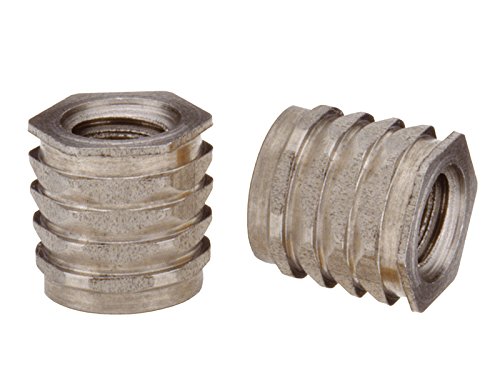
Similar systems to what you are talking about are often used in building construction where they are called anchor bolts/rods. One trick is to cut the top of the rod at 45° or to tack weld the nuts and washers. You can also buy various swedged anchor rods, ie that are additionally knurled in the middle for the epoxy to grip. You also get barbed, press-in threaded inserts, including high torque ones. These are used for epoxying fixing bolts/rods in to concrete.


all-thread-anchor-epoxy-300x257.png
41%2BOJc2jhwL.jpg
s-l500.jpg
 
Why not use stainless coach bolts? Say M6 - rounded flattish heads and won't rotate due to the square under the head. This what I used to secure the fixed hatch over the engine to the frame. A small amount of Butyl tape under the head, bedded onto self adhesive 'P' rubber as used for sealing windows. Admittedly I have a grp not a teak faced deck and you may not like this solution but it worked for me.
 
If you use option 2 replace the hex nuts with wing nuts as the wings will be held better in the epoxy.

I would use square bar with a thread to lock against the wingnuts.

I have done something similar to option 2 with a chain locker bulkhead so I could easily remove the whole bulkhead if need be.
 
Many thanks folks. ... I've gone and ordered some hardware !

Although I still really like the first option (using a female connector sleeve) since it seems much neater, I actually went with option 2 in the end ... partly on price (half the price on hardware, and with 20 fixings it adds up surprisingly), and also because of a couple of reasons I hadn't really thought of earlier - it will allow a smaller hole (6mm body of the M6 stud instead of 10mm body on the sleeve, and seems like it will be stronger/have more vertical "grip" (the hex sleeve will resist turning better but is "slippy" in the vertical, whereas the two nuts/washers on the other option seems like it would give it a lot of vertical pull strength in comparison - which is where it counts).

I had some last minute concerns about the connector nut/sleeve option too , in that each side top & bottom would thread into it only so far - I was intending 16mm top & 20mm from bottom - but for what it's worth - it turns out that there is a rule of thumb which seems to be that as long as you go into the thread as far as the diameter or the stud * 1.5 or *2 the bolt will break before the threads strip .. so both 16mm+20mm thread depth would have been more than adequate.

Overall, I think I was overthinking this though - knowing I was going to be locking these away for good, I was being a little paranoid about the possibility of the nut & bolt arrangement turning in the epoxy when I tightened it from underneath - which would be a real mess since there's no access to hold it from above. However, from what I read about the strength of epoxy I really doubt if hand cranking a nut from underneath would turn them providing there's any grip at all in the hardware - and a second nut helps give more grip anyway. The more important consideration is the vertical/hold-down strength.
 
Top