aidancoughlan
Well-Known Member
Hi Folks,
I'm hoping to get some advice on bedding M8 Hex bolts/studs (or some more suitable alternative fastener) in epoxy.
My cockpit floor is out to fix leaks in the engine bay & facilitate some maintenance work , and will hopefully be going back down soon.
The floor fits into a recess onto a GRP flange, and sealed with some type of tube-sealant/adhesive and bolted through the flange with washers underneath - using M8 slot-head screws on top, and nuts/washers underneath in the engine bay.
The builder had originally fixed the floor to the flange by cutting nearly dozen plugs in the Teak sole panel to allow slot-head M8 set screws to go down through the flange, filled with Teak plugs afterwards from top.
I have a new Teak Panel ordered to fit into the recess designed for this purpose, and rather than cut holes in it to through-bolt the set screws using the same approach, I am considering an alternative of permanently bonding the set screws (or Hex-head bolts as a replacement) in epoxy so that I don't have to cut holes in the nice new panel, and in order to eliminate the possibility of leaks via a dozen holes in the floor surface.
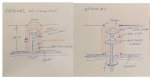
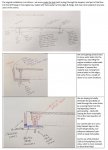
The original approach was this ...
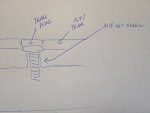
I am considering this...
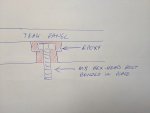
The core is 20mm deep (ply core I think + GRP ).
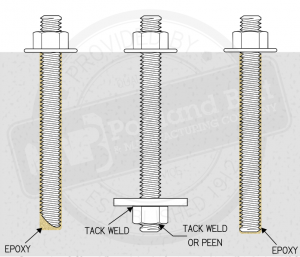
I found some links online - in particular, the West system hardware bonding articles seem to be referenced a lot, and they have a detailed PDF online .....but I found nothing exactly matching my scenario.
I was planning on
Any advice welcome - will this work, what am I missing, or should I just follow the original approach ?
Aidan.
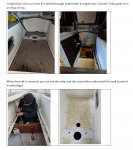
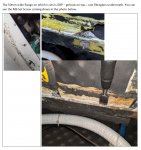
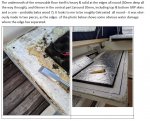
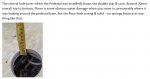
EDIT: Updated the photos below in case there is confusion about the nature of the floor /teak etc. - It's a fairly heavy structural GRP/wood floor which needs to be removed to remove the engine - it was semi-permanently fastened with mechanical fasteners & tube sealant. Its important it is secure, but equally important that it can be removed when needed without serious effort or undue damage . The teak is just a fairly thin cosmetic inlay on top.
I'm hoping to get some advice on bedding M8 Hex bolts/studs (or some more suitable alternative fastener) in epoxy.
My cockpit floor is out to fix leaks in the engine bay & facilitate some maintenance work , and will hopefully be going back down soon.
The floor fits into a recess onto a GRP flange, and sealed with some type of tube-sealant/adhesive and bolted through the flange with washers underneath - using M8 slot-head screws on top, and nuts/washers underneath in the engine bay.
The builder had originally fixed the floor to the flange by cutting nearly dozen plugs in the Teak sole panel to allow slot-head M8 set screws to go down through the flange, filled with Teak plugs afterwards from top.
I have a new Teak Panel ordered to fit into the recess designed for this purpose, and rather than cut holes in it to through-bolt the set screws using the same approach, I am considering an alternative of permanently bonding the set screws (or Hex-head bolts as a replacement) in epoxy so that I don't have to cut holes in the nice new panel, and in order to eliminate the possibility of leaks via a dozen holes in the floor surface.
The original approach was this ...
I am considering this...
The core is 20mm deep (ply core I think + GRP ).
I found some links online - in particular, the West system hardware bonding articles seem to be referenced a lot, and they have a detailed PDF online .....but I found nothing exactly matching my scenario.
I was planning on
- filling the existing holes temporarily to give something to drill into, centred on the old hole
- then drilling an over-sized hole maybe 20mm diameter & just to the depth of the Hex head to let it sit flush with the surface - perhaps 5mm or 6mm into the 20mm core of the cockpit sole.
- drilling a smaller hole for the M8 studs to go though (a little oversized to allow 2-3mm of epoxy around the edges.
- Wet the edges with un-thickened epoxy
- With the floor in place, put the Hex-head bolts in and fill the whole space around them with thickened Epoxy mix (yet to figure out exactly what)
- One downside I can think of is that with all the bolts permanently embedded in the floor, when it is re-installed after removal in future, it would have to be replaced in a manner which leaves it fairly level as it is lowered, or the fixed studs may not line up 100% with the holes underneath and cause it to bind making replacement trickier. I don't plan to remove/refit it that often of course, and I'm not sure if that would be much of a problem in practise . Widening the holes in the flange that receives them would make it much less of an issue and hopefully a bit of wiggling would pop it into place
- The studs will have washers/nuts tightened from underneath - I am assuming (without much doubt, but I don't know a lot about this) that the epoxy bonding is likely to be strong enough for this purpose? I won't have access to the heads to stop them turning when tightening nuts underneath, so the hex head would have to be solid in epoxy.
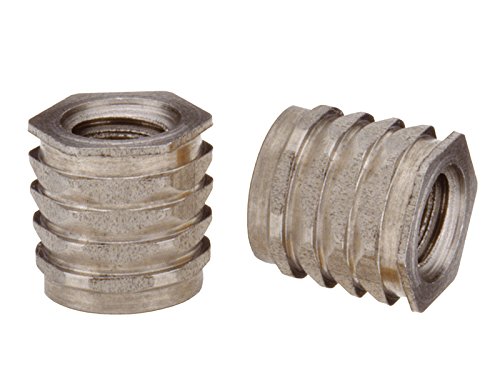
- I came across "Bighead" fasteners (wide washer-style head with holes to grip epoxy) designed for embedding in epoxy for construction projects, but they only seem to be sold in large quantities, and I can't seem to find M8 versions that are 60mm long anyway. Does anyone know a source ? Would they be better than Hex heads , or are hex heads fine ?
- There is a danger that damage to the threads would be permanent - no easy route to removing the bolt for replacement. But I'm inclined to hope that won't happen.
- I didn't draw it in the diagram, but I suspect it would make sense to put washers under the hex head (also embedded in the epoxy) ?
Any advice welcome - will this work, what am I missing, or should I just follow the original approach ?
Aidan.
EDIT: Updated the photos below in case there is confusion about the nature of the floor /teak etc. - It's a fairly heavy structural GRP/wood floor which needs to be removed to remove the engine - it was semi-permanently fastened with mechanical fasteners & tube sealant. Its important it is secure, but equally important that it can be removed when needed without serious effort or undue damage . The teak is just a fairly thin cosmetic inlay on top.
Last edited: