Is it safe to climb the mast when the boat is ashore in a cradle?

I've just been going through the comments an I'm sure climbing masts is banned in Australia under Work Safe Regulations. I'll keep checking but to date the nearest I've found is:

Going up
Do it while the boat is afloat. Most boatyards ban climbing the mast of a boat on the hard and for good reason. A keel boat propped up ashore is defying gravity and your weight jerking around aloft can cause it to lose balance.
Problem is that Aussie public servants like to regulate everything, even if they have no idea of the process. A yacht defying gravity would be something to behold!
 
In our club, we can't get riggers to climb masts whilst boats are ashore so we were going to hire an access platform to do the work. Lockdown stopped that. I've been up my mast a few times to retrieve halyards or reset the wind indicator but it's a different matter trying to safely use tools up there.

As mentioned, in addition to the bosun's chair, wear a harness attached to a different halyard which can be secured in steps as you ascend and descend.
 
What would plans B and C involve?
The rational part of my brain was reasonably satisfied that it was a viable plan, but the extent of the plan was:
Is the boat adequately supported - yes
Does the bosun's chair appear to be adequate - yes
Do I have a suitable rope? - yes, the mainsail halyard which appears ok although I do intent to replace as they are of unknown age and type
Do I have a suitably competent person to control the rope - yes
Are the weather conditions favourable - well there was about 18 knots of wind so arguably not perfect but I doubt I would create really significant windage, even 50+ feet up.
Plan B is a MEWP otherwise known as a cherry picker and pay the yard £90 or whatever
 
I've built up my own props as I am building on the back lawn so ordinary props would be useless in a wind.

When I was talking to the Marina Manager (where I will launch my boat) he took one look at a photo of them and said he would buy them!! :LOL: They are completely adjustable width wise and of course height-wise by using Acrow props.
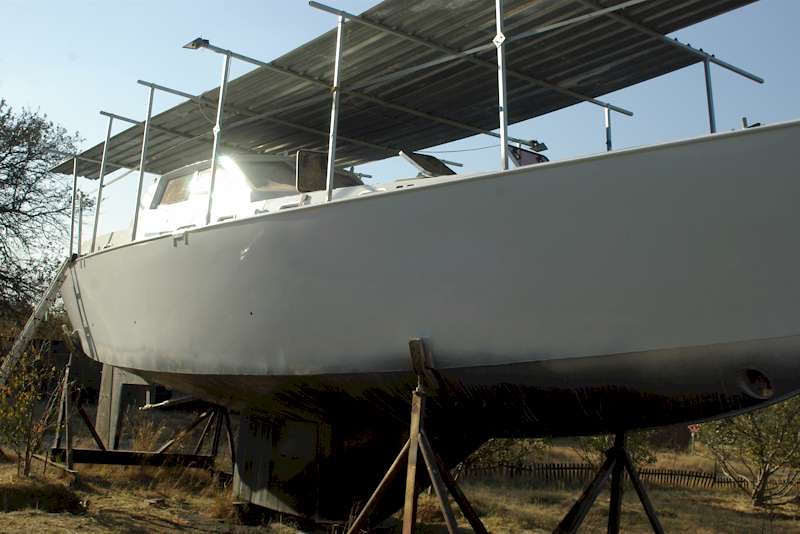
View attachment 102948

This is how mine was supported while fitting out.

The roof was to keep the African sun of anyone working on deck and the temperature lower when working inside before insulation was sprayed in
img
 
I've been up the mast every winter on the hard using a bosun's chair, checking the rig. Had an argument in Moody yard at Swanwick one time, they wouldn't allow use of ladder off deck or ground in the yard, to fit radar on mast. They were quite happy to lend a ladder for the same job afloat in their marina, with added danger of wash from passing boats. H & S gone mad.
 
In our club, we can't get riggers to climb masts whilst boats are ashore so we were going to hire an access platform to do the work. Lockdown stopped that. I've been up my mast a few times to retrieve halyards or reset the wind indicator but it's a different matter trying to safely use tools up there.

As mentioned, in addition to the bosun's chair, wear a harness attached to a different halyard which can be secured in steps as you ascend and descend.

I understand the desire for belt and braces but consider what these additional measures entail. If the main halyard is anything but in top order (inspect closely) no one should put their lives at risk climbing on it and hoping a standby will save them if the main parts. Mountaineers don't climb on double ropes because they fear the prime carrier is about to part !

Climbing masts or being hauled aloft has sufficient distractions and potential complications without having other (backup) halyards getting in the way (and they will). Keep it simple and dependable. Use ascenders - they're made for the job, if not hauled up by winch.

How many accidents happen vs mast ascents - very few. But you can easily "lose it" up there, drop tools or equipment, if planning is not thorough.

BYW, I climb my 16m mst every year so recommend as I do.

PWG
 
I understand the desire for belt and braces but consider what these additional measures entail. If the main halyard is anything but in top order (inspect closely) no one should put their lives at risk climbing on it and hoping a standby will save them if the main parts. Mountaineers don't climb on double ropes because they fear the prime carrier is about to part !

Climbing masts or being hauled aloft has sufficient distractions and potential complications without having other (backup) halyards getting in the way (and they will). Keep it simple and dependable. Use ascenders - they're made for the job, if not hauled up by winch.

How many accidents happen vs mast ascents - very few. But you can easily "lose it" up there, drop tools or equipment, if planning is not thorough.

BYW, I climb my 16m mst every year so recommend as I do.

PWG
Is there a brand of ascender that you can recommend please.
 
Is there a brand of ascender that you can recommend please.
Yes, refer to my Post #22
Ascenders from a quality mountaineering company will be fit for purpose. They are substantial bits of gear. You need two - one attached to a bar for feet and another attached to the load bearing ring on a proper bosun's chair. You ascend by working your feet up a notch followed by sliding the top ascender up theclimbing rope. Do not use ascenders on anything but proper climbing line, not your halyard.

PWG
 
I helped a friend climb his Centaur's mast this summer, afloat. Not a big boat but a significant undertaking which needed proper care.

He had done the same as the O.P...let a headsail halyard get hauled all the way aloft without a sail attached...

...might it be intelligent to suggest that a short bit of shockcord be secured near the pulpit, with a snapshackle attached...

...and before every occasion when the halyard needs disconnecting from the head of the sail, the halyard should first invariably be snapshackled to the pulpit?
 
If the cradle is of unitary construction, i.e. not supported at the bow and stern as some are, then I would not hesitate. Your mass is on the centreline.


Cradles with props and similar structures (kegs and pallets) are a different kettle of fish.


Maybe on a windless day! Tennamast looked into the loading on masts some years ago and without the extra windage of a body up at the top of the mast the wind load was actually quite high. To answer the OP's question we need to know if the wind was on the beam and what windspeed as well as the cradle width. I saw one boat on a cradle a few years ago where the wind load had not turned the boat over but the cradle arms on the lee side had punched through the hull.
 
Yes, refer to my Post #22
I think he meant something like an Ascender e.g. Petzl! I use one as a safety back up. It is under my control. I hook it onto whatever is within reach as I ascend (using a MastaClimba of course!). The only problem arises if I forget to unhook it on the way down and then the winchwench has to go below to find a winch handle to lift me sufficiently to unhook it!

I recommend to clients that, if they can think of something to make the evolution safer, do it. It is too late to change your mind hurtling towards the deck. Don't use an electric winch and do use safety helmets on deck.
 
Maybe on a windless day! Tennamast looked into the loading on masts some years ago and without the extra windage of a body up at the top of the mast the wind load was actually quite high. To answer the OP's question we need to know if the wind was on the beam and what windspeed as well as the cradle width. I saw one boat on a cradle a few years ago where the wind load had not turned the boat over but the cradle arms on the lee side had punched through the hull.

The wind was slightly off the nose, quite a bit forward of the beam, about 18 knots with a bit more in the gusts. I haven't measured the width of the cradle but it is maybe a metre or so wider than the maximum beam of the hull.

I'd be amazed if windage alone could put one of the props through the hull - would have thought that would take a shock load.
 
Top