Is it normal for a pressure reducer to act as a non-return valve

MapisM

Well-Known Member
Joined
11 Mar 2002
Messages
20,658
Visit site
Ok, I guess a bit of explanation is in order, 'cause the question as such is a bit weird, I reckon.
Some years ago, I thought of using the transom shower for a "reversed" water flow, i.e. connecting it to the dock water supply.
This way, when docked, I can avoid filling tanks and running pumps, because the whole boat is supplied directly from the dock, with constantly fresh water.
All well and good, but last year, after noticing some scaring peaks in the pressure of the fresh water supply from the grid, I decided that I had pushed my luck enough, and it was time to fit a pressure reducer under the deck, where the transom shower hose connects to the rest of the boat circuit, to avoid blowing some hose anywhere inside the boat - whose potential consequence is obviously the sinking of the whole thing! :eek:
Another premise is that, while cruising, I always used the same connection in its normal way, i.e. detaching the dock hose before leaving, and re-attaching the transom shower.
Obviously, in this case, the internal pump takes care of supplying fresh water from the tank anywhere in the boat, transom shower included.

Now, lately the transom shower became temperamental: after a few minutes when it seems to work normally, the water stops flowing completely.
Anywhere else onboard, fresh water supply is just fine.
My first thought was that the pressure reducer packed up, but after returning to the dock, it seemed to work normally.
Otoh, the next time I went out, the same happened again: transom shower working for a while, and suddenly the water stops going through the pressure reducer in reverse direction - as if the pressure reducer, after a couple of minutes, would be annoyed by the reverse water flow, hence locks it, as if it were a non-return valve.

Which leads me to the question of the title - should I expect any pressure reducer to behave like that?
Because if yes, I guess I should fit a bypass (with a proper non-return valve) for using the transom shower while cruising, but that is a bit annoying due to its position and some space restrictions.
And if no, obviously I should just buy another pressure reducer and replace the existing one.
That's why I thought to ask, before going either way...
Thanks in advance! :)
 
If the pressure on the output side of the reducing valve is less than the set point, the valve will be open. As the pressure approaches the set point the valve will throttle back and even close. It's not the right way to use a reducing valve but if you set the pump output pressure to less than the reducing valve pressure, the valve will remain open.
 
Doh! That definitely makes sense, thanks for the hint.
By "not the right way to use a reducing valve", what do you mean exactly?
Of course I understand that it's not designed with the reverse flow in mind, but if all that can happen is that it goes bust after say 5 years instead of 10, I can live with that.
Otoh, I'd rather arrange some sort of bypass, than risk to replace the valve every other week... :D
 
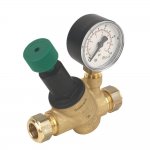
Nope, this is exactly the thing I fitted (plus a pressure gauge attached to its narrower side).
Why, do you think that the type you posted would not lock when the flow is reversed? That would be nice!
art_106v.jpg
 
This is the data sheet for the prv;

file://remlimited.com/dfs/UserData/Peter.Matthews/Documents/Downloads/D04FS-Product-Specification.pdf

Clearly, none of these valves are designed for the purpose you are putting them to! Is it possible that since the valve works on the principle that it is the pressure on the outlet (boat systems) side of the valve that controls whether the valve is open or not, that your on-board pump is creating too much pressure, so the prv detects this and closes itself off?

It might be a bit more work, but could you run a separate supply pipe, so that you don't need to keep removing and then putting back on, the shower hose?

[EDIT] I have sent you an e-mail.
 
Last edited:
Hi P, I can't access your link for some reason, but I got your email.
I agree that connecting the shower "after" the PRV, with a separate pipe, would be the most elegant solution, allowing also to leave it permanently connected and simply detaching/attaching the shore pipe when leaving/returning.
But it's a bit tricky, because the PRV is currently under the boat deck, so I should make another hole just for the shower hose, and I'm not sure it's worth.
Maybe I'll try to move the PRV above deck, inside a bench where the existing hose goes through...
... but not today, weather's too hot! :D :cool:
 
A pressure reducing valve is NOT a non return valve as standard

In fact, we sometimes use them as reverse flow sensing

In your case if the boat pressure is higher than the dock then water will flow from the boat to the dock if the pump is running

If the pump is not running then the pressure reducer controls prevents the pressure on the boat from going higher than the set point.

If you disconnect the dock then the pressure the boat side of the reducer has to be higher than the set point

The fix is to lower the pressure set point of the reducing valve (remove the black cap and unscrew the internal adjuster) or increase the pump pressure (reduce other demands)

May
xx
 
Last edited:
If you disconnect the dock then the pressure the boat side of the reducer has to be higher than the set point

The fix is to lower the pressure set point of the reducing valve (remove the black cap and unscrew the internal adjuster) or increase the pump pressure
I guess you actually meant (in the same order of your above words which I underlined):
lower
increase
screw
decrease
Because otherwise, I must be missing something.

Btw, in the meantime I've been out and about, and I had the opportunity to recheck the behavior of the thing.
Funnily enough, the PRV is now set just a tad lower than the max pressure of the boat pump, so what happens is that the reverse flow works nicely till the boat pump runs and reaches its max pressure. If the transom shower is being used while this happens, the PRV closes the flow.
Therefore, no big deal, I'll just raise a bit the PRV setting.
Much easier than fitting some sort of bypass! :)
 
haha P,
a few years ago, after your sugestion remember ;-) I had istalled a hose connection on the transom, for exactly your application,
the former Canados workers in Rome installed exactly the same PRV like yours, (without me asking for that)
and I immediately noticed the same problem like you have, because I wanted to use that hose connection in some occasions for cleaning the deck with water from the tank (on Anker fe) but that did not work !
actually I have never added any bypass or whatever, is somewhere on the bottom of the todolist,
and we have another tap inside the utility room for connecting the cleaning hose,

but honestly speaking I've never used that shore water connection, for having permanent shore water on all the boat taps,
because when you leave the water pressure on a standard plastic hose for a long time, the hose will expand, and eventually perforate or leak...
I've never bothered about a solution for this,

so until today, that transom hose connection with PRV has hardly ever been used
 
actually while I read my previous post,
best solution for me would be:
take the PRV out,
and use it as a portable unit on the dock water connection, with a short solid piece of hose on the input, and reduce the outcoming water pressure to a suitable level for going in to a standard hose ,
or what do you think ? :)
 
but honestly speaking I've never used that shore water connection, for having permanent shore water on all the boat taps,
because when you leave the water pressure on a standard plastic hose for a long time, the hose will expand, and eventually perforate or leak...
I see your point B, but just for your reference, the hose I'm using for the dock-transom connection is a yellow hose, allegedly anti-UV, but nothing special really - I bought it from a local supplier of gardening stuff.
And IIRC it's now in its 5th season, always connected, pressurised and laying under the (often strong!) sun, but still working as on day one.
Btw, I've seen peaks of almost 6 bar occasionally - hence the decision to fit the PRV.
Besides, if it would eventually blow, the water might get all over the place in the cockpit, but that's still above deck anyway, so there's no risk of filling the boat with fresh water till she reaches the bottom of the marina... :o

Re. your suggestion, yep, fitting the PRV externally and remove it together with the hose when leaving the marina would eliminate the root of the problem, but I like its current placement out of sight.
And in the meantime I tried the trick of raising the PRV pressure just a notch above the max pump pressure, which seems to be working.
Therefore, unless the problem will reappear, I'm going to call it a job done! :D
 
Top