Iron filings all over Play d'eau

Why do you say that?
Simple, because I assume that anyone cares about his/her own health, first and foremost.
So, since they obviously didn't (just look at the pics showing the conditions in which they were working), that can only be explained by ignorance - though I suppose you can also call it incompetence, rather than not giving a toss about it.
 
Simple, because I assume that anyone cares about his/her own health, first and foremost.
So, since they obviously didn't (just look at the pics showing the conditions in which they were working), that can only be explained by ignorance - though I suppose you can also call it incompetence, rather than not giving a toss about it.

To be honest P, I think it's a combination of ignorance and not caring. Regarding H&S, surely they should have been wearing goggles and masks (and lifejackets wouldn't be a bad idea either)? Almost unbelievable that they aren't.

Pete
 
... and the proximity of the oxygen and acetylene (maroon) bottles with (apparently) incandescent metal flying over them...

The fact that they came back with a blanket after the initial work, speaks volumes for their method statement and risk assessment.
 
Why do you say that? Surely they could see the fallout glowing in the air and I would have thought it might occur to them to go and have a look to see if it was falling on neighbouring boats? I could say the same about the marina staff. To me this just looks like incompetence and / or people not giving a toss.

If I was Piers, I'd be half a mind to ask the police to consider charging the contractors / the marine for criminal damage!

Fully Agree with Petem, People doing that sort of work must be fully aware of the problems from fall out.
If they were new to the job they obviously were not aware of the problem filings could cause or did not worry about the effects.
 
The weather has been ghastly. It's been a nightmare for John Norman who is in charge of running the yard and the job. But he's winning.

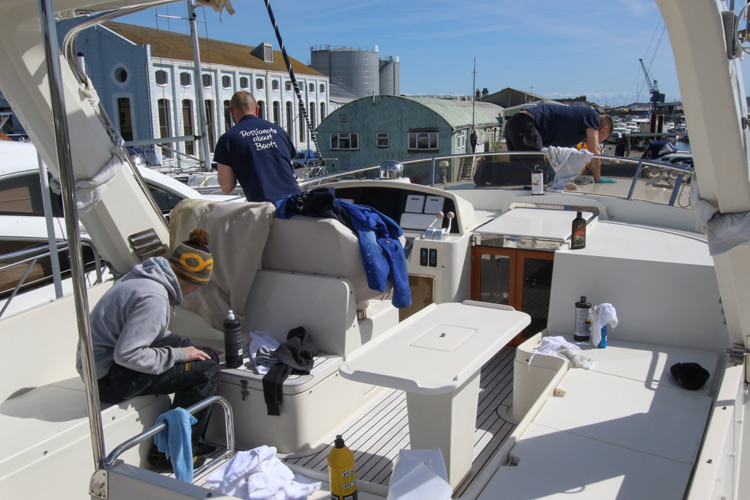
The sun would tease with a glimpse of brightness only to turn its back to allow rain to pour. Having taken her to St Sampson on 13 March, the topsides and forepeak have been completed and on 5 April, when summer arrived for two days, three guys went for the flybridge.

Iron-filings-9-5.3.2018-w.jpg


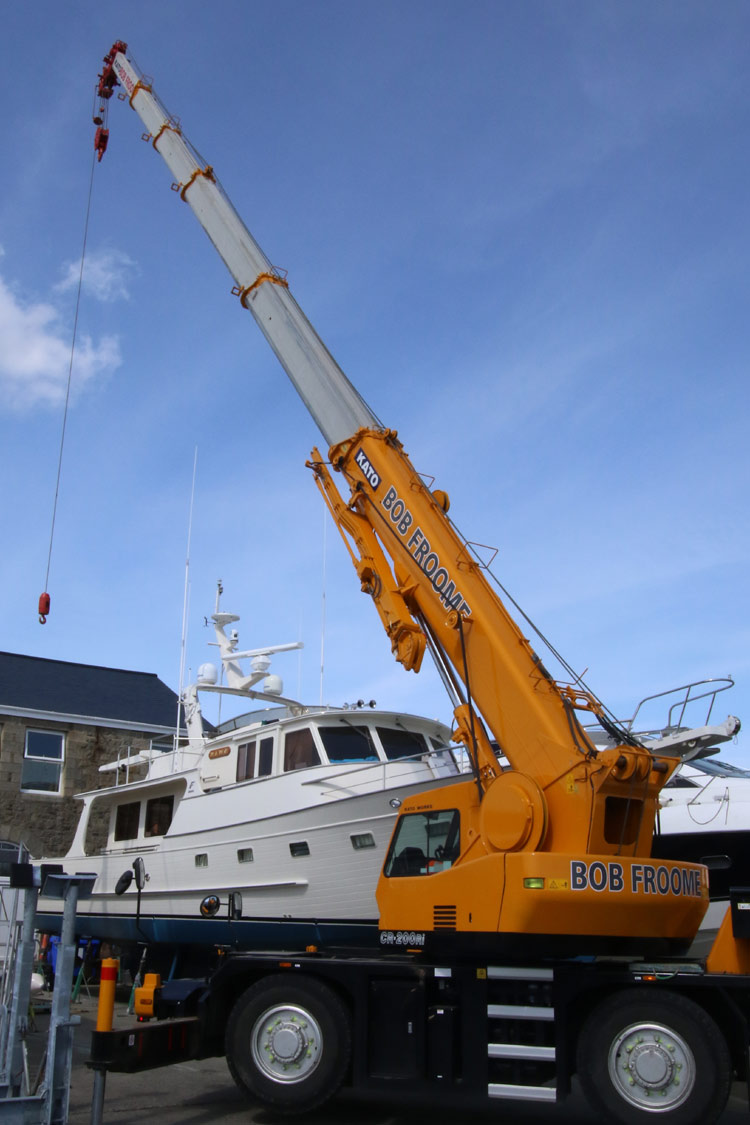
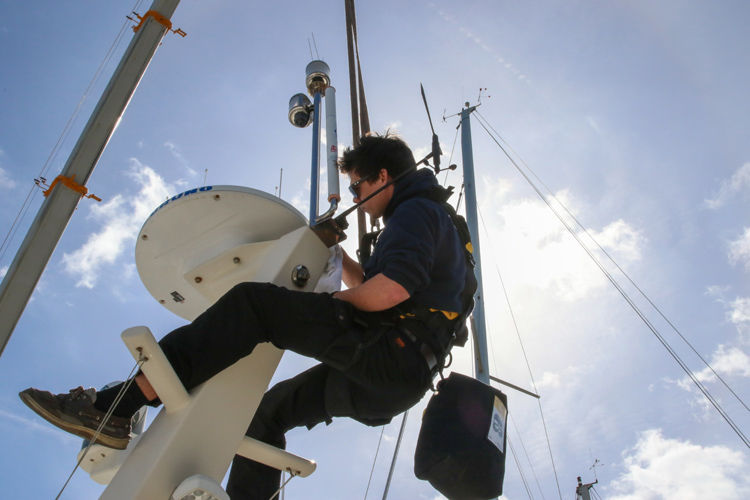
At lunch time, a huge crane arrived to lift and dangle John's brother, Alex, from a long line to clean the pony mast.

Iron-filings-10-5.3.2018w.jpg


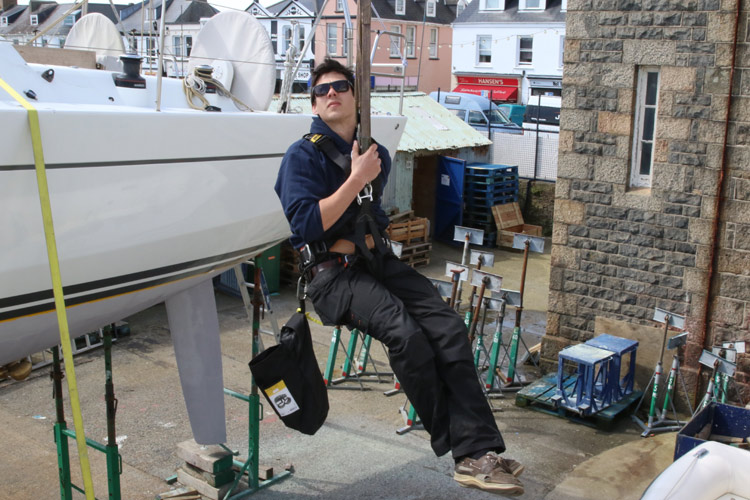
Attaching his climbing gear, Alex was hoisted heaven-wards...

Iron-filings-11-5.3.2018-.jpg


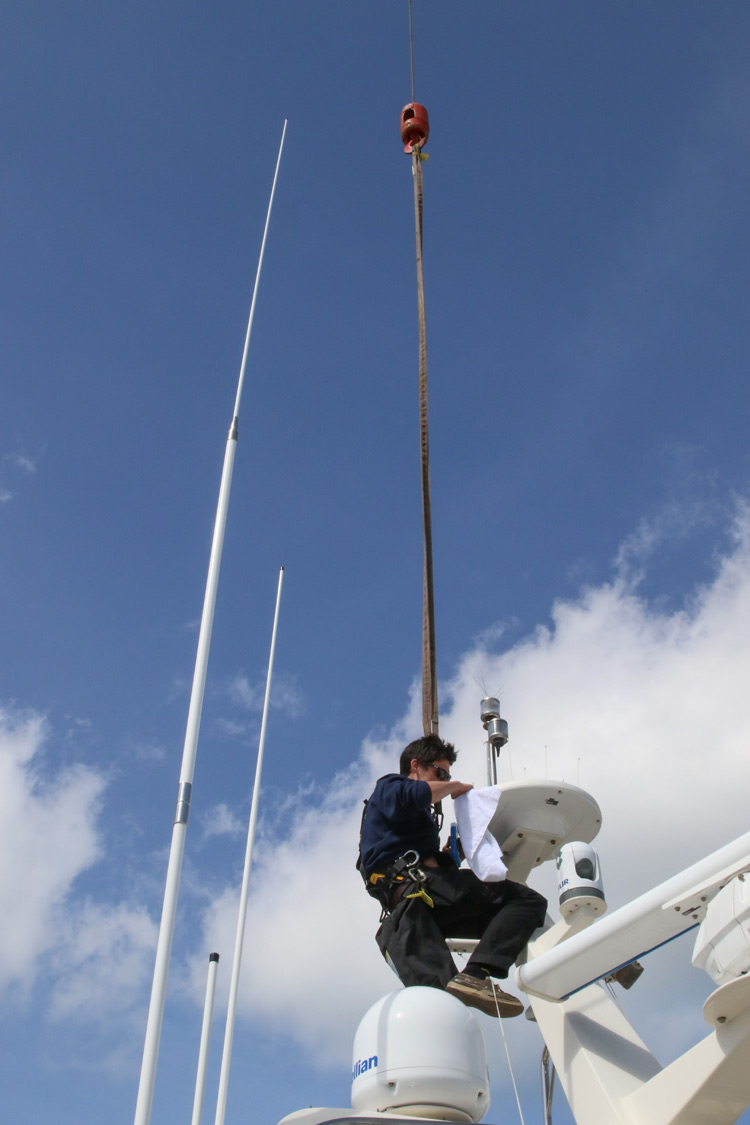
...from where Alex was dangled to inspect the pony mast.

Iron-filings-12-5.3.2018-.jpg


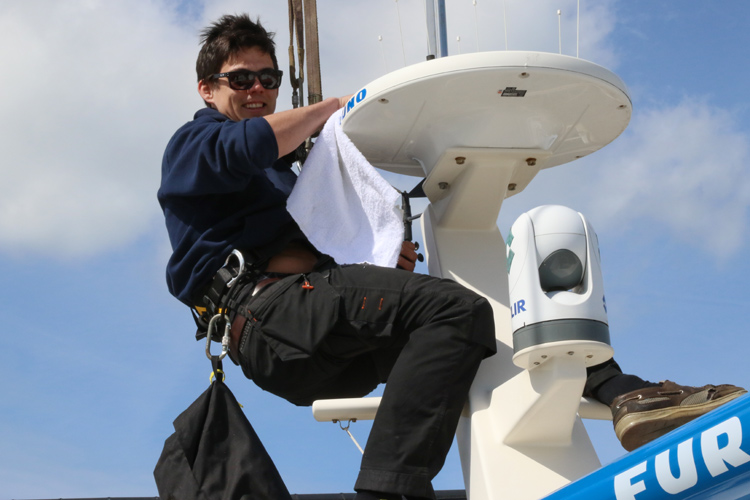
Inspection complete, cleaning began.

Iron-filings-14-5.3.2018-.jpg


The filings were stubborn, so cleaning went on and on...

Iron-filings-15-5.3.2018-.jpg


It took almost 3 hours to complete the job. Now to focus attention on completing the flybridge and everything beneath it. Really hoping the weather stays good for us but the forecast remains dubious.
 
Last edited:
The weather has not helped many of us this winter. It has delayed the CC application on Rafiki. However, this looks like good progress for you Piers. Best wishes for a rapid completion.
 
I've just read the complete thread........with much interest and, in parts, lost the will to live.:)

Hoping everything works out in your favour, Piers.....and that those responsible are keelhauled.

Bunch of

silhouette-3267887__340.png
_5095788.jpg
's
 
She's back in the water and ready for the short trip back to Beaucette Marina. It's 0600 on 13 April 2018. The wind's calm, mist hangs in the air, and daylight is breaking. Oh yes, it's good to be back on the water. I can feel Play d'eau heaving a sigh of relief.

It took 4 weeks and 3 days to remove the iron filings. An epic task. Yes, rain stopped play on many of those days, but whenever possible, the guys were on her removing the damage caused by the metal cutting and grinding works by sub-contractors at Beaucette Marina.

It's been a long and concerning time in boat hospital, but all seems well. My thanks to the guys at Marine and General for their care and attention to detail.

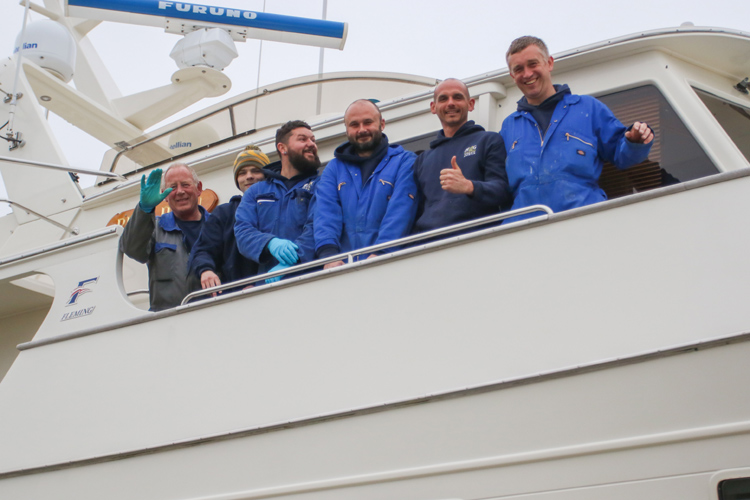
From left to right....

Dave (brilliant engineer); Jordan (an adept iron filing remover and keen polisher); Scott (innovative fabricator); Simon (gel coat restorer supremo); Kerrin (Officer In Charge of boat movements and anti-fouling guru); Steve (Mastermind and foreman behind all works on Play d'eau). Phil (a manual polishing machine) is missing from the photo, but he, too, spent hours in filing removal

Iron-filings-16-13.4.2018w.jpg
 
Do I get an award for reading the whole post?
Anyway my 2p comment is whilst agreeing with JFM comments on liability why not improve your position as follows. Claim on your insurance first. Then claim/ sue for your uninsured losses --- the XS ,plus work out the no claims discount over enough years to get back to where you are now, plus anything else maybe the holiday let / your time supervising costs etc.

Advantage can be you only shell out a few £100 in XS day one. There is only tiny risk and cost in your small claims litigation for XS etc- you could do case yourself for fun save on lawyers (did i really say cut the lawyers out??)- if you lost that case it would be peanuts.
You have privity of contract with your insursers so can exert control over quality/ method of repairs- is sue `em if needed. Its often quicker to deal with own insurers and get boat back on water first - enjoy the fun of court case later (in winter season).
Appreciate repairs done now and either method should get you to the end result.
Happy cruising.
 
Of course its worth it--you have a winning case. Before the event legal expenses insurers can be hard work like all insurance if they play silly you can take steps to recover from them.
BTE insurers(in my humble) can have too cosy a relationship with their panel Lawyers. I have never been on a panel preferring to find my own clients and fight their cases my/ the client`s way .
PM me if you want and we could have a phone chat.
 
Folks apologies for dragging up an old tread but I thought my experience (and Pier's obviously) would be good for peoples future reference.

We came down to the boat this weekend for the first time post lockdown. I was horrified to see that the front of the boat got sprayed with Iron filings at some point over the winter. Pier's experience and this tread came to mind immediately. I won't go into detail about the yard where the boat sits for winter storage but needless to say I didn't want to engage with them on blame initially and wouldn't particularly trust them to remedy the situation.

I managed to get my hands on some Iron X equivalent (ABDL is the brand) and some clay bar on Saturday. The fallout remover was a gel type so didn't run as quickly - ideal for use on the boat. Iron X had been suggested by others and myself in the early stage of this tread. The method was to spread the fallout remover across the contaminated areas using a brush and let it dwell. The clay was used on smooth surfaces and a brush on the non skid. All in this took about the same time as washing the boat and removed 95%+ of the contaminates. I can do the remaining individual spots next week. I followed this with an all over wash and then dried the smooth surfaces (left the non skid obviously) using automotive drying towels with Gtecniq Liquid Crystal C2V3 as a drying aid and followed up with a coat of the C2V3 once the boat was dry. All in it looks pretty much perfect now.
 
Me too! Down at the boat the other week and noticed that the side deck had developed measles.
Luckily whoever had been grinding was far enough away that the debris was cold when it landed and had not burnt into the gelcoat.
As expected all around denied any knowledge of grinding.
Luckily a strong solution of oxalic acid and wallpaper paste for thickening did the trick after a couple of applications.
I thought of poor Piers and the grief that he has gone through.
 
Just as they used to take photgraphs like this, surely it's not beyond the wit of man to develop a 21st century version for cutting and grinding near sensitive areas, to include air supply for the engineer.

View attachment 69919

They have and its common name is a venturi collector and they are rarely used due to their costs as it takes a couple of hours to set them up for each cut and firms bidding for a contract want to reduce costs, not increase them as it costs profitibility; you can run them through a filtration system to collect the materials, have a magnetic bed to collect magnetic particles, and even a simply drain tube which blows them into the sea under pressure to wet tham and prevent them floating in the air.
 
Top