Inverters

Seastoke

Well-Known Member
Joined
20 Sep 2011
Messages
13,724
Visit site
So we have a generator a battery bank and inverter , so how do you use you set up , we tend to use the inverter over night to ie charge phones etc , but we lose the 240v at some time . Does this knacker the batterie .

 
We have 500ah house batteries , 4kva generator and 500w victron inverter that is on permanently to run both TVs and assorted charging plugs, it also runs a small freezer when shore power is off. At anchor in a 24 hour period we will run the generator for 2-3 hours morning and evening , with water heating / kettle on and that seems to work for us.
 
My understanding is that battery choice & selection is vital on a boat. There are many debates around battery type, size (amps) and number of batteries and then how to charge them. I think many ignore the fact that batteries are actually quite delicate and need careful mngt to get the best and longest life.

Balancing the house bank, in series or parallel, depth of discharge, current draw etc etc are all important considerations when setting up or managing batteries.

When we bought our boat, it had 2 x engine starter batteries (wet cell, 105 amp) and a measly single 105amp wet battery for house on an all electric boat.

Needless to say, when away from the marina, we are unable to use most of the systems onboard. Our plan after owning the boat for about 10 months is to revamp the power set-up to match how we will use the boat. We didn’t buy it to sit in a marina.
 
We have 500ah house batteries , 4kva generator and 500w victron inverter that is on permanently to run both TVs and assorted charging plugs, it also runs a small freezer when shore power is off. At anchor in a 24 hour period we will run the generator for 2-3 hours morning and evening , with water heating / kettle on and that seems to work for us.
IMO, that strategy only works for a couple of days.
2 to 3 hours charge doesn't completely charge the batteries.
As a result, the charged state of the batteries gets lower and lower.
Remember that you only have 50% usable charge in your battery bank so after a few days you can easily reach that level.
Hit 50% and thats the bank knackered.
I use your strategy but I have solar panels that finish off the charging.
Batteries take most current when they are empty and to save running the generator until they a completely charged, my solar panels will finish the job.
The panels aren't big enough to completely charge the batteries.
 
IMO, that strategy only works for a couple of days.
2 to 3 hours charge doesn't completely charge the batteries.
As a result, the charged state of the batteries gets lower and lower.
Remember that you only have 50% usable charge in your battery bank so after a few days you can easily reach that level.
Hit 50% and thats the bank knackered.
I use your strategy but I have solar panels that finish off the charging.
Batteries take most current when they are empty and to save running the generator until they a completely charged, my solar panels will finish the job.
The panels aren't big enough to completely charge the batteries.
Hurricane assumes standard lead acid batteries are used. Nowadays there are alternatives such as lead carbon and lithium, which can go much lower than 50% DOD with no ill effects and recharge much quicker due to less internal resistance. Time to charge also depends on the charger of course, but more importantly the charger/battery type pairing.
 
IMO, that strategy only works for a couple of days.
2 to 3 hours charge doesn't completely charge the batteries.
As a result, the charged state of the batteries gets lower and lower.
Remember that you only have 50% usable charge in your battery bank so after a few days you can easily reach that level.
Hit 50% and thats the bank knackered.
I use your strategy but I have solar panels that finish off the charging.
Batteries take most current when they are empty and to save running the generator until they a completely charged, my solar panels will finish the job.
The panels aren't big enough to completely charge the batteries.
Yep agreed Hurricane, have always regarded your set up pretty much as good as you can get. To be fair we only manage 2-3 days tops on the hook so I'm comfortable with what we do, but i have been browsing a few solar panels in case we start spending longer away.
 
Hurricane assumes standard lead acid batteries are used. Nowadays there are alternatives such as lead carbon and lithium, which can go much lower than 50% DOD with no ill effects and recharge much quicker due to less internal resistance. Time to charge also depends on the charger of course, but more importantly the charger/battery type pairing.
Agreed but how many people have Lithiums - they are still way more expensive than lead acid.
I use AGMs which are a little better than flooded cells and the chargers can/are set for a slightly higher voltage.
I would love to change to Lithiums but I have 2 battery charger (one spare) so I have some redundancy.
Also to get a 24v setup, it seems that on most Lithium suppliers, I would need twice as many cells.
But I'm still looking - it would be good to find a lithium setup that could use my existing chargers - also not sure what effect the engine alternators would have on them.
 
Yep agreed Hurricane, have always regarded your set up pretty much as good as you can get. To be fair we only manage 2-3 days tops on the hook so I'm comfortable with what we do, but i have been browsing a few solar panels in case we start spending longer away.
I’ve had solar panels for over 10 years. Now 250W. I almost never use the 240v battery charger, maybe just a few hours each year. The panels keep the batteries nicely topped up. And when on a trot mooring on the Dart I also used to leave my large fridge freezer permanently on, the panels coped well with that too.
I wouldn’t be without them.
 
slowly planning the move to lifepo4 for next season.
not easy, bit mindbogling sorting out how charging from 3 sources (invertercharger, alternator, solar) will work and how the whole thing wont kick offline if one of the sources doesn't behave and BMS considers conditions as critical...
[the last bit above is my main concern tbh!]
I believe the integration of a serial (or CANBUS) BMS with Venus OS (victron general "controller" os) will help a lot.
Victron MPPT and Multiplus can be configured to stop charging at levels that Lifepo4 seems to be happy, alternator a bit more difficult without spending more cash (it seems)
For sure one should not trust the lithium readymade boxes on sale now!
interesting and fairly exhaustive thread on the topic over at PBO for anyone interested:
270ah DIY LiFePO4 build
 
Last edited:
When researching this for camper vans off grid I found this guys videos quite useful. Also make some interesting products and has a video showing real world scientific testing on battery drain and its impact on longevity
Sterling Power link

Cheers,

TC
 
I set up a 100w solar panel on the fly bridge. It’s connected to the dinghy crane winch battery. I was planning to connect an inverter to the panel via another battery and get a source of 240v. I even bought the inverter a few years back. But I’ve never bothered. My boat is mainly 12v (fridge, tv) and for everything else I switch on the generator, even if it’s just to make coffee. Although I admit that I don’t like switching it off once it’s on out of mechanical sympathy. When I have a set time to put the on generator like in the mornings, I gather everything chargeable, from iPhones to electric toothbrush and the recliner sofa and put it on charge for as long as possible. I cannot use the generator after 10pm because the wife goes to bed by then and complains about the noise.
Now, I’d rather invest the time, money and effort in sound insulation rather than battery banks, inverters and more panels.
 
As an alternative you could consider 12v usb sockets for charging.
Draw is minimal on phones etc.
Agree. You don’t need 240V to charge a phone. I had 12V USB sockets installed in the cabins on my boat and they are perfectly adequate for charging phones overnight
 
We didn’t buy it to sit in a marina.

That's where you and Roy differ.

solar panels that finish off the charging

Solar panels are superb. It was such a revelation on how far they have come in the last few years. I dont have shore power and what the boat cannot replenish on alternator the solar panels more than adequately make up for. Even after a heavy weekend of abuse by the time I'm back at the boat for the next weekend they are all nicely topped off. I even run the fridge off the PPM controller's load settings. Boat is fully rigged for 12V and the only thing I would like is a means to heat the calorifier without running the engines. We can hold enough hot water for a family of 4 for showers and a dish washing for a day. (We of course have no need of air conditioning in the Welsh Med). diesel heaters fulfil that role
 
We have 560AH of Lithium batteries no generator, and a 3000w inverter we can run immersion heater for an hour in the morning for showers before setting off switched from Gas to convection combi oven .

Lead acid batteries are not really great at giving up there power in fact that you are only supposed to run them to 50% capacity if you want them to last so our old potential 400Ah of lead was already cut to 200Ah and then add in the fact that they don’t like charging either taking ages to get from 70% - 100% charge probably brings us down to nearer 150Ah this can also be worsened by something called the Peukert effect where the more amps you draw the less usable capacity you have so a typical 100ah leisure battery in some cases is good for about 30 -40Ah

in general Lithium batteries have a very low internal resistance which means they can give out loads of power potentially even up to 100% of their capacity and can accept loads of amps in charge to charge back up quickly. Lithium batteries also generally have a ridiculously large amount of cycle life generally >3000 cycles

lithium batteries have massive power density packing loads of amps in a small and light weight package so feasibly a 100ah lithium batteries is equivalent to ~200ah of lead acid but at half the size and quarter the weight

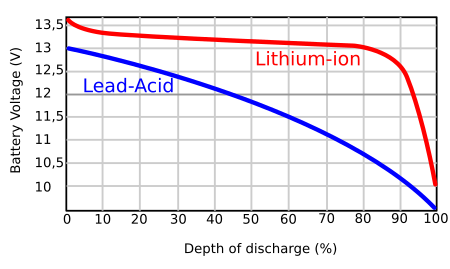
the discharge curve of lithium batteries is very flat for most of the discharge which means they provide a very constant voltage under load which is great for continuous power draw unlike the large voltage drop under load experienced with lead acid

Switching to Lithium Batteries Curve10

we get little to no voltage sag and they charge back up so quickly compared to Lead acid as they will take everything you can throw at them from empty right till full.

the initial sticker shock can be a bit off putting but they are dropping in price a lot and you can get the equivalent lithium for not much more than a good AGM battery and you don't need a noisy generator
 
Please show us where?

So £540 for 100a and they are fro Sterling a well known uk brand.

12V 100Ah Lithium Leisure Battery campervan / RV / marine E-marking BLUETOOTH | eBay

If you base this on being equivalent energy of a 200a AGM then it's not that different

Even cheaper @ £431 for one or £404 each if u buy 2

Ultramax LI100-12 12V 100Ah LiFePO4 Battery - Replace SLA 12V 100Ah with 4 times cycle life 100 Amps Maximum continues current, lighter weight, Charger Included - LiFePO4 Batteries - Lithium Phosphate LiFePO4
 
BMS? Relays, fuses, compatibility with chargers, etc? Have you read the PBO lifepo4 thread?
Things are not that simple...
 
BMS? Relays, fuses, compatibility with chargers, etc? Have you read the PBO lifepo4 thread?
Things are not that simple...

Yes obviously these are "drop in" type so have the BMS and low voltage / high voltage cut off internally probably worth an alternator protection device to protect against high voltage disconnect and a dc to dc for alternator but so long as your shore charger and charging sources support ~14.4v constant voltage charge profile then for basic use you can be up and running

Yes I have read the PBO thread and inputted to it, there my lifepo4 system have a REC ABMS can bus BMS and can bus Wakespeed alternator regulators all talking to the victron inverter and charger but that's not for everyone
 
Last edited:
Top