Inverter on board

As i said earlier, if the manufacturer has fitted an Earth connection, it needs to be Earthed.

I ask again what protection will the case earth connection of an inverter will give and how will it work.

I had a Honda suitcase generator used on my old boat using just an extension lead to power tools that also has case earth where should that be connected too


Victron won't know anything about basic principles.

I would be surprised that the Electrical design Engineer and in particular the Chief Electrical Engineer don't understand the basic principles of Electrical Engineering as I would expect there to be several senior Electrical Engineers who are members of the Institution of Electrical Engineering so a C Eng. This is just like the companies I work for do mechanical Engineering design who has several Members of the Institution of Mechanical Engineers including myself.


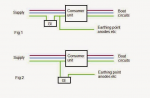
The picture I posted is from the boat design forum

Install galvanic isolater in DC to AC ground connection?

Showing 2 different ways in connecting a GI, Fig 1 is the same as Victrom recommend but a failure (open circuit) of the GI would disconnect the shore powr protective earth leaving only the secondary earth via the sea water. His is not for me My designs are fail safe where possible.

Yes yo did answer the OP's question with out any reasons just the manufacturer fits a case earth connection.

If you don't know its there other than a manufacturer fitted how do you know its safe as you installed it.

I personally analysed this and cannot find what it does hence my question

Personally I think as its a safety requirement on metal cased mains power equipment, the assumption is that an inverter must had the same.

Paul think about what would happen if there was an internal short to the metal case inside to inverter case. What protective device would trip shutting the short / mains leakage.
 
The picture I posted is from the boat design forum

Install galvanic isolater in DC to AC ground connection?

Showing 2 different ways in connecting a GI, Fig 1 is the same as Victrom recommend but a failure (open circuit) of the GI would disconnect the shore powr protective earth leaving only the secondary earth via the sea water. His is not for me My designs are fail safe where possible.

Roger

This diagram of 2 ways to connect a GI

1611929303406.png

It never was intended to show 2 actual ways in which a GI can be connected

It was originally posted on these forums for discussion of fig 2 as a possible alternative way.

I know this because it is my diagram ... I drew the original and posted it and I still have the original file on an old computer.. Ive checked
Its been rattling around the internet ever since and turns up from time to time

The file is dated October 2009
 
Roger

This diagram of 2 ways to connect a GI

View attachment 108096

It never was intended to show 2 actual ways in which a GI can be connected

It was originally posted on these forums for discussion of fig 2 as a possible alternative way.

I know this because it is my diagram ... I drew the original and posted it and I still have the original file on an old computer.. Ive checked
Its been rattling around the internet ever since and turns up from time to time

The file is dated October 2009


Yes Vic I can remember you position the diagram and discussion it some time ago. I was not aware you were the originator and if apologise for reposting it but I found it on the boatdesign forum.

I do consider that Fig is better than fig 1 as if the GI fails for some reason the main protective earth will be disconnected leaving only the ground connected protective earth.

My GI is connected as Fig 2 and I have no issues. If others think Fig 1 is better and connect it that way that's their choice. The main think is to have a GI to protect excessive wasting of the anode as Paul say will carry any fault current through the Anode if connected to the sea grounding point.

The main issue in the OP's post was the connection of the case of the inverter to the sea ground connection.

I wish to know what safety benefit that gives of that connection and if there is a fault from live to the inverter case what will happen i.e will the RCD trip shutting down the fault in the same way as a line fault in an earthed care of a metal cased appliance.

Paul is the resident expert on electrical installations on boats on this forum but seems to ignore my question.
 
Roger

This diagram of 2 ways to connect a GI

View attachment 108096

It never was intended to show 2 actual ways in which a GI can be connected

It was originally posted on these forums for discussion of fig 2 as a possible alternative way.

I know this because it is my diagram ... I drew the original and posted it and I still have the original file on an old computer.. Ive checked
Its been rattling around the internet ever since and turns up from time to time

The file is dated October 2009

This just goes to show how internet myths begin, doesn't it ?
 
Whilst all the experts are still in a charitable mood :giggle: - CouldI just check if I've got this correct...

I have always found the terms 'earth' and 'Ground' to cause confusion. For a long time I misunderstood what was happening when an electrical circuit 'shorted' (either via me or via an 'earth leak' or whatever). I presumed (as I think many lay men did / still do) that the electrical escapees were just leaking onto the 'earth' (earth as in dirt or soil) like a leaking hose pipe, rather than using me and the 'earth' simply as a route back to where they actually go which is the original source (i.e. the pos and neg terminals of the original supply).

Q. Assuming that I have got the above correct i.e. that they always go back to source ????? - does the same thing happen onboard when earthing out to sea water? I.e. Do the little electrical devils swim around to the next anode and rescue themselves by jumping back onboard to nice warm dry source from whence they came?
 
Yes Vic I can remember you position the diagram and discussion it some time ago. I was not aware you were the originator and if apologise for reposting it but I found it on the boatdesign forum.

I do consider that Fig is better than fig 1 as if the GI fails for some reason the main protective earth will be disconnected leaving only the ground connected protective earth.

The GI is only there for the shore power connection, it serves no purpose for generator or inverters.

It is a requirement that GIs fail safe, in other words they must fail closed circuit.

Looking at the image VicS posted, figure 1 is the conventional way to connect the GI, that's how everyone in the industry does it, how all the manufacturers fitting instructions say to do it and how every schematic in the current (2020) ISO shows it, simply put, it is the correct way.

In fig 1, if the GI fails safe, as it should, there is still a PE connection to shore power and a connection to the boats Earth point, double protection. If the GI failed open circuit, which it should not do, there is still a PE connection to the boats Earth point. It requires three faults to lose the protective PE when connected to shore power. No matter if it fails closed circuit or open circuit, there is still a PE connection to the boats Earth point for a generator or inverter.

In fig 2, if the GI fails open circuit or closed circuit there is still a PE connection to shore power and if it fails safe there is a connection to the boats Earth point. If it fails open circuit, there is no PE connection to the boats Earth point for a generator or inverter.

In both cases, if the GI failed safe, as it should, you lose your galvanic protection. Connected as it should be, in fig1, depending on what system you have for monitoring the state of the GI you'll have a warning that is has failed, connected as fig 2, there will undoubtedly be monitoring systems that will not function correctly.

My GI is connected as Fig 2 and I have no issues. If others think Fig 1 is better and connect it that way that's their choice. The main think is to have a GI to protect excessive wasting of the anode as Paul say will carry any fault current through the Anode if connected to the sea grounding point.

You have that backwards Roger. Fig 1 is the correct way, if you choose to ignore that and connect it the wrong way, that's up to you.

The main issue in the OP's post was the connection of the case of the inverter to the sea ground connection.

I wish to know what safety benefit that gives of that connection and if there is a fault from live to the inverter case what will happen i.e will the RCD trip shutting down the fault in the same way as a line fault in an earthed care of a metal cased appliance.

That will depend on the actual inverter, how it's internally constructed, what safety methods it employs, etc. The OP hasn't even purchased an inverter, so i cannot possibly answer any of those questions. It's a reasonable expectation that the manufacturers didn't put it there because they were bored, it should serve some purpose and it seems pretty stupid to ignore the requirement to connect it. I most certainly would not be leaving it off. As for the RCD tripping, there is no chance of that happening with the installation that the OP initially enquired about, he said he was using it stand alone.

Paul is the resident expert on electrical installations on boats on this forum but seems to ignore my question.

Please don't blow smoke up my transom.

As i said earlier, i have been 130 miles from base all week, working long hours, staying in a hotel. My time for posting on here is not endless.
 
[
In fig 1, if the GI fails safe, as it should, there is still a PE connection to shore power and a connection to the boats Earth point, double protection. If the GI failed open circuit, which it should not do, there is still a PE connection to the boats Earth point. It requires three faults to lose the protective PE when connected to shore power. No matter if it fails closed circuit or open circuit, there is still a PE connection to the boats Earth point for a generator or inverter.
What sort of range of values do you find for the earth loop impedance when the earth loop is via the external earthing plate and the water
 
[

What sort of range of values do you find for the earth loop impedance when the earth loop is via the external earthing plate and the water

Yawn.

Why do you persist in your trolling ?

When was the last time you fitted anything electrical ?
Have you ever fitted an inverter ?
Ever fitted a GI ?

Thought not.
 
Yawn.

Why do you persist in your trolling ?

When was the last time you fitted anything electrical ?
Have you ever fitted an inverter ?
Ever fitted a GI ?

Thought not.

Why not answer the question

Surely you know the sort of readings you get when you test your installations ?

If I wanted an inverter a GI or any other electrical equipment fitted to any boat of mine I would be looking for a competent, qualified marine electrician to fit it for me.
 
Yawn.

Why do you persist in your trolling ?

When was the last time you fitted anything electrical ?
Have you ever fitted an inverter ?
Ever fitted a GI ?

Thought not.

Sorry Paul this is the sort of response you get from a self appointed expert who cannot answer the valid question asked by a well known and long standing member.

It called deflection and it what ever politician use when they are asked a question they they cannot of don't want to answer for fear of embarrassment.

If you don't know the answer it no shame to say you don't know.
 
This thread perfectly proves a few things.

Take the image in post #2; it's a sketch posted by VicS 9 years ago showing an incorrect method of connecting a GI, that he dreamt up. In both sketches he shows the Earth connection being made to the "Earthing point, anode etc", yet when i advise it's connected to the anode he says that's wrong. He suggests an alternative of a metal keel. I doubt there is a single person here that does not know that connecting the Earth to the keel will not work as the keel is antifouled.

Roger insists there are two ways to connect a GI, despite the fitting instructions from every GI manufacturer, the standards contained in the current ISO and every regulation showing clearly how it should be connected. He cites an image he found on the internet as proof that he is correct and there is a second way to connect the GI. How funny is it, that the image he uses for his "proof" is the one that VicS sketched of an incorrect method that he dreamt up back in 2009 ?
 
Last edited:
Whilst all the experts are still in a charitable mood :giggle: - CouldI just check if I've got this correct...

I have always found the terms 'earth' and 'Ground' to cause confusion. For a long time I misunderstood what was happening when an electrical circuit 'shorted' (either via me or via an 'earth leak' or whatever). I presumed (as I think many lay men did / still do) that the electrical escapees were just leaking onto the 'earth' (earth as in dirt or soil) like a leaking hose pipe, rather than using me and the 'earth' simply as a route back to where they actually go which is the original source (i.e. the pos and neg terminals of the original supply).

Q. Assuming that I have got the above correct i.e. that they always go back to source ????? - does the same thing happen onboard when earthing out to sea water? I.e. Do the little electrical devils swim around to the next anode and rescue themselves by jumping back onboard to nice warm dry source from whence they came?


Terminology for the non technical can be confusing or designed to confuse.

In the UK and South African and others use a single ended electrical supply . This being the one end of the 2 supply cables are connected (tied) to an a common connection (potential) . In the out case we have a 3 wire supply (shore power) to connect to the electrical supply grid.

These 3 being termed line , neutral, and earth (protective return wire).

The neutral becomes neutral when the protective return wire is connected to one of the supply wires AT THE SUPPLY DEVICE. In the normal supply grid this connection is at the supply sub station. On a boat a fixed mains generator or inverter is also a supply device this is why the neutral and the protective return wire must ne connected at the supply device for a RCD to operate. In a non fixed installation in the case of a suitcase generator or portable inverter then is generally no RCD so no point in making this neutral connection , EXCEPT you will have no trip disconnection even by a current overload.

Going back to the neutral / protective return wire connection of the supply device its is also connected to a metal spike inserted in the earth/ ground/ soil next to the supply device (electrical substation). This is why it id called earth or ground.

In a domestic electrical set up you will also have a earth / ground spike at your hone the connects the protective supply wire in the supply cable.

This "earth/ground" connection at the substation and at you house provides a second path for any leakage / short to a metal case back to the neutral at the upply device (substation). In the case of a boat this earth/ground spike will become any conductive metal in contact with the sea water .
 
Why not answer the question

Surely you know the sort of readings you get when you test your installations ?

If I wanted an inverter a GI or any other electrical equipment fitted to any boat of mine I would be looking for a competent, qualified marine electrician to fit it for me.

I'm under no obligation to answer your facetious questions, that have absolutely no relevance, you are just trolling.

Roger has the right phrase, "deflection". You are just trying to deflect attention from the fact that, once again, you're wrong and are giving incorrect and potentially life threatening advice.
 
This thread perfectly proves a few things.

Take the image in post #2; it's a sketch posted by VicS 9 years ago showing an incorrect method of connecting a GI, that he dreamt up. In both sketches he shows the Earth connection being made to the "Earthing point, anode etc", yet when i advise it's connected to the anode he says that's wrong. He suggests an alternative of a metal keel. I doubt there is a single person here that does not know that connecting the Earth to the keel will not work as the keel is antifouled.

Roger insists there are two ways to connect a GI, despite the fitting instructions from every GI manufacturer, the standards contained in the current IS and every regulation showing clearly how it should be connected. He cites an image he found on the internet as proof that he is correct and there is a second way to connect the GI. How funny is it, that the image he uses for his "proof" is the one that VicS sketched of an incorrect method that he dreamt up back in 2009 ?

Yes there are 2 ways of connecting a GI and as I prefer to have as little connection in my protective return eaarth line I prefer to have the latter.

If all the suppliers give one one way that does not mean my way is incorrect.

We used to bond all the anodes together on a GRP boat which was recommended by the anode suppliers now its consider unnecessary and in fact can cause excessive anode erosion. Th suppliers just sell more anodes.
 
Yes there are 2 ways of connecting a GI and as I prefer to have as little connection in my protective return eaarth line I prefer to have the latter.

If all the suppliers give one one way that does not mean my way is incorrect.

We used to bond all the anodes together on a GRP boat which was recommended by the anode suppliers now its consider unnecessary and in fact can cause excessive anode erosion. Th suppliers just sell more anodes.

Yes, there are two ways;

1) The correct way
2) The incorrect way

You are free to choose option 2 if you want, but please don't promote it as a correct method, or worse yet, a better method. It's just a wrong method that VicS "invented" in 2009 and you found an image of it, mistakenly thinking it was valid.
 
I'm under no obligation to answer your facetious questions, that have absolutely no relevance, you are just trolling.

Roger has the right phrase, "deflection". You are just trying to deflect attention from the fact that, once again, you're wrong and are giving incorrect and potentially life threatening advice.

Paul all this is doing is confusing the less experienced forum members. Accusing a long standing members of being a troll does not help your case of critising any other member

Just consider Vic or Myself have no commercial interest in the subject at hand. We are both retired.

I have been involved in design of many industrial electrical and mechanical installations but I an not allowed to do the wiring as I don't have a wireman's license as required by law and the unions.
 
Yes, there are two ways;

1) The correct way
2) The incorrect way

You are free to choose option 2 if you want, but please don't promote it as a correct method, or worse yet, a better method. It's just a wrong method that VicS "invented" in 2009 and you found an image of it, mistakenly thinking it was valid.

Any engineering designer knows there is always several ways to design and solve any problem. Its only blinkerd people who consider "their way is the only way".
 
Any engineering designer knows there is always several ways to design and solve any problem. Its only blinkerd people who consider "their way is the only way".

So we can put the shore power wires into any old connection, the live doesn't actually have to go in the live terminal, it can go in the Earth terminal ?

No, of course it can't, some things have a set way of being done.

Feel free to wire your boat up any way you see fit, it's your boat.
 
Top