Internal transducer how much silicone?

onesea

Well-Known Member
Joined
28 Oct 2011
Messages
3,842
Location
South West
Visit site
We have new transducer to go into the boat. Annoyingly it doesn't work through the flat area on hull (internal ballast).

So I am left with a just fit area forward of the ballast, I am VERY limited on space.

Today I slowed water flow through the scuppers and filled the area with water, it worked until the water leaked away.

However there is very space to make a cofferdam and put a cap on to hold any mineral oil in place. There maybe ways but that’s a project for another day. As it is to fit the transducer needs to tilt about 5 deg forward to fit.

I am going to try the simple approach first - Silicone sealant.

As the hull is V shaped in this area, so the silicone will be an inch or so in the middle, whilst being zero at the edges.

Any suggestions for the best way to achieve this. Any particular sealant? Any other technique’s?
 
I tried it as a temporary arrangement one year and it was fine; indeed the 'ducer which is now not used is still there and can still be used if required. Critical - no air bubbles but hardly likely to have bubbles in a good quality silicon. I made a bed of 10/12mm and squished it down to about a bed of 5/6mm. Tested it and it worked instantly. I then calibrated it because I thought the readings might be odd (Ii.e. measured an old fashioned plumb line) but I don't recall much difference.
 
I don't think silicone will work so well at that sort of thickness as it is so rubbery. Equally , solid epoxy won't help either.

If you can bond in some drainpipe of suitable diameter and fill with antifreeze, that will probably offer a better option.
 
I don't think silicone will work so well at that sort of thickness as it is so rubbery. Equally , solid epoxy won't help either.

If you can bond in some drainpipe of suitable diameter and fill with antifreeze, that will probably offer a better option.
As I said the cofferdam is not an option at the moment. I have same concerns about Silicone, however if it doesn’t work no loss I can look at later.

Surprised at same idea with epoxy.

I know there will be losses but if it’s working in the last 50-100m it will do me for now.
 
We have ours beaded on about 15mm of high modules silicone, I pumped it out the tube without the nozzle as I did not want ant gaps or air. It’s been like this for the last four years. The transducer is down looking sonar designed to fit on transom, as tillergirl said, a temporary test that has turned into a permanent one for us. We also have a DST810 on through hull and both read around the same even in fairly sand/mud water
 
I have bonded with epoxy - worked fine ....

Bonded with silicon - worked fine ...

For testing - have even used Bluetack !!

The main point to bear in mind - do not squeeze out the agent too quickly - to avoid any air / bubbles forming .... any bubble in that will degrade the signal through.

I would use plastic sheet to create a small box .... then pour in the epoxy or silicon ... let it flow out and level ... then carefully ease the transducer into it ... there's some question as to how far in ... I have read that the 'ducer' should not touch the hull but be just a slight gap and use the oil / resin / silicon as the contact ... I believe its because of the sound pulse ??
 
I have bonded with epoxy - worked fine ....

Bonded with silicon - worked fine ...

For testing - have even used Bluetack !!

The main point to bear in mind - do not squeeze out the agent too quickly - to avoid any air / bubbles forming .... any bubble in that will degrade the signal through.

I would use plastic sheet to create a small box .... then pour in the epoxy or silicon ... let it flow out and level ... then carefully ease the transducer into it ... there's some question as to how far in ... I have read that the 'ducer' should not touch the hull but be just a slight gap and use the oil / resin / silicon as the contact ... I believe its because of the sound pulse ??
Thanks for that I can confirm it works in water with transducer touching the hull with water.

Thinking about this technique of silicone placement to reduce bubbles seems critical.

My thinking is to put nozzle at lowest point and pump in silicone from lowest point.

Then place transducer at slight angle to silicone surface to reduce bubbles before pushing into place.
 
Of course, the Proper Way To Do It is to get a length of tube, carefully shape the bottom so it stands vertically and epoxy it in place. Pour in an inch or two of castor oil and add the transducer. Like using the right anchor, you will die a horrible death if you don't do it this way.

I used the Gosport pound shop's version of No More Nails to glue my transducer down. It worked for years.
 
Of course, the Proper Way To Do It is to get a length of tube, carefully shape the bottom so it stands vertically and epoxy it in place. Pour in an inch or two of castor oil and add the transducer. Like using the right anchor, you will die a horrible death if you don't do it this way.

I used the Gosport pound shop's version of No More Nails to glue my transducer down. It worked for years.

Yes it only needs a tube long enough to insert the head and a few turns of threaded stem.
 
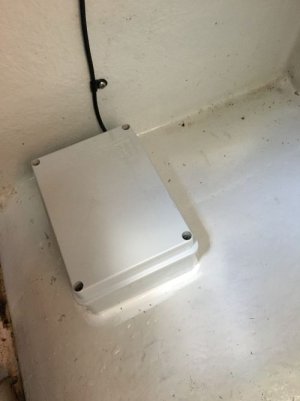
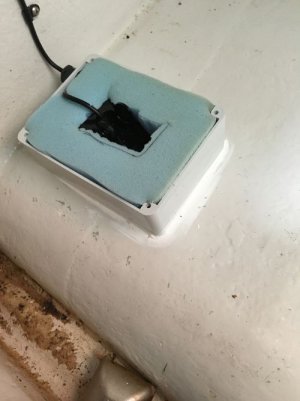
There is another way which is to cut a piece of closed cell foam to fit your space and cut a transducer shaped hole slightly smaller than it. Glue the foam to the hull, then when cured fill the transducer hole with liquid and push the transducer into the hole. I have this setup in my bilge inside a waterproof box for protection and it works fine. It's an angling boat and I have three fishfiders: one with through hull, one with in hull and one transom mount transducers and all work equally well. The kayak boys use the foam without a box, but they have theirs inside the sealed part of the hull. Garmin will sell you the piece of foam for just shy of £20 but this is PBO so I don't expect anyone to take up that offer.


transducer 2.jpgtransducer 1.jpg
 
We have similar, just glued in place with sikaflex.

2 points I will note.

We notice, going astern under motor, we get some crazy readings on the depth. No problem going forwards. But the crazy readings stopped when a little water got in the bilge and the transducer was then sitting in a puddle of water. Perhaps that indicates there was an air bubble in the sikaflex?

Towards the end of the season the transducer broke free. We had glued it down to a painted surface and the paint had peeled off. Will shortly be re doing it but scraping he paint off to bare fibreglass first.
 
@ProDave thank for tips I did consider whizzing of the paint but it looked pretty solid.

There will be little danger of crazy readings when going astern under motor, we have a long keel!

If I start getting crazy readings I will try adding water.
 
We have similar, just glued in place with sikaflex.

2 points I will note.

We notice, going astern under motor, we get some crazy readings on the depth. No problem going forwards. But the crazy readings stopped when a little water got in the bilge and the transducer was then sitting in a puddle of water. Perhaps that indicates there was an air bubble in the sikaflex?

Towards the end of the season the transducer broke free. We had glued it down to a painted surface and the paint had peeled off. Will shortly be re doing it but scraping he paint off to bare fibreglass first.

Not unusual for strange readings when going astern - due to aeration / cavitation of prop ....
I think the bilge water may have been co-incidence. But if 'ducer' was sitting on flaky paint - many boats vibrate when going astern due to prop not being in its most efficient direction ... maybe the vibration caused 'ducer' to move.

I always scrape back and then use Oven Cleaner to get the area super clean and ready to bond to ... I've tried so many products to clean up before fitting 'ducers' - but Oven Cleaner beats all hands down. Just make sure well rinsed off and dried.
 

Other threads that may be of interest

Top