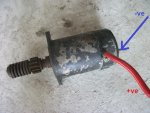
Interesting problem with starter / solenoid Perkins 4-107

The terminal on the side is actually the +ve ... that's certain ... when you look at it - the terminal exits via a grommet affair isolating it from the case. When the guy tested on the repair bench - he also connected +ve to that side terminal.

If that terminal was shorting - I think I would see a lot more 'event' than what I see now !!

The most likely scenario is that the starter is finding earth return via the lighter domestic connection block and that short lead to engine block. The shortness of the path being from a HD cable via screw terminal to the thin lead means that rest of domestic system is not burnt.

Today I will be getting a length of decent battery -ve cable .... couple of crimp terminals and connecting starter -ve to engine block ... removing solenoid -ve wire.

Having checked and compared old solenoid to present - I now know why the -ve wire was there ... the old solenoid is a 4 pin unit requiring a -ve wire to ground the start switch action.

As to the A-AB-B switch .... I'm happy enough with it ... its never given any problems in all the years its been there .... boat is a 1975 vintage ...
Fair enough about the + terminal as you seem certain about it. I assume your starter motor does not have the terminal on the end shown in the picture in my post

I does seem that the starter current is finding its way to ground via the lighter connection I agree. Maybe there should be a heavy cable between the starter motor and the engine block which is missing or maybe the connection via the mounting is poor ??? The purpose of the lighter cable is unclear

As far as the selector switch is concerned If it is a decent quality item it it adds no more resistance than a similar separate isolator and will be no less reliable. Absolutely no valid reason to change it unless updating the battery and charging systems makes it inappropriate.
 
Last edited:
I does seem that the starter current is finding its way to ground via the lighter connection I agree. Maybe there should be a heavy cable between the starter motor and the engine block which is missing or maybe the connection via the mounting is poor ??? The purpose of the lighter cable is unclear

Certainly my Land Rover described above has a very thick, short cable which goes from the lower bolt on the starter motor across to a small flange with a hole in in which is welded to the chassis. During the rebuild, I did think about leaving this cable off on the basis that the motor must surely be getting sufficient -ve through the crank case but, in the end, I decided to scrape the paint off the chassis flange and re-fit the short cable.

Richard
 
OK - I checked with seller of the M45G starter same as I have ... he's a Marine Electrical Guy .... and he confirmed that my starter is insulated ... his words :

"
Hi Nigel.

You can wire these wound field coil starters either way and they will work.
The starter is insulated so needs the same size earth wire as the positive and should be wired straight back to the battery.

Hope this helps, Regards Ray"

His reply basically confirms my suspicion that its the -ve of the starter that is at fault ... and that because I already see the starter turns the engine correct way (the bendix would not engage if wrong way !) ... I need to sort better -ve back to battery.

I bought a set of 300A jump leads to provide donor cable .... tried direct jump battery to starter ... it burnt the jump leads with the load ! Which now we suspect is because engine has stood for too long and she always had a tendency to get 'difficult' to turn over ... needing persuasion by hand. I bet those jump leads could never handle 300A ... not with small crimped connection to the croc clips - which is where they failed ... and wire is stranded barely 2.5mm ....

So now its sort out a decent -ve cable and keep trying to get her to free up and spin fast enough to cough into life ......

Watch this space for updates !!

Many thanks to everyone ...
 
OK - I checked with seller of the M45G starter same as I have ... he's a Marine Electrical Guy .... and he confirmed that my starter is insulated ... his words :

"
Hi Nigel.

You can wire these wound field coil starters either way and they will work.
The starter is insulated so needs the same size earth wire as the positive and should be wired straight back to the battery.

Hope this helps, Regards Ray"

His reply basically confirms my suspicion that its the -ve of the starter that is at fault ... and that because I already see the starter turns the engine correct way (the bendix would not engage if wrong way !) ... I need to sort better -ve back to battery.

I bought a set of 300A jump leads to provide donor cable .... tried direct jump battery to starter ... it burnt the jump leads with the load ! Which now we suspect is because engine has stood for too long and she always had a tendency to get 'difficult' to turn over ... needing persuasion by hand. I bet those jump leads could never handle 300A ... not with small crimped connection to the croc clips - which is where they failed ... and wire is stranded barely 2.5mm ....

So now its sort out a decent -ve cable and keep trying to get her to free up and spin fast enough to cough into life ......

Watch this space for updates !!

Many thanks to everyone ...

I don't understand. :unsure:

If the starter motor is insulated, surely it must have two electrical terminals as it will not be earthing through its casing? You have only mentioned one terminal so where are you going to connect the -ve to?

If it does have a second terminal on the back plate, what was that connected to when you removed it?

Richard
 
OK - I checked with seller of the M45G starter same as I have ... he's a Marine Electrical Guy .... and he confirmed that my starter is insulated ... his words :

"
Hi Nigel.

You can wire these wound field coil starters either way and they will work.
The starter is insulated so needs the same size earth wire as the positive and should be wired straight back to the battery.


Hope this helps, Regards Ray"

His reply basically confirms my suspicion that its the -ve of the starter that is at fault ... and that because I already see the starter turns the engine correct way (the bendix would not engage if wrong way !) ... I need to sort better -ve back to battery.

I bought a set of 300A jump leads to provide donor cable .... tried direct jump battery to starter ... it burnt the jump leads with the load ! Which now we suspect is because engine has stood for too long and she always had a tendency to get 'difficult' to turn over ... needing persuasion by hand. I bet those jump leads could never handle 300A ... not with small crimped connection to the croc clips - which is where they failed ... and wire is stranded barely 2.5mm ....

So now its sort out a decent -ve cable and keep trying to get her to free up and spin fast enough to cough into life ......

Watch this space for updates !!

Many thanks to everyone ...

Which agrees with the diagram in the link I posted in #3

the thin wire which you have cooked is presumably the wire which should connect the engine block to negative ( shown in the diagram ) All the other electrical bits and pieces on the engine are shown with their negative connections grounded to the block

Rather a puzzle as to why your battery negative is connected to the block but you now have a choice of leaving that as it is and replacing the negative connection to the starter motor with something heavy enough to carry the starter motor current or connecting it all as shown in the diagram.
 
I don't understand. :unsure:

If the starter motor is insulated, surely it must have two electrical terminals as it will not be earthing through its casing? You have only mentioned one terminal so where are you going to connect the -ve to?

If it does have a second terminal on the back plate, what was that connected to when you removed it?

Richard

The +ve connects to the side terminal ... the -ve connects to the terminal on the back end of starter ...

terminals M45G 26249A.jpg

I've worked out why the -ve wire to solenoid having found the old .... the old solenoid was a 4 pin isolated version. That requires a +ve and -ve wires setup.
What is not clear is why the starter worked for years with the inadequate sized -ve cables. I wonder if someone may have modified it and repairs have re-instated correct design ?

Anyway - checking with jump leads - rotation and terminals are correct as the picture here. Problem now is the engine is so sluggish and hasn't been run for months waiting repairs - the amp draw is too great for the jump leads ... discussing with locals here - they said (before I even mentioned size of the jump leads )- I would need at least 35mm2 cable ... the jump leads are of course nowhere near that size.

Because I have only put one battery into the box .. I have the second cable set spare. I can take the -ve short cable that's spare - its at least 35mm2 if not bigger ... and use that to ground starter to engine block.
 
Which agrees with the diagram in the link I posted in #3

Yep ... still strange that boat is all those years on with this system !!

the thin wire which you have cooked is presumably the wire which should connect the engine block to negative ( shown in the diagram ) All the other electrical bits and pieces on the engine are shown with their negative connections grounded to the block

The thin wire is now understood to be a left over from the old 4 pin solenoid. Unnecessary with the 3 pin version now fitted. But it was carrying the starter -ive part of circuit ... terrible,

Rather a puzzle as to why your battery negative is connected to the block but you now have a choice of leaving that as it is and replacing the negative connection to the starter motor with something heavy enough to carry the starter motor current or connecting it all as shown in the diagram.

The battery negative is to block completing circuits such as glow plug ... solenoid .... etc.
 
The +ve connects to the side terminal ... the -ve connects to the terminal on the back end of starter ...

View attachment 83302

I've worked out why the -ve wire to solenoid having found the old .... the old solenoid was a 4 pin isolated version. That requires a +ve and -ve wires setup.
What is not clear is why the starter worked for years with the inadequate sized -ve cables. I wonder if someone may have modified it and repairs have re-instated correct design ?

Anyway - checking with jump leads - rotation and terminals are correct as the picture here. Problem now is the engine is so sluggish and hasn't been run for months waiting repairs - the amp draw is too great for the jump leads ... discussing with locals here - they said (before I even mentioned size of the jump leads )- I would need at least 35mm2 cable ... the jump leads are of course nowhere near that size.

Because I have only put one battery into the box .. I have the second cable set spare. I can take the -ve short cable that's spare - its at least 35mm2 if not bigger ... and use that to ground starter to engine block.

I understand ..... but I thought you said that the terminal on the end plate was not isolated from the body of the starter motor. Did you remove a heavy cable from that rear terminal when you removed it?

Richard
 
I understand ..... but I thought you said that the terminal on the end plate was not isolated from the body of the starter motor. Did you remove a heavy cable from that rear terminal when you removed it?

Richard

Yes I did .... and that is how it looks ... but apparently - the terminal is isolated.

The cable I removed is a medium sized cable of about 2mm and is the one that goes up to the domestic -ve block I said about originally. The thin wire to solenoid comes of that same block ... so obviously the starter saw that as the shortest route and burnt it.
 
Yes I did .... and that is how it looks ... but apparently - the terminal is isolated.

The cable I removed is a medium sized cable of about 2mm and is the one that goes up to the domestic -ve block I said about originally. The thin wire to solenoid comes of that same block ... so obviously the starter saw that as the shortest route and burnt it.
I would take the very heavy battery negative cable direct to the starter motor because that is the biggest load. (This should be the same size as the battery + cable. I'd expect 35mm² at least)

Then a less heavy cable ( probably 10mm²) from there to the engine block for the glow plugs, the alternator negative connection and other equipment negative connections
 
I would take the very heavy battery negative cable direct to the starter motor because that is the biggest load. (This should be the same size as the battery + cable. I'd expect 35mm² at least)

Then a less heavy cable ( probably 10mm²) from there to the engine block for the glow plugs, the alternator negative connection and other equipment negative connections

I looked at doing that - but unfortunately the battery cable is too short. The battery box is under the rear divan and immediately in front of to port of the engine box. Cable passes through box bulkhead and bolts to the engine mount there. Starter is on stbd rear of engine ... needing at least 1m of cable to extend.
The solenoid is bolted to engine using the long bolt that goes through air intake body and is only about 15cms above that starter terminal.
My idea for temporary is to use the spare battery cable in the box, ~35mm2, to connect starter terminal to that bolt on engine air intake. The body is cleaned up and good contact available. If successful - I will look to create a more permanent cable arrangement. My plan being to have heavy cable run round to that mount bolt and connect there basically joining to the existing battery cable. The only concern then is length of cable adding resistance.
 
Yes I did .... and that is how it looks ... but apparently - the terminal is isolated.

The cable I removed is a medium sized cable of about 2mm and is the one that goes up to the domestic -ve block I said about originally. The thin wire to solenoid comes of that same block ... so obviously the starter saw that as the shortest route and burnt it.

Interesting. I just do not think that a cable that is 2mm diameter would carry sufficient current to the starter motor for it to spin the engine for more than a split second without overheating.

It sounds unlikely but I wonder whether your starter motor was actually earthed via the block before it was repaired so the thin cable was not actually doing any work. The repair guy has now repaired the motor so that it really is insulated -ve now, and is therefore relying on the thin wire and that just isn't going to cut the mustard. If that is the case I'm surprised that the repair guy didn't explain what he had done so maybe I'm talking nonsense. :unsure:

Someone might well have already said this, but you could simply earth the negative terminal to the motor stud and revert back to a crankcase -ve if it really was like that before and it wasn't causing any undue loss of anodes or similar unwanted side-effects.

Richard
 
Interesting. I just do not think that a cable that is 2mm diameter would carry sufficient current to the starter motor for it to spin the engine for more than a split second without overheating.

It sounds unlikely but I wonder whether your starter motor was actually earthed via the block before it was repaired so the thin cable was not actually doing any work. The repair guy has now repaired the motor so that it really is insulated -ve now, and is therefore relying on the thin wire and that just isn't going to cut the mustard. If that is the case I'm surprised that the repair guy didn't explain what he had done so maybe I'm talking nonsense. :unsure:

Someone might well have already said this, but you could simply earth the negative terminal to the motor stud and revert back to a crankcase -ve if it really was like that before and it wasn't causing any undue loss of anodes or similar unwanted side-effects.

Richard

If you go back in my posts - I said similar. The Repair did not speak english and his boss only knows computers ! So the translation of repairs carried out could well have missed this point.

I was told that both bushes were changed .... there was a short and damage to windings .... the helical gear needed a piece welded in and then ground to give smooth run ...

I asked if the short needed rewind and was told no. So I think that may have been it.

I am of the opinion that the starter was shorting to ground and therefore repair has highlighted the lack of decent -ve cable. The easiest way to solve now to get engine started - is to take that spare battery cable and bridge that -ve stud to the engine block. I need to start the engine so I can run Anti-freeze through it and gearbox before the winter freeze sets in ... it gets down to less than -25C at times here ...

The engine was fitted to replace my seized 4-99 many years ago ... around 1999 - 2000 ?? And its been that way all that time.

Anodes ? They went 'west' many years ago ... and I have no evidence of any effects as a result.
 
Anodes ? They went 'west' many years ago ... and I have no evidence of any effects as a result.

Running -ve through the block sounds the way to go, certainly in the short term. :)

Some boats are recommended to use isolated starter motors and alternators etc such that everything runs back to the battery negative terminal but I'm not sure why, other than perhaps for metal-hulled boats, this would be any advantage. However others who understand this much better than me might be able to comment.

Richard
 
Given that todays advice is to ground everything .... I cannot see it making any difference now. The battery will be grounded to engine usually for cold start and other gear - so what's the benefit of isolated ?

I've rummaged about in my shed .... actually is a barn ! and found a length of 8mm diameter copper core house grounding cable. I've crimped on ring connectors and will try that to ground the starter to the block. Its slightly less diameter than the battery spare cable, 10mm diameter - but being a short length - should do the job ...

Fingers crossed .....
 
The reason for isolated starter motors, alternators and oil /temperature senders is as Richard said is for metal hulled boats like mine.

I do not have isolated engine set up so I isolated the whole engine.

isolation helps prevent circulating currents in metal hulls that could cause excessive corrosion or anode usage.

i.e No 12vdc negative connected to the hull but if you have 240VAC on board the incoming earth must be connected to the hull through a galvanic isolator.

GRP boats don't have such a problem.
 
Fitted my 'new' cable ...... removed old ....

Hit button and she turned over much better - now she gets more power instead of just heating up cables !!! But refused to start ... she's done this before - fuel tank is under fwd bunk and if low the fuel drops back. The silly little priming lever Perkins have - on mine - I don't think it works. So you just have to keep hitting start till it gets a sip of jungle juice. Even Easy Start only helps the engine turn faster !
Being only one medium sized battery on there at moment ... it drained down and needs charging up again .... Try again tomorrow.

Found out that my domestic system used that 2mm -ve lead I just removed .... so will put that back but connect to more sensible place.

At least I am now sorted for starter / solenoid .... just need to get engine running ..... Might be idea to put a bit of diesel in the Glow plug feed, its supposed to have a small header tank, but I just have a bit of fuel tube sticking up that you drop about 10ml into ...
 
Fitted my 'new' cable ...... removed old ....

Hit button and she turned over much better - now she gets more power instead of just heating up cables !!! But refused to start ... she's done this before - fuel tank is under fwd bunk and if low the fuel drops back. The silly little priming lever Perkins have - on mine - I don't think it works. So you just have to keep hitting start till it gets a sip of jungle juice. Even Easy Start only helps the engine turn faster !
Being only one medium sized battery on there at moment ... it drained down and needs charging up again .... Try again tomorrow.

Found out that my domestic system used that 2mm -ve lead I just removed .... so will put that back but connect to more sensible place.

At least I am now sorted for starter / solenoid .... just need to get engine running ..... Might be idea to put a bit of diesel in the Glow plug feed, its supposed to have a small header tank, but I just have a bit of fuel tube sticking up that you drop about 10ml into ...
A squeezy bulb like outboards have would enable you to prime your fuel system ( One of my diesel cars had one too)

You referred several times to glow plugs. I take it from what you say above that it has a "Thermostarter" ??
 
Thermostarter ? Didn't know a flame igniter had a fancy name ... :D

Basically its a glow plug with bi-metal valve that sits in the air-intake. You press the button and the plug heats up - the valve opens and a tiny drop of diesel ignites on the plug. The book tells you to listen for the POP and a trickle of smoke from intake ... that shows the diesel has ignited. You are supposed to hit starter as soon as you hear that POP to drag the flame into the manifold ...

Sounds horrendous - but I'm told its derived from the old days of Tank engine starters etc.

I must admit - I had considered a pump bulb many times. Pal of mine on his centaur had a small bilge pump and lever to do it ..
 
Top