Intercoolers, these perfect strangers...

Why two sections?

  • Not a clue

    Votes: 3 37.5%
  • To heat the airflow

    Votes: 0 0.0%
  • R U joking? To cool the airflow further, of course! It ain't called cooler for nothing!

    Votes: 5 62.5%
  • Either heat or cool, depending on which way the wind is blowing

    Votes: 0 0.0%

  • Total voters
    8

MapisM

Well-Known Member
Joined
11 Mar 2002
Messages
20,659
Visit site
I am reposting a pic which some of you might have already seen in this previous thread.
Eventually, I found out the reason for the two separate sections which can be seen in the pics. Over to you guys, wadduthink they are meant for? :)
TGfDMwSG.jpg
 
Diesel burns in the presence of air,the more air you can get in the more diesel you can burn and develop more power .
After the turbo,s compressed the air it's also inadvertently heated it ,the " intercooler " (in between the turbo and inlet manifold ) cools it down making it more dense - as said the more air you can crammed in the more fuel the more power .

MAN are pretty robust ,official service schedule is clean ( along with everything else ) every TWO years .
Typically with valve adjustments ( 400 hrs ) you are looking @ € 15K for a pair of V ,s

The general consensus once out of warranty is every FOUR years or sooner if temps rise .
Modern MAN,s have charge air cooler temp gauges along with sea water coolant temps for HE ,s
They also have oil temps , and Exhaust Gas Temps gauges - with alarms .
EGT,s rise with poor intercooling cos the air going in is hotter to start with .

So with all that ^^^ you can tell when it's ready to crack open the intercoolers and Heat Exchangers.

Also --- this is important it's all depends on the installation regarding the relative height ,inclination of the exit pipes on the engines systems to the water line position and type and position of the boat exhaust .
The relative position on the above are such on my boat that after shut down the seawater drains out of the intercooler , heat exchanger ,engine oil cooler and gearbox cooler .
Thus there's hardly any build up of salt scale etc ,cos they not sat pickling in it .
This makes the " by the book 2 year " crack open pointless .

Some boats will have varying degrees of pickling after shut down , and temps will rise faster 2-3 years or so ?
They cos of the install will require a more frequent crack open / clean .

CAT have a reputation for poor intercoolers ,it's to do with the actual metal piping ,it's not that good in sea water .Theres various threads on American boat forums reporting leaky intercoolers .Additionally a separate issue they have a drain valve underneath with blocks and condensate accumulated accelerates corrosion .
Recently as a " get of jail card " CAT advice on new engines is 6 yearly renewal of the intercoolers -- yup renewal - not clean and replace .There intercoolers have become a throwaway part these days .

Pics - they look ok --
What difference did the cleaning make on what temps you could measure ?
 
What difference did the cleaning make on what temps you could measure ?
Not much - if any at all.
As it turned out, the high(ish) temps reported on the dashboard had to see with bulbs and VDO gauges, rather than actual temperature.
Btw, the blxxdy electrical connections contributed to the misleading readout, because there are two temperature bulbs on the engine (plus one for the alarm), which would lead you to think that it's almost impossible to get a high reading on both p/h and f/b instrument, right?
Wrong. The two bulbs are actually connected (1) to BOTH the p/h and f/b in parallel, and (2) to the e/r instruments box, if installed (which it ain't, in my boat).
And bulb (1) is different from (2), because the first is meant to drive two gauges, and the latter just one.
In fact, I'm now considering to replace bulb (1) with a single gauge version, snake two more wires, and have p/h and f/b gauge each connected to a separate bulb.

But I digress.
Back to the poll, I'll spill the beans right away, because it's already crystal clear from the results so far that I wasn't alone in not even dreaming that an aftercooler could be meant to warm air, rather than cool it. But believe it or not, that's what the two separate sections are meant for.
And the very same aftercooler can either increase or decrease the air temperature, so the right answer to the poll was the last one, albeit you will forgive me for not having described it as "Either heat or cool, depending on the turbo pressure", because that would have been like giving away the trick in advance, kind of. :rolleyes:
In a nutshell, the thing is meant to warm aspiration air when the engine is spinning at low rpm, before the turbos begin working.
But as soon as they do, the aftercooler comes into its own, and cools the air.

That's the reason for the two sections:
The larger one (left side of the pic) is meant for raw water, and there's a valve opening that section as soon as charged air pressure goes up.
The smaller section is meant for the engine cooling liquid, and it's permanently open.
When the engine is working as a naturally aspirated, this section actually warms up the air (from 50°C to 70°C or so, according to MAN technical manuals), and the first section remains closed. In turn, this should reduce smoke while operating at low rpm.
As soon as the turbo starts working, on top of increasing air pressure, it raises significantly its temperature (at around 200°C, again according to MAN). At this point, a valve opens the larger raw water section, and BOTH sections actually contribute to cool down the air.

Clever on paper, but a rather useless complication according to all engineers I spoke with.
It's a pity that LS1 seem to have abandoned the asylum a bit lately, because I would have been VERY curious to hear his view on this setup.
 
I think they may have abandoned all that 2 way malarkey when they went MORE electronic ,
Other ways to reduce smoke @ start up ,EDC or similiar .
Nether the less interesting :encouragement: to understand .
 
interesting and odd,

wonder how they manage all their raw water routing around the engine...
The installations I've seen (volvo, iveco and a few more) seem to go around a route of cooling according to the temps the material needs cooling from low to high. So in theory you start with CAC as air is the one you want to cool the most (I remember how much stronger and faster my old fiat coupe 16vt engine feels during cold winter days or the variation throughout the day - with a massive CAC - air to air though), then to the two oils and LAST the engine coolant which anyway should be around 80odd. Now mixing the cooler with the hotter together is "interesting". So there's a VALVE on the raw seawater opening and closing, that's v.nice to know and keep a few spares :D If thermostats have a habit of failing (hopefully open) in nice sweet coolant, I wonder how these survive in seawater. Any stories of them locking solid or need replacing often?
Who else except you P and Bart is on manual MANs?

cheers

V.
 
Who else except you P and Bart is on manual MANs?
I can't think of anyone else, at the moment.
IIRC, Portofino has the first ECU controlled but not yet common rail version of the L6, while Deleted User and MYAG have V12 CR.
I guess there might be others I'm not aware of though, because mechanical MANs were very popular in their days, and many yards installed them.

Ref. how the valve works, I don't think there's a risk of letting sea water into the closed circuit, because they are in completely separated sections of the intercooler.
If you look at the pic, in the larger section on the left there's the pipe stack where sea water flows (when the pressure-driven valve opens), and in the smaller section on the right there's the pipe stack where cooling liquid flows (constantly). It's just the air that goes through BOTH pipe stacks.
But you have a point ref the valve needing to be "fail safe", because it actually isn't.
In fact, the valve is just based on a calibrated spring, which the turbo pressure can push open to allow sea water flow inside.
So, if it would get stuck closed for some reason, raw water could not flow in the intercooler anymore. Not clever, 'fiuaskme...
So much so, that a MAN chap (off records...) suggested to lock the valve open, his reasoning being that at our latitudes there isn't any real need to limit the air cooling - as opposed to N Europe, for instance.

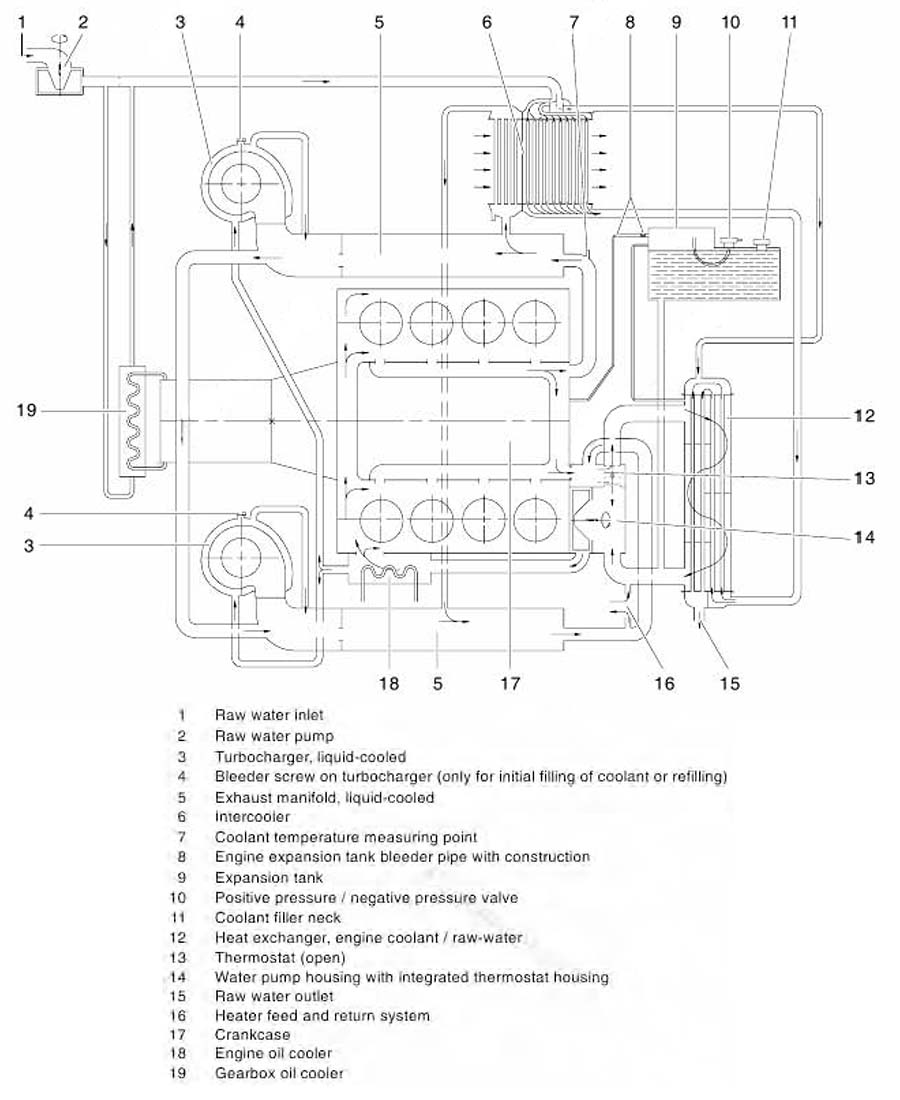
Ref. the cooling sequence, actually in my engines fresh raw water is routed in parallel (through a smaller pipe) to the gearbox heat exchanger and to the intecooler, then goes to the engine cooling heat exchanger, before eventually going through the wet section of the exhaust.
The engine oil heat exchanger is internal, and cooled by the closed cooling liquid.
Below is the scheme, if you wish to have a look.
You can see the two separate sections of the intercooler (#6), but for some reason the valve regulating the raw water flow is not included in the drawing...
Gi96z5Hk_o.jpg
 
I think they may have abandoned all that 2 way malarkey when they went MORE electronic ,
Other ways to reduce smoke @ start up ,EDC or similiar .
Actually, I think that the air warming capacity of the intercooler is irrelevant upon cold startup, because also the cooling liquid is not warm yet.
So, the engine is bound to breath air as cold as it is in the e/r, at least for the very first minutes.
According to the manual, the system is specifically meant for when the engines are already warmed up, but you run them at low rpm.

Anyway yes, as I was told this type of intercooler was not used anymore in CR engines, but I don't know exactly in which other models it was used.
Though as I recall your engines are the D2876LE401, or am I mistaken?
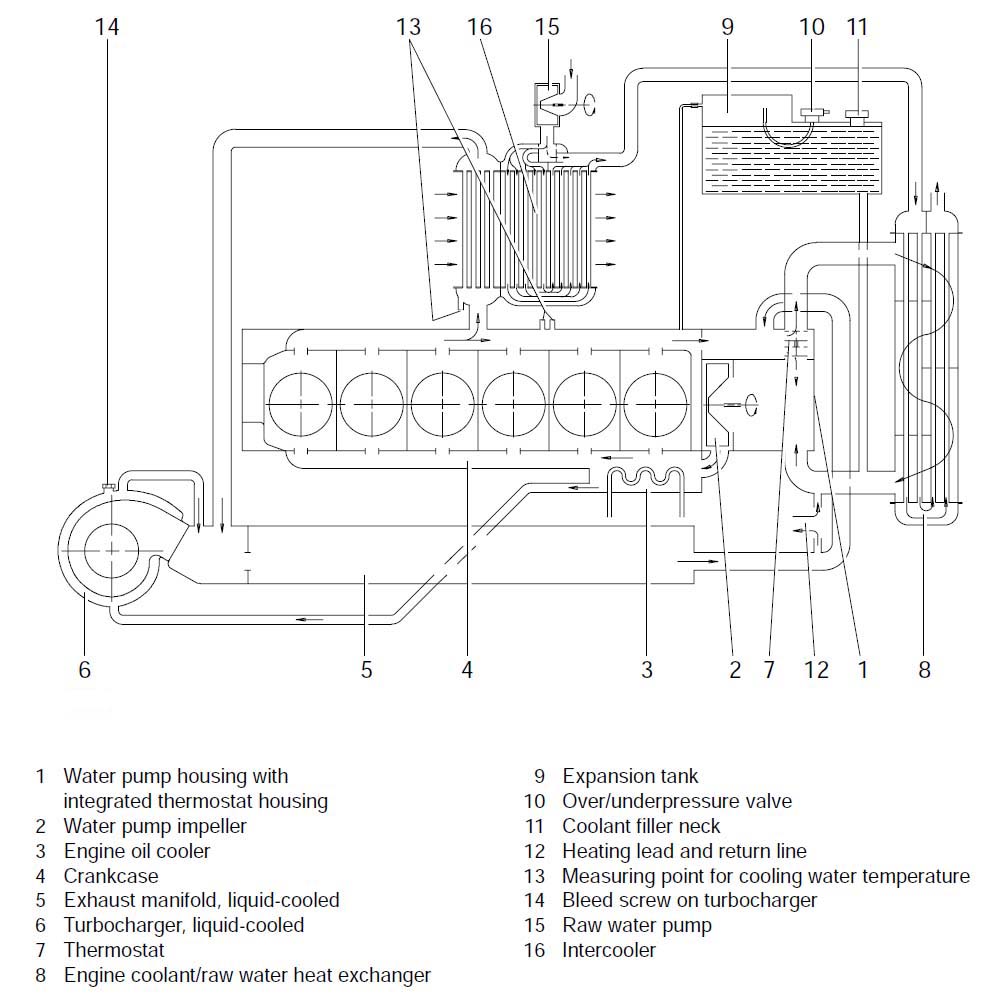
If they are, I think they should still have the same type of intercooler as mine - see drawing below.
The intercooler is #16 rather than #6 of the V8 drawing, but it appears to be exactly the same two sections thingie...
7PfI9a4w_o.jpg
 
Actually, I think that the air warming capacity of the intercooler is irrelevant upon cold startup, because also the cooling liquid is not warm yet.
So, the engine is bound to breath air as cold as it is in the e/r, at least for the very first minutes.
According to the manual, the system is specifically meant for when the engines are already warmed up, but you run them at low rpm.

Anyway yes, as I was told this type of intercooler was not used anymore in CR engines, but I don't know exactly in which other models it was used.
Though as I recall your engines are the D2876LE401, or am I mistaken?
If they are, I think they should still have the same type of intercooler as mine - see drawing below.
The intercooler is #16 rather than #6 of the V8 drawing, but it appears to be exactly the same two sections thingie...
7PfI9a4w_o.jpg

Yes mine are as you describe ^^^
I was just studying the diagram above in the manual .
It does indeed seem part of the intercooler is fed from the block say a 1/4.
how ever I,am sure there are no control valves like yours .
Maybe it's ( the little 1/4 part ) is to warm / heat up the 84/86 degree water in the block - see fig 13 by passing it through 200 degree compressed air so that it's less of a thermal shock when it meets the exhaust part 5 , which is 550-560 degrees @ 1800 rpm .

Think about it closed cooling fluid 23 ish ( ambient ) + a few seconds or less near the engine after starting being squirted over a cast iron exhaust pipe manifold who,s gases can reach 550 degree s +++ ,@ 1800 rpm
So I think it's nowt to do with warming the air when cold. It's to do with controlling the temp diff of the eventual closed cooling fluid cooling the exhuast .
The other 3/4 of the SWAC does its day job of increasing air density ,the surface area of both my 1/4 water warmer ( closed ) and the 3/4 raw water / air cooler is all calculated .---- peski Germans :) - you can't put anything past them engineering wise :)

Of course at start the exhaust is cold tick over mine is 125 degrees , so is the closed cooling water relatively ! Unwarmed 20 odd degrees for a few mins ? This is ok the temp diff at the mo .

but @ 1800 rpm it's 550 degrees - moves almost instantaneous with throttle up or down .
E.g. Planning at 27 knots , 550 if I throttle back slowly coming off say in 10-15 sec, the EGT drops to 125 before the boat ( momentum ) slows . So I reckon that 1/4 of the SWAC is heating the cooling water deliberately using some of 200 degree air temp .

I read somewhere in the manual to warm the whole thing s up to water 60 degrees before " letting rip " i.e. Getting up to planning speeds / rpm --- this too could be temp differential management as well as obvious lub issues .
 
Last edited:
how ever I,am sure there are no control valves like yours .
Maybe it's ( the little 1/4 part ) is to warm / heat up the 84/86 degree water in the block - see fig 13 by passing it through 200 degree compressed air so that it's less of a thermal shock when it meets the exhaust part 5 , which is 550-560 degrees @ 1800 rpm .
...
So I think it's nowt to do with warming the air when cold. It's to do with controlling the temp diff of the eventual closed cooling fluid cooling the exhuast
Porto,
I'm struggling a bit with your train of thoughts.
I think that the valve is actually a red herring, and anyway (based on MAN manual) it's not meant for cold start: it could stay closed forever regardless of engine temperature, as long as you stay under 1200/1300, when turbo kicks in.
At 1800 or whatever, the valve is fully open, and raw water flow is unrestricted - exactly as if there weren't any valve at all.
Not to mention that I was recommended to lock it open, i.e. get rid of the "warming-only" functionality at low rpm, which allegedly is useless in warm Med waters...

I see your point ref. the coolant being theoretically warmed by 200 deg compressed air, but the density differential between the coolant and air is huge, so while compressed air gets already cooled a bit before going through the colder and larger raw water section, I don't think the coolant temp can increase more than a couple of degrees, if that.

Anyhow, that's how these weird intercoolers work regardless of the valve.
And the manual doesn't mention any effect on the coolant as a rationale behind it, fwiw.
 
Top