Injecting epoxy

Kelpie

Well-Known Member
Joined
15 May 2005
Messages
7,766
Location
Afloat
Visit site
I have a repair to do on a foam-cored dinghy hull. What I'm intending to do is scrape/dremel out the filling between the GRP skins, and then inject epoxy into the void. This is so that I can fit a self-bailer without the bolts crushing the hull skin.

What is the smallest diameter of needle which will be practical in this application? And is there anything I can do to get the epoxy to be as runny as possible to make injecting easier?
 
I've repaired a 30 foot hull in that way years ago.I found that it is better to use a small syringe without the needle.The plastic tip seals better against the hole if you countersink it slightly.This way it is possible to inject the epoxy with some pressure.
 
Last edited:
What is the smallest diameter of needle which will be practical in this application?

I don't think you'll be able to use a needle - normally you just use a syringe. If necessary make a 5mm hole in the GRP skin and inject the epoxy through that.

The only acceptable way to 'thin' epoxy is with heat. Don't be tempted to thin with acetone or the like. Make sure your epoxy is at about 20°C before you mix it and make sure the dinghy is warmed to a little more than that (but not too much or the epoxy will 'foam' and you'll have a bad job and fire risk!). This will ensure you have runny epoxy but still with adequate work time. But if you're replacing foam core by way of fixings, you usually want to work with thickened epoxy after an initial wet out. I can't quite visualise your intended work procedure.
 
You certainly don't want to use a needle, depending on size of syringe and thickness of the mix you may want to chop the entire end off the syringe, or drill out the hole at the end, that allows you to dispense very thick gunge
 
I used a cooking beat 'Baster' years ago on a small stantion repair, the end knozzle has about a 1/8" dia hole, worked easy, if you not sure ask your wife to show you a baster, normally about £1 at the Pound shop!!

Mike
 
Thanks guys. It sounds as though the limit for what epoxy can be squeezed through is quite large- not hypodermic territory anyway.

I'll try to clarify what the situation is- it's quite hard to describe.
The boat is a Wayfarer World, built with an inner (cockpit) and an outer (hull) moulding. Generally these two moulding have an airspace between them, and are up to a foot apart. In order for the self-bailers to be fitted, however, the cockpit moulding dips down creating a small well, so that the two skins are in contact, with no gap between them.

In the bottom of these wells, a rectangular hole is cut through both skins; this is what the bailers are mounted in. So, in this location, there is a double thickness of GRP. Each moulding is also foam-cored. The bailers are held in place by six machine screws whose heads are countersunk into the hull moulding, with the nuts on the inside of the boat.

I hope that explains the layout sufficiently... suffice to say I don't have a photo and google isn't helping.

Now, my problem is that a previous owner seems to have over-tightened these machine screws, and damaged the foam core. The result is both some cracking on the outside around the countersunk holes, and also a slow but persistent leak as water is getting inbetween the two mouldings and into the buoyancy space created between them.

What I would like to do is remove the bailers and their machine screws, giving me access to the perimeter of the rectangular hole. At this point I should see a sandwich comprising two foam-cored skins of GRP. I would like to dremel out the damaged core material for a few mm, and then inject epoxy into the channel thus created. I would then re-drill the six holes, and re-fit the bailers.

The total thickness is probably about 8mm, and the foam coring is a small part of that- hence the reason why I am looking for a way of getting epoxy into a very tight space.
 
8mm thick in total?

Well once you've gauged out as much core as you can, I think I might be tempted to trowel / inject in some PU adhesive/sealant.

The cartridge stuff comes out of the guns under quite high pressure and an assortment of spatulas cut from scraps of stiff plastic should enable you to force / poke it into both cores and the gap in between.
It would certainly set up firm enough to stop small fasteners like that from compressing the make up.
 
Thanks guys. It sounds as though the limit for what epoxy can be squeezed through is quite large- not hypodermic territory anyway.

I'll try to clarify what the situation is- it's quite hard to describe.
The boat is a Wayfarer World, built with an inner (cockpit) and an outer (hull) moulding. Generally these two moulding have an airspace between them, and are up to a foot apart. In order for the self-bailers to be fitted, however, the cockpit moulding dips down creating a small well, so that the two skins are in contact, with no gap between them.

In the bottom of these wells, a rectangular hole is cut through both skins; this is what the bailers are mounted in. So, in this location, there is a double thickness of GRP. Each moulding is also foam-cored. The bailers are held in place by six machine screws whose heads are countersunk into the hull moulding, with the nuts on the inside of the boat.

I hope that explains the layout sufficiently... suffice to say I don't have a photo and google isn't helping.

Now, my problem is that a previous owner seems to have over-tightened these machine screws, and damaged the foam core. The result is both some cracking on the outside around the countersunk holes, and also a slow but persistent leak as water is getting inbetween the two mouldings and into the buoyancy space created between them.

What I would like to do is remove the bailers and their machine screws, giving me access to the perimeter of the rectangular hole. At this point I should see a sandwich comprising two foam-cored skins of GRP. I would like to dremel out the damaged core material for a few mm, and then inject epoxy into the channel thus created. I would then re-drill the six holes, and re-fit the bailers.

The total thickness is probably about 8mm, and the foam coring is a small part of that- hence the reason why I am looking for a way of getting epoxy into a very tight space.

Epoxy is the right stuff to use.

For this to work you must remove the foam core all the way from the edge of the bailer hole and past the bolt holes.
Once you have removed the foam, you can seal the bolt holes on the underside with plastic packing tape.
Use a syringe w/o needle to inject through the old bolt holes.
Start at one hole and squeeze in epoxy until it go out at the neighboring holes and in the bailer opening, seal with tape and repeat for each hole.
You will need a helper to put a finger on the tape opposite the hole you are injecting at.
If necessary you can drill new holes through on of the skins to get epoxy distributed all around. If you turn the boat upside down and inject from the bottom the extra holes will no be visible.
 
Last edited:
So realistically, what's the minimum diameter hole that I can inject epoxy through? And, by extension, the size of needle/nozzle to have on the syringe?
 
So realistically, what's the minimum diameter hole that I can inject epoxy through? And, by extension, the size of needle/nozzle to have on the syringe?

I use 10ml syringes from the pharmacy the ID is 2mm, I use these to inject epoxy with a little bit of microfibers as reinforcement.

Just ask for syringes (buy some it's one time use) without needle an tell the pharmacist that you are going to use with glue :)
 
I would treat this as a standard seal of foam core.

All you need to do is drill out the 4 holes oversized. fill with a mix of epoxy resin and Micro-fibres (or bits of fibreglass finely chopped).

Push through, no syringe needed, wipe away excess on the underside and tape it.
Let it cure and re drill to the required size and fix bolts.

Note: Just filling with resin only will be very brittle and prone to cracking, the resin needs a binder to prevent this.

Good luck and fair winds. :)
 
I have previously inserted a grease nipple, simply drill the appropriate sized hole and screw into the GRP, the nipple will cut it's own threads as it goes.
Then used a cheap grease gun, filled with epoxy resin/filler paste. It worked well and drove the mix a long way along the hidden voids.

Naturally, remove all traces of grease first!!
 
8mm thick in total?

Well once you've gauged out as much core as you can, I think I might be tempted to trowel / inject in some PU adhesive/sealant.

The cartridge stuff comes out of the guns under quite high pressure and an assortment of spatulas cut from scraps of stiff plastic should enable you to force / poke it into both cores and the gap in between.
It would certainly set up firm enough to stop small fasteners like that from compressing the make up.

I would agree with not using epoxy.
Using a rigid material inside a flexible one will just lead to cracking or crazing around the edges of the epoxy. Ie there may not be any of this where the epoxy is, but there's nothing to stop it where the epoxy ends.
A high modulus PU sealant/adhesive would seem a better option.
 
My gut instinct is that something solid needs to go into the void where the damaged core is.
I think the compressibility of the core is what has allowed the damage in the first place.
They might only be little machine screws but you can still get a good bit of force on them. Also, the only thing holding the two mouldings together is these screws, so in the interests of watertight integrity I can see why the previous owner tightened them up so much.
Surely a flexible filler will just allow the very thin GRP skins to bend/crack?
 
I have done this to mount cleats on a balsa cored yacht deck.
Drill the top hole.
Use a bent nail or something similar in a drill or dremel to break up the weak core, in an area extending around the hole.
Hoover out as much debris as possible.
Stuff in bits of chopped up glass cloth (not mat, mat has a binder not good with epoxy) use tweezers.
Mix epoxy
Warm with hot air gun until runny
Use syringe to fill hole.
Gently warm area with heat gun, air will bubble out, add more epoxy.
It worked for me!

Mask around the area is a good idea.
 
My gut instinct is that something solid needs to go into the void where the damaged core is.
I think the compressibility of the core is what has allowed the damage in the first place.
They might only be little machine screws but you can still get a good bit of force on them. Also, the only thing holding the two mouldings together is these screws, so in the interests of watertight integrity I can see why the previous owner tightened them up so much.
Surely a flexible filler will just allow the very thin GRP skins to bend/crack?

Some of the Sikaflex PU products set very hard (not much more flexible than car type rubber) yet with some flexibility which is what you need in an inherently flexible material like grp with or without a foam core.
The top box on my camper was glued on with it and I had to use an angle grinder to get it off. Don't confuse it with the silicone sealants which are a lot more flexible.

http://usa.sika.com/en/solutions_products/01/01a006/01a006sa02/01a006sa02100/01a006sa02103.html

Sikaflex 291
 
Last edited:
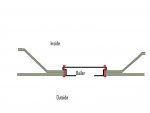
Here's a sophisticated computer generated image of the area in question.
The GRP is grey, the core material is green. The machine screws are in red.
This is a cross section as if looking through the bottom of the boat, the buoyancy chamber is the gap formed between the two skins either side of the bailer well.


Wayfarer X section.jpg
 
Fill the void with Sikaflex, and bed the bailer down on fillet of it all round the perimeter, then the screws won't need to be very tight. (you will the angle grinder to remove it!)
 
Here's a sophisticated computer generated image of the area in question.
The GRP is grey, the core material is green. The machine screws are in red.
This is a cross section as if looking through the bottom of the boat, the buoyancy chamber is the gap formed between the two skins either side of the bailer well.


View attachment 28224

I've repaired a 30 foot hull in that way years ago.I found that it is better to use a small syringe without the needle.The plastic tip seals better against the hole if you countersink it slightly.This way it is possible to inject the epoxy with some pressure.

I still think epoxy is the best product
I described my suggestion here http://www.ybw.com/forums/showthread.php?349019-Injecting-epoxy&p=4026960#post4026960

This time I used your drawing to illustrate.
Remove the foam around the opening - your dremel should go far enough into the slot - the point is to get epoxy all over the area under compression and all around the opening.
Once the core has been removed cover the old bolt holes with packing tape on one side.
Drill extra holes for injecting epoxy - you can countersink as 30boat wrote.
Use a small syringe 10ml and start injecting at one hole, you might need a finger applying pressure to the tape on the opposite side.
You should see epoxy squeezing out at the holes on both sides and at the edge of the opening, the remaining foam should act as a dam on the inside.
Going around the hole in a circle pattern repeat above.
At last you can use packing tape to seal of the edges of the bailer opening to prevent epoxy running out.

After the epoxy has cured, re drill the holes and install
WayfarerXsection_2_zps6d83407e.jpg
 
Top