"In line/inline" engine definition [correcn, "on-line"]

Roberto

Well-Known Member
Joined
20 Jul 2001
Messages
5,842
Location
Lorient/Paris
sybrancaleone.blogspot.com
Hello,
while listening to this streaming audio -marine communications in New York Harbour, quite interesting- ,
Northern NJ and NY City Area Marine Live Audio Feed
I heard the VTS tell a ship:
"We have a high wind warning, you are required to keep your engine in line [or inline?]"
The ship replied with a foreign accent "Understood, we keep our engine ready"
The VTS "Negative, not engine ready, you have to keep your engine in line"
The ship did not understand, the VTS ultimately asked "please tell your Agent to contact us".

What does it mean "to keep an engine in line" ? I looked in the internet and could only find references to the position of cylinders, none to the handling of a ship.
Should I ever go to NY harbour and be asked to keep my engine inline better know what it means, I would have no agent to call the VTS :D
 
Coming from the same exalted level of ignorance, my guess would be that inline to them means that the engine must be running and engaged to the prop.
 
In line or on line? The latter meaning to have thrust available immediately, as required.
Good question, I do not know precisely, it sounded like "engine 'nline" it might well have said on line.
What is difference with "engine ready"?
They used the same expression with a ship which was transferring liquid cargo and two other ones which were at anchor.
 
I would interpete their request "engine online" to mean "engine running" - not engaged to the prop but ready to go
 
I would interpete their request "engine online" to mean "engine running" - not engaged to the prop but ready to go
It will be good to get something from a professional to confirm. I assumed the same thing, that they'd said online to mean actually operating. The worry about ready is that they probably interpreted it as ready to start. Several steps with generators, compressors, system checks and heaven knows what else to get to the stage where the engine is ready to start. Start procedure itself takes a fair bit of time and there's always the risk it won't start. Fairly certain you are correct.
 
I would say if they have a strong wind warning in place in the confined New York harbour anchorage they are asking big ships to take reasonable precautions - engine on and ready to go
 
I can only assume that it was a large vessel at anchor and the message meant that the vessel was required to have engine running and engaged thus taking some strain off the ground tackle helping the vessel to avoid dragging.

Pure guesswork as I have never heard the expression and would have thought that it meant engine on tick over ready to engage should the vessel drag.
 
That would make sense: "engine ready" should mean "ready to start", whereas an engine online would already be turning and be ready to be quickly engaged to the prop.
Are there ships where for example the engine/shaft are turning but the propeller is kept at zero pitch?
 
Could it be applicable for large installations where the main unit is also used for power generation etc and requires a sequence to enable drive to shaft and thrusters ?
 
That brings back memories of February 1972. I was on Ark Royal and luckily our engines we still available, "on-line" perhaps? My pal Mick Stanley was the buoy jumper that day.
 

Attachments

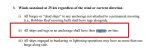
  • Screenshot 2023-03-06 111623.png
    Screenshot 2023-03-06 111623.png
    212.4 KB · Views: 41
Last edited:
It sounds like a local Americanism - they love to mangle language and invent new slang, and expect foreigners to understand - just listen to the verbal scribble that passes for RT at JFK. Standard voice procedure seems unknown to them.
Engine-wise the phrase in-line refers solely and exclusively to the config of the cylinders. On-line is not a phrase that I've ever heard used of an engine - generators yes, but not engines. Even so its terribly anbiguous. Whatever the VTS thought it meant was inevitably not going to be clear to anyone else!
They'll have an accident one day due to lousy RT discipline.
 
Last edited:
On line to me means ready for immediate use.In the old days steam ships would have full steam available, 'motor' ships had duplicate systems running, generators, oil and cooling water pumps, air compressors etc to enable immediate maneuvering.

Large ships were direct drive from crankshaft to propellor so engine was stopped but available for immediate start.
 
On line to me means ready for immediate use.In the old days steam ships would have full steam available, 'motor' ships had duplicate systems running, generators, oil and cooling water pumps, air compressors etc to enable immediate maneuvering.

Large ships were direct drive from crankshaft to propellor so engine was stopped but available for immediate start.

How do they reverse? Do they stop the engine and then start it again backwards? If there is a gearbox for reverse they will need some method of changing gear and then they might as well have a neutral. I suppose the obvious answer to avoid a gearbox would be a variable or controllable pitch propeller able to handle forward and reverse. It would allow forward and reverse without changing the engine's direction of rotation.

I guess the 3 options would be to have a reverse gear, run engine in reverse or do if by altering the propeller blade angle.
 
Last edited:
How do they reverse? Do they stop the engine and then start it again backwards?
This was a common method that I've heard frequently from engineers when I was offshore. The conversation would usually mention running out of air from the starter tank during tight manoeuvring and so on...
 
How do they reverse? Do they stop the engine and then start it again backwards? If there is a gearbox for reverse they will need some method of changing gear and then they might as well have a neutral. I suppose the obvious answer to avoid a gearbox would be a variable or controllable pitch propeller able to handle forward and reverse. It would allow forward and reverse without changing the engine's direction of rotation.

I guess the 3 options would be to have a reverse gear, run engine in reverse or do if by altering the propeller blade angle.

Yes! The engine was stopped, and then started in the opposite direction.

As a non steam person, my understanding was they had a small 'reverse' turbine with blades unning in the opposite direction.

On 'Motor' ships, ie Diesel (Heavy fuel 6000 sec high sulpher, realllly bad for the environment ) the engines were 2 stroke diesel, the engine was stopped, the camshaft moved by 15Deg (will accept correction, been a long time) and the engine restarted. Due to cam timing it ran the opposite direction.
 
This was a common method that I've heard frequently from engineers when I was offshore. The conversation would usually mention running out of air from the starter tank during tight manoeuvring and so on...
Another yes!
The engines were started by injecting compressed air into the cylinders, the reason for multipuple compressors running when 'manouvering'

It was unusual to 'runout of air' when manouvering, only 1 recollection, entering dry dock in Greece. 25 year old ship, a little tired and a second engineer on the controls a little the worse for alchol, emptied the air reservoirs on first (non)start! Fortunately we had Tugs to put us in dry dock.
 
Top