

You are using an out of date browser. It may not display this or other websites correctly.
You should upgrade or use an alternative browser.
You should upgrade or use an alternative browser.
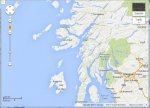
I hope nobody relies on Google maps for navigation!
- Thread starter agurney
- Start date

DaveS
Well-Known Member
Hmm... There appear to be a few bits missing from the jigsaw...
macd
Well-Known Member
Does this mean I'll no longer be able to get my favourite Scotch?
NormanS
Well-Known Member
very odd, as it shows the road, with no island under it.
macd
Well-Known Member
very odd, as it shows the road, with no island under it.
That'd be the low road, I imagine. Best tak the other one.
Last edited:

AntarcticPilot
Well-Known Member
What are they hiding from us??? 
macd
Well-Known Member
What are they hiding from us???
Corrievrecken...too terrible to contemplate.

bikedaft
Well-Known Member
Sssh - jura is a great spot, lets just not tell everyone it hasn't sunk.

AngusMcDoon
Well-Known Member
Corrievrecken...too terrible to contemplate.
Not any more. The water will have gone all slack with that huge gap to get through now.

Bilgediver
Well-Known Member
Does this mean I'll no longer be able to get my favourite Scotch?
It sank below the waves.....Oh well maybe a container ship or HMS Sub will find it if using their Iphone.

claymore
Well-Known Member
It can get quite misty at times, usually later on at night, especially efter a session in the Jura Hotel. I wonder if Mr Google took his picture then?
ffiill
Well-Known Member
Once upon a time perhaps when the Ordnance Survey were digitalising their paper maps they forgot our house.
Problem is that its almost impossible to persuade them they have made a mistake as their usual response is that it must be new.
No use telling them that it was on the first ever one inch Ordnance Survey of as I recall 1834.
Google earth behaves a bit oddly in Plockton.
When I was laying my mooring I downloaded a copy of the aerial photo of the harbour with the cross hairs over the mooring and noted that the lat long on the photo was about 2 miles off.
Problem is that its almost impossible to persuade them they have made a mistake as their usual response is that it must be new.
No use telling them that it was on the first ever one inch Ordnance Survey of as I recall 1834.
Google earth behaves a bit oddly in Plockton.
When I was laying my mooring I downloaded a copy of the aerial photo of the harbour with the cross hairs over the mooring and noted that the lat long on the photo was about 2 miles off.
claymore
Well-Known Member
I had a similar thing in Loch Craignish, mind you, as the coordinates put the mooring in a lay by it would have saved us rowing out....
AntarcticPilot
Well-Known Member
On a serious front, no-one should use Google Maps for navigation. The data are NOT guaranteed to be accurate, and the satellite images may well be out of position by over a hundred metres. In some places, coastline data are taken from very poor quality sources as well (Antarctica is a prime case!). Data is also not current; in fact it is frequently several years out of date - not a problem on rocky coasts, but sand/mud coasts may well have changed. There are also technical problems in the north and south, beyond about 60 degrees latitude, where the way Google handles map projections means that the representation of the data isn't accurate.
Although Google includes bathymetric information, this is NOT reliable in coastal areas, being of low resolution and taken from global geophysical datasets which are intended for the use of people studying plate tectonics.
Google is fine for a visualization of geographic information and relationships, and for looking at high resolution pictures of anchorages etc, but it should never be relied on as an accurate source of navigational information
Although Google includes bathymetric information, this is NOT reliable in coastal areas, being of low resolution and taken from global geophysical datasets which are intended for the use of people studying plate tectonics.
Google is fine for a visualization of geographic information and relationships, and for looking at high resolution pictures of anchorages etc, but it should never be relied on as an accurate source of navigational information
GHA
Well-Known Member
Would agree don't rely on it but if you have a play around with ge2kap and opencpn it can be remarkably accurate.On a serious front, no-one should use Google Maps for navigation. The data are NOT guaranteed to be accurate, and the satellite images may well be out of position by over a hundred metres. In some places, coastline data are taken from very poor quality sources as well (Antarctica is a prime case!). Data is also not current; in fact it is frequently several years out of date - not a problem on rocky coasts, but sand/mud coasts may well have changed. There are also technical problems in the north and south, beyond about 60 degrees latitude, where the way Google handles map projections means that the representation of the data isn't accurate.
Although Google includes bathymetric information, this is NOT reliable in coastal areas, being of low resolution and taken from global geophysical datasets which are intended for the use of people studying plate tectonics.
Google is fine for a visualization of geographic information and relationships, and for looking at high resolution pictures of anchorages etc, but it should never be relied on as an accurate source of navigational information
http://yachtvalhalla.net/navigation/googleearth.htm
I went up faversham creek recently using Google maps on a tablet and it was a godsend, luckily the images were taken at low water. Would have been aground otherwise.
claymore
Well-Known Member
Best not mention my adventures with an AA roadmap then.....
ffiill
Well-Known Member
I do find the aerial photos a great help when navigating into unknown places eg Arisaig Bay
NormanS
Well-Known Member
On a serious front, no-one should use Google Maps for navigation. The data are NOT guaranteed to be accurate, and the satellite images may well be out of position by over a hundred metres. In some places, coastline data are taken from very poor quality sources as well (Antarctica is a prime case!). Data is also not current; in fact it is frequently several years out of date - not a problem on rocky coasts, but sand/mud coasts may well have changed. There are also technical problems in the north and south, beyond about 60 degrees latitude, where the way Google handles map projections means that the representation of the data isn't accurate.
Although Google includes bathymetric information, this is NOT reliable in coastal areas, being of low resolution and taken from global geophysical datasets which are intended for the use of people studying plate tectonics.
Google is fine for a visualization of geographic information and relationships, and for looking at high resolution pictures of anchorages etc, but it should never be relied on as an accurate source of navigational information
Yes maybe, but you wouldn't really expect them to miss out a whole island. Jura is about 30 miles long!
I like your quote of "data is frequently several years out of date". Parts of the West Coast haven't been re-surveyed since Captain Henry Otter in the 1850s, with HMS Porcupine, steam and sail.
AntarcticPilot
Well-Known Member
Yes maybe, but you wouldn't really expect them to miss out a whole island. Jura is about 30 miles long!
I like your quote of "data is frequently several years out of date". Parts of the West Coast haven't been re-surveyed since Captain Henry Otter in the 1850s, with HMS Porcupine, steam and sail.
Well, that's obviously a gross data management error.
On the west coast, it doesn't matter all that much about old surveys; rocks don't move. But in many places it does matter; sand and mud do. Places like the Clyde estuary are certainly surveyed more frequently, though it doesn't matter all that much there - the main channel is artifically maintained anyway.
NormanS
Well-Known Member
Well, that's obviously a gross data management error.
On the west coast, it doesn't matter all that much about old surveys; rocks don't move. But in many places it does matter; sand and mud do. Places like the Clyde estuary are certainly surveyed more frequently, though it doesn't matter all that much there - the main channel is artifically maintained anyway.
Rocks may not move, but several "new" ones have been found since these original surveys were done, - some of them the hard way!