Hydronic heating advice

pearson.henry2

New Member
Joined
24 Jan 2024
Messages
5
Visit site
I’m planning a hydronic installation for next winter on our 3 cabin Hanse 370.
Plan is eberspacher d5wsc (5kw hydronic), connected to dual coil calorifier and heating circuit.
Will have valves the classic “summer valve” to isolate calorifier and heating circuit.

Planning on replacing calorifier for a 30 or 40l one under the port aft bunk. Planning on the following matrix heaters:
4.7kw in main saloon.
4.7kw in forepeak
Double duct one to do both aft cabins
Single duct to do heads.

Just a few questions really for anyone with experience of a hydronic system:
What size hydronic unit do you have installed? (And boat size)
How long do you find it takes to heat up your hot water (and what capacity)
How many and of what size (kw) matrix heaters do you have?

Thanks
 
After lengthy research we fitted a Webasto 'Thermo Top', 40ltr calorifier and two heated towel rails, one long narrow radiator on the setee berth front.

Twenty minutes you were stripping to tee shirts. One towel rail on the galley end the other in the heads/shower. All joined with 15mm 'Speedfit' pipe and connectors.

Matrix and fans were discounted after advice from a big installer on inland waterways. He said they were not reliable and also noisy.

He was on the Canal system near Leicester and was, compared to South Coast suppliers, very competitive.

Some time ago now, the subsequent owners of the boat, a three cabin Gibsea 96, told me when I met them a couple of years later they were the envy of their club.
 
We have a 12m steel hulled mobo.

We have a 9kw unit supplied by MV Heating - this one MV Hydro 9 M

For domestic hot water, we have an Aquafax 120 litre unit with twin coils. One coil fed from the port engine and the other from the MV unit. I have a motorised valve fitted to the heating supply which is power to open, remove power to close. I have also fitted one of these valves to the engine circuit which is powered from the engine ‘run’ circuit so that it opens when the engine is running and closes when it stops. This prevents heat loss from the calorifier in a thermo syphon when the engine is cold.

We have 4 x 1.7kw matrix heaters - one in the forward cabin, one in the mid cabin and two in the saloon. We also have one 4.25kw matrix heater in the aft cabin. Nothing in the forward heads or aft cabin en-suite as yet, but that may be an addition for the future. The smaller matrix heaters (axial fans) are fairly quiet but the larger one (centrifugal fan) in the aft cabin is very noisy and will get swapped out for a 1.7kw unit soon.

From cold, we usually have the heater on for domestic hot water for an hour first thing in a morning which gives us two good showers and hot water for most of the day.

The matrix heaters were supplied by Butler Technik
 
I am amazed as how large the calorifiers are on some of these boats. Our 44ft sailing yacht uses a 27litre model. We find the size perfectly adequate for two people living aboard. Unless you mount a large calorifier vertically, you need to heat up most of the water in a large horizontal calorifier to get any heat out of it. Don't over size your calorifier
 
I am amazed as how large the calorifiers are on some of these boats. Our 44ft sailing yacht uses a 27litre model. We find the size perfectly adequate for two people living aboard. Unless you mount a large calorifier vertically, you need to heat up most of the water in a large horizontal calorifier to get any heat out of it. Don't over size your calorifier
It’s horses for courses! The calorifier needs to be sized according to perceived demand for hot water, available space and the effect that the weight may make on the boat.

If family join us on the boat, we could have 6 or 8 aboard on total and when that happens, we use a lot of fresh water both hot and cold.

Our calorifier is a vertical unit and sits centrally beneath the saloon floor in between the fresh water tanks which are 400 litres each.
Displacement boat at 17.5 tonnes wet so no problem with the weight
 
It’s horses for courses! The calorifier needs to be sized according to perceived demand for hot water, available space and the effect that the weight may make on the boat.

If family join us on the boat, we could have 6 or 8 aboard on total and when that happens, we use a lot of fresh water both hot and cold.

Our calorifier is a vertical unit and sits centrally beneath the saloon floor in between the fresh water tanks which are 400 litres each.
Displacement boat at 17.5 tonnes wet so no problem with the weight
We have 800 litres of water and weigh 19t also. It's not an issue for us if we have guests. We just turn the immersion heater on. Clearly it's not an issue for you but I see lots of oversized horizontal calorifiers that take a huge amount of energy to heat up unnecessarily
 
An update on this project:
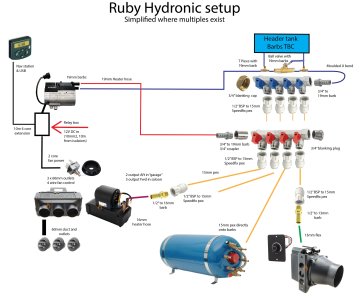
Hanse 370 - eberspacher hydronic (D5WSC) installation
We've almost completed this winters main project of getting a hydronic heating system installed.
We acquired a used (2008) eberspacher unit which we reconditioned (new seals, filters etc).
New 30L twin coil calorifier relocated to the "garage" aft.

15mm PEX pipe run to 3 heater matrix units:
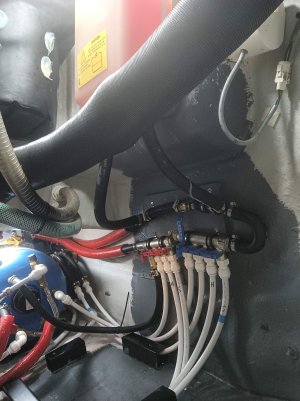
One for two aft cabins, one dedicate to heads and one for saloon/fwd cabin (2 outlets in saloon, one in forepeak). Via a standard plumbing (316 stainless) manifold so any combination of circuits can be selected.

15mm PEX around boat just has standard domestic foam insulation on. Managed to get some insulation on main hydronic pipes and engines ones to calorifier. For longer runs between fan matrix and outlet also put some cheap foil bubble wrap insulation around them.

Control cable ran to Nav station including diagnostic cable to connect unit to PC. Can get old eberspacher Edith software to see internal flame sensor temperature, status, voltages, error codes etc.

Added a day tank and fuel transfer pump from main engine tank.
Required new 10mm2 cables to be run aft, goes through a 20a fused relay. On main startup can draw 15a but once running goes down to about 4.5a, and about 0.5L of fuel per hour.

Also have temp sensors on the pipe work and small (35cm) tank level sender in day tank connected to Victron Cerbo. Also added an accumulator to hot water side of system.

Requires a bit of planning but all relatively straightforward. On big tip is on the small fuel pipes use only proper "super clamps" and try both correct size and the size down (size down generally better).

Ruby hydronic setup V2.jpgRuby manifold small.jpg
 
Top