Hull speed.

[ QUOTE ]
The theoretical hull speed formula applies to displacement boats.

[/ QUOTE ]

The theoretical hull speed formula above applies to displacement boats with a lwl:bwl ratio of approx 3:1.

[ QUOTE ]
Planing boats such as most catamarans

[/ QUOTE ]

Multihull hulls are usually displacement hulls, not planing.

[ QUOTE ]
because they, in a way, sail on the water not in it

[/ QUOTE ]

Multihull hull sail in the water, not on it.

[ QUOTE ]
becomes in effect a displacement hull and the rule starts to apply

[/ QUOTE ]

They are already displacement hulls. The reason that the formula above does not apply is because of the lwl:bwl ratio being typically 8:1 to 15:1, rather than monohull 3:1. With this high ratio there is virtually no bow wave to ride over.

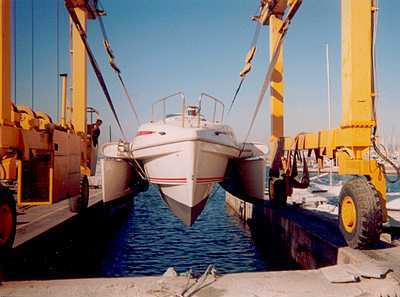
Look at the shape of the below-waterline parts of these hulls. That's a displacement hull.

i22.jpg


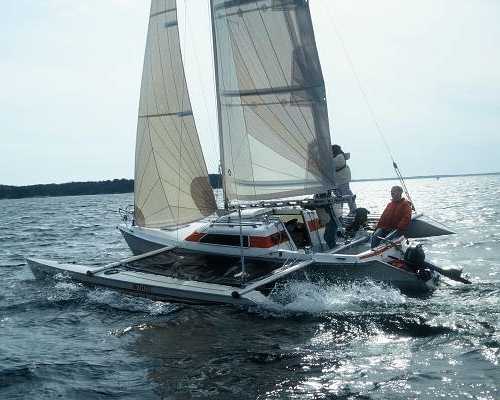
And here the leeward hull is pushed right down in the water. It's not skimming across the top.

df25.jpg


Maybe there are some planing multihulls that I'm not aware of, but this Hobie 16 has a displacement hull too. That leeward hull is definitely not planing!

gallery_01_lr.jpg
 
[ QUOTE ]
i have 31ft w.l 37ft o/all (one ton rated boat ) with 37.5 hp 7ton displacement max under engine with a clean bottom 7.5Kts.
no Westerly 33 will get near that /forums/images/graemlins/wink.gif. and with bilge keels??

[/ QUOTE ]

A few years ago I brought a Westerly 33 (Lucy B) in through the Needles Channel. We got picked up by an incoming swell, the stern rose and we accelerated until there was a jet of water coming out on either side of the bow and the mechanical speed log was on its stop. Can't remember whether that was 12 or 15 knots, but it was certainly a lot more than 7.5. And it was certainly more than displacement speed!
 
You are quite right, I have never got above 6.5kts, so far. I get 6.3-6.5kts at 1800 rpm. That is in Cardiff bay, checked by gps. I have yet to increase the revs. The motor is a Beta 50(BV2203) and is rated at 50hp @ 2800 rpm.
Allan
 
Sorry I didn't make my self clear. I have never tried more. Thus far 6.5kts is as fast as I have needed. My orignal question was just to get some idea of what I may get if I wanted to go faster. I will probably try some more revs to see how close I get to the speeds you and Refueler attain.
Allan
PS. One problem I find is that I get 3.5kts @ 800 rpm (tickover) and need to keep putting it out of gear when mooring etc.
 
The original engines fitted to a lot of Westerley 33s were Mercedes 42hp. I like the idea of having power to spare and it seems even better when it comes from a lighter motor.
Allan
 
the perkie 4108 is rated @ 50hp @ 4500 RPM
mine ran @ 2850RPM flat out so worked out around 38hp being used. i re-engined with the Nanni 4150 rated @ 37.5hp @ 3000Rpm.
i had to inrease the MaxProp pitch to bring the RPM down to under 3000 RPM so the new engine is more efficient than the 4108 + much lighter ( the transom rose by 50 m/m )
 
But still way overpowered and overpropped! You should be able to get maximum hull speed of about 7.4 with a 35hp engine, 2.6 reduction and a 17*15 3 bladed prop.

Then you would have a well matched drivetrain and would not have the low speed handling problem. Also your engine will never run at its most efficient speed unless you flatten the pitch or reduce the diameter to put the revs up.

Powering a sailboat with an auxiliary is one area where more (power) is not always better! As you have discovered it is absolutely wasted as you can't do anything with it!
 
That's a very comprehensive response to my gross oversimplification!
Catamaran hulls can be displacement, semi-displacement or planing hulls. (I didn't mention trimarans)
I was hoping to give the OP a general idea of monohulls ploughing through the water, incapable of climbing over their own bow wave and, therefore, restrained by the formula about which he enquired.
I used the example of catamarans as planing boats, skimming over the water, not restrained by the formula and not subject to it's restrictions.
I plead guilty to 'nautical profiling'.
That last picture of a Hobie-type catamaran looks to be planing to me, by my definition of planing. Skimming, perhaps?
Anyway, thank you for the lesson in hydrodynamics!
 
Ok, we'll have to agree to differ. In my opinion the Hobie 16 hull is a pure displacement shape, being knife edge thin along its whole length. It has a lwl:bwl ratio about as high as they ever get on a sailing boat. Consequently the leeward hull never lifts out of the water, it cuts through it, and to me that is not planing.

steve-hull-fly-01.jpg


I'd say that this is a planing hull that is planing...

470_%28bag%29.gif
 
Allan,I would like to take your boat out in flat water with a full sail and a F4 -5 just ahead of the beam. Forget the engine, SAIL IT and let it reach hull speed (around 7.6 knots) which is what is was designed to do!

(I know I could get 7.1 knots out of a bilge keel mirage 29 with knackered sails so I m sure I can get 7.6 out of your 33!)
 
displacement spd under engine was the OPs question.
under sail is another matter as the wl length will be greater mine would be greater than 35 ft.

if you get 7.5Kts out of a bilge keel Westerly 33 in F5 apparent wind 60 > 70Deg
i will buy you a beer & eat my Old Breton Hat /forums/images/graemlins/laugh.gif /forums/images/graemlins/laugh.gif /forums/images/graemlins/laugh.gif /forums/images/graemlins/laugh.gif
 
I find it quite difficult to get a correct speed as I sail in the Bristol channel and don't trust the log, it reads a little different on each tack. I have had 11+ kts on the gps loads of times, but then I had that from my Etap22i. In anything at or above F4 6 kts through the water is easy to acheive.
IMGP0666.jpg
I took this on a recent trip. The log reads higher on the other tack. I need a few more knots before it really gets moving, around 20 kts is better. After 25kts I chicken out and start reefing. After the picture was taken the wind dropped but the tide started to kick in. Allan
 
The speed I wanted in my original post was the "theoretical hull speed" I said nothing of how the boat was powered at the time. As far as I recall the method of power does not affect the theoretical hull speed, or am I wrong? I do understand your point about angle of heel and waterline length.
Allan
 
You are not wrong. The hull speed is a function of waterline length, which for many boats increases as the boat heels. It is usually easier to achieve consistently under power.
 
As I recall it Nordhavn use three different multipliers when calculating displacement speeds. In each case the multiplier is applied to the square root of the waterline length in feet, to give a speed in knots.

The maximum speed is 1.4 x

"Coastal cruising" speed is 1.2 x

"Long distance economy" is 1.1 x

I regard these as useful rough guidelines.

Now for a question which has puzzled me for some time. Displacement motor boats generally have engines with much higher power outputs than their sailing counterparts. For example an early Mitchell 31, designed as a purely displacement boat (not semi-displacement as the mark II and III were) typically had an 80 hp engine.

So why should we not have sailing boats, which spend a good deal of time under power, with relatively large engines? I appreciate that quite small engines can drive boats at "hull speed" in flat water but someone needing to pass through a narrow piece of rough water, against the wind, will need a lot more oomph.

We are currently looking to buy a second hand boat of about 34' LOA and intend to use it as a motor sailer (by which I mean a boat which can make good progress in most directions, in adverse conditions, under sail OR power). I expect to be re-engining so this subject is particularly interesting to me.

All sensible and knowledgeable comments welcome. Apologies to the OP if this is thread drift or hijacking.
 
Top