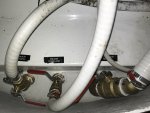
How's it sealed ?

Crowblack

Well-Known Member
Joined
23 Apr 2005
Messages
345
Location
East Coast.
Visit site
Got to replace the larger of the two head seacocks and through hull.

Intend to use ASAP's finest DZR and don't want to debate the various merits versus bronze etc, decisions made regarding material.

It looks a pretty easy job particularly because all the bits on the boat are easy to get to - - thing I need help with revolves around how you get the valve (seacock) to seal on the skin fitting efficiently.

Assuming the skin fitting is fitted and secure - the valve (seacock) is then screwed down onto the skin fitting.

My understanding is these fittings have straight threads which don't in themselves seal or tighten - the design allowing correct orientation of the handle - - - so something needs to be applied to the threads to provide the seal.

What's the appropriate sealing stuff ?
 
I used (and recommend) the loctite stuff that looks like dental floss. Can't recall the number but it's user-friendly, easily stored and inexpensive.

Advice is that you can re-align without losing the thread. But it's still worth IMHO counting the number of turns on the thread to your final position.

I also attached the hose tail first, using the same stuff, before then attaching both as a composite unit to the skin fitting.
 
Got to replace the larger of the two head seacocks and through hull.

Intend to use ASAP's finest DZR and don't want to debate the various merits versus bronze etc, decisions made regarding material.

It looks a pretty easy job particularly because all the bits on the boat are easy to get to - - thing I need help with revolves around how you get the valve (seacock) to seal on the skin fitting efficiently.

Assuming the skin fitting is fitted and secure - the valve (seacock) is then screwed down onto the skin fitting.

My understanding is these fittings have straight threads which don't in themselves seal or tighten - the design allowing correct orientation of the handle - - - so something needs to be applied to the threads to provide the seal.

What's the appropriate sealing stuff ?
The Loctite mentioned above.
There are also liquid Loctite pipe thread sealants

Sikaflex or whatever adhesive sealant you normally use wll also do the job.
It;s not a bad idea to use a back nut to lock the valve firmly in the required orientation as well as using sealant on the threads.
 
I used the Locktite 55 thread on my trudesign throughhull to ball valve fitting. It does allow adjustment to get the handle in position but felt very scary turning it about when you think it should be locked up rock solid. It has never given any problem though.

For information from the Trudesign fitting instructions, likely to be similar for bronze fittings.

"THREAD SEALING: Ball Valve to Skin Fitting (Thru Hull)

3MTM Marine Adhesive Sealant Fast Cure 4200 is approximately half the strength (once cured) of 3M 5200 which allows for eventual disassembly of the ball valve from skin fitting.

LOCTITE® 5331 A one-part acetoxy silicone sealant. Starts to cure (tack-free) in approx. 10 minutes, after which hoses can be attached. Full cure is achieved within 12 hours (at min. 40% atmospheric humidity) – refer to product literature. Creates a permanent seal for threaded connections.

PTFE (Teflon) Thread Tape is a traditional thread sealing method which provides a good seal when applied correctly. However, in some cases if the position or tightness of the Ball Valve is incorrect, it will need to be unscrewed and more tape applied, slowing the assembly process. Additionally, the fittings can sometimes be turned by hand after being installed.

LOCTITE® 55 Pipe Sealing Cord is a coated multi-filament cord designed as a faster method than Teflon tape to seal threaded fittings. The main advantage is that a component, for example a Ball Valve, could be screwed down then screwed back a turn to suit positioning whilst still maintaining a tight seal. This eliminates the need to remove the entire Ball Valve and apply more tape as with traditional Teflon tape."
 
Got to replace the larger of the two head seacocks and through hull.

Intend to use ASAP's finest DZR and don't want to debate the various merits versus bronze etc, decisions made regarding material.

It looks a pretty easy job particularly because all the bits on the boat are easy to get to - - thing I need help with revolves around how you get the valve (seacock) to seal on the skin fitting efficiently.

Assuming the skin fitting is fitted and secure - the valve (seacock) is then screwed down onto the skin fitting.

My understanding is these fittings have straight threads which don't in themselves seal or tighten - the design allowing correct orientation of the handle - - - so something needs to be applied to the threads to provide the seal.

What's the appropriate sealing stuff ?
When I installed my heads discharge valve, I was concerned about the effort required to operate it. It is a stainless steel ball valve. The valve was supplied with two threaded holes (function undeclared) that allowed me to attach a strap the other end of which was bolted to a bulkhead. This takes the load of the torque. The valve is thus prevented from turning on the skin fitting without relying on the sealant or the backing nut.
 
When I fitted seacock ball valves on to a parallel skin fitting you can use a back nut to get the orientation and position valve correct or as I do use a pipe socked as below the file the top surface to get the valve locked in the correct orientation.


434212.jpg


This one is DZR brass also available from ASPS

To seal the threads of both the socket and valve you can use any of the liquid thread sealing /lock posted by others. I have used sikaflex as my fittings are stainless steel and I wished to prevent any crevice corrosion to prevent any sea water got into the threads.
 
I used CT1 to seal everything including on the threads. i had very fiddly access so orientation was essential.
 

Attachments

  • 46F9FA92-2888-48EB-8997-CAA9557678C6.jpeg
    46F9FA92-2888-48EB-8997-CAA9557678C6.jpeg
    533.4 KB · Views: 15
Would thread tape be suitable for this sealing task? It's not at all messy and easy to apply so, assuming it's appropriate, would be my first choice.
 
My toilet seacocks are free to turn on the skin fittings - that's how they were when I got the boat. There is no chance of them coming undone because the hose restricts them to +/- a few degrees and some thick grease means they don't leak. A bit odd, but it seems to work.
 
I use this stuff

AQUAFAX CLESSETITE THREAD SEALANT

Very useful stuff, cures aerobically and very solid.

Princess yachts and others have been using it a long time.
 
I used CT1 to seal everything including on the threads. i had very fiddly access so orientation was essential.
I also used CT1 to seal everything and get handles in line: access for spanners near-as-dammit impossible. Of the five Jeanneau cheap brass valves and skin fittings I replaced three years ago one has needed a second replacement as the brass ball in a stainless handled Groco bronze valve stopped rotating whilst shut. I was with quite a lot of force able to break the thread seal after pouring boiling water over the valve thread area, clean the skin fitting thread and put another new valve on - this done whilst afloat. Despite the spout of water from the skin fitting a new valve went on with fresh OB1 (CT1 not in stock) and it has both sealed and handle-angle-located the new valve. Interestingly the replacement bronze valve from the original supplier now has a plastic ball.

I did not discover the valve had expired shut until the boat was launched and I found I had no seawater flow to the engine. It was definitely working when hauled out, as I shut it to run fresh water and antifreeze through the engine after liftout. The brass ball looked very pink..... The one that went was the critical one: the others are toilet and sinks fittings. Annoying if they stop working but not particularly safery related. If one of the other four also dies I'll replace the lot.
 
Top