How to wire a volt and amp meter

I fitted the same meter but without the shunt(to read up to 10amp).I connected the thin red power supply wire to the same source as being measured but it reads up to 0.4 volts low depending on current being drawn,if I was to connect a dc to dc converter from ebay in to the power supply would that correct it.The prices vary would one of the under £2
work or would I have to spend more.
 
The quick imediate amswer to OP problem of power supply is to fit a 9v battery and switch. But long term he would probably prefer one of the little isolation "transformers" as in the ebay link. (run froma fuse and the ships battery)
I think it most likely that the amp meter will hapily measure both positive and negative current. ( sales pitch says "protected frokm reverse polarity" but we don't know if that refers to power supply or measured voltage/current) Hence the shunt could be fitted in the negative battery lead to measure both charge and discharge current. (into and out of battery) However as mentioned the starter current would also pass through the shunt possibly causing it to cook and also losing some starter power. As said the alternator negative almost cetainly passes through the engine block along with the starter current. So an only option if he wants to measure alternator charge might be to fit a high current relay to short (bypass) the meter shunt when the engine starter is engaged.
Of course any good boat should have an engine and domestic battery. So the shunt could be put in series with the negative to the domestic battery provided that that battery is never used for engine start. A proviso that negates the value of the domestic battery as an emergency engine start battery. It all gets a bit complex when we don't know what set up the boat has for batteries. good luck olewill
 
I think you may have forgotten your basic physics electrical lessons! An ammeter is actually a galvanometer that measures the potential between the two ends of the shunt. The shunt is a calibrated resistance through which passes all of the current returning to the battery. In your case the galvanometer is a digital device that requires its own power supply.


Exactly. If you redraw that appalling diagram as two separate diagrams it will be a lot simpler as there's actually two separate instruments of course. Ignore the transformer thing as it's presumably just the power supply for the display.

First diagram you have a voltmeter or galvanometer that you will want to measure the potential difference across the battery terminals - that's nice and simple just connect it across the +ve side of the battery and the shunt (battery side).

The "ammeter" - as vyv says there's no such thing as an ammeter it's a voltmeter really but, by measuring the voltage drop across a known resistance (the shunt), you can calculate the current flow (Amps = Volts/Ohms) . So the shunt needs to be between the battery and everything else on you boat, although it's common to have some very high loads such a the starter motor going direct to the battery terminals instead of through the shunt and the +ve terminal of the battery.

So for the second "ammeter" diagram the shunt should be connected in between the -ve return to the battery and the -ve battery terminal. Then connect the "ammeter" to the shunt using the yellow and black cables so that you can measure the measure voltage drop across the shunt which the display will convert in Amps as it knows the resistance of the shunt.

On your two diagrams the Thick Black cable from the Voltmeter to the shunt and the Thick Black cable from the Ammeter to the shunt are, of course, the same cable coming out of the display.

After that connect your power supply to the display and off you go. Does that help?
 
I would check my fire insurance before running 600 amps through a 100 amp shunt, @ 75mv shunt is 7.5 watt, 600 amp you get 45 watt massive overload, remember also to fit fireproof ventilated safety guard to avoid contact with shunt.

A Hall Effect shunt would solve overload and temperature problem, log reading bar graph would allow 600 amp load and 60 amp charge display, fitted with out cutting a wire.


Brian

Brian

That was how my setup was before I fitted the hall effect "shunts" you supplied. The 600 amps was a bow thruster that only had a 3 minute maximum run time and a longish rest time so it would be very unlikely that he shunts would have a high heating effect. It was the volt drop that I was more concerned about hence my move to your hall effect shunts, which work very well in deed.
 
Thanks to all for their input in to this thread, I have learnt a lot.

It is a far more complex issue than I originally thought. I'm concerned that I have a shunt of unknown quality and still need to source a power supply etc.

All things considered, I think I will take the early advice of VicS and buy something of known quality with a proper wiring diagram, proper support. So I think I'll invest in a NASA BM1, it will be more money but given my level of expertise, a safer option.Plus it is going to take quite an investment in time and I think this route has a far higher chance of success.
 
Brian

That was how my setup was before I fitted the hall effect "shunts" you supplied. The 600 amps was a bow thruster that only had a 3 minute maximum run time and a longish rest time so it would be very unlikely that he shunts would have a high heating effect. It was the volt drop that I was more concerned about hence my move to your hall effect shunts, which work very well in deed.

The problem is that your shunt may not be the same spec as the alternate one, what works with yours may be the norm, or it could be the exception.

Brian
 
When I composed my earlier post, I had failed to take the basic step of looking at the link showing the item. In my calculation of the shunt resistance, I used the example of an ammeter that I have several of, purchased as surplus from J Bull (of Hove IIRC.) I also made the simplifying assumption that the circuitry of the poster's boat would be similar to my own. I suppose that all respondents have been guilty of similar assumptions and have had to do so as a full response to the OP would require a post of similar length to the series of articles written by Alistair Garrod (?) several years ago for PBO or a book such as the "12 Volt Bible". I think the OP is wise to go down the route of buying a tried and tested battery monitor as it will be a lot easier to fit and will not require doing crash course in electrical theory and practise.

Confession time. As a science teacher with an honours degree in physics, I had only the vaguest idea about actual practical electricity right up to the day when I connected up an ammeter to measure the voltage drop across a light bulb. Fortunately it was a cheapo meter that was one of a batch I had bought in instead of an "educational" type from our approved supplier costing 20 times as much and doing less. The smell of burning insulation taught me more about electricity in a few seconds than I had learned in 4 years at university.
 
Thanks to all for their input in to this thread, I have learnt a lot.

It is a far more complex issue than I originally thought. I'm concerned that I have a shunt of unknown quality and still need to source a power supply etc.

All things considered, I think I will take the early advice of VicS and buy something of known quality with a proper wiring diagram, proper support. So I think I'll invest in a NASA BM1, it will be more money but given my level of expertise, a safer option.Plus it is going to take quite an investment in time and I think this route has a far higher chance of success.

BM1 possibly a sensible choice although for your needs it may be a bit of an overkill.

If you opt for the BM1 be sure to wire it exactly as shown in the instructions. You can view the instructions on line at anytime so well worth a peep before buying.
It will comprehensively monitor the house battery , measuring and showing charge or discharge current and also the volts as well as state of charge and a few other things it calculates. It will also give you a volts reading on the engine start battery so useful for keeping an eye on that.

You might as an alternative also look at the the Smartgauge battery monitor which having no shunt is easier to connect up than falling off a log. http://www.smartgauge.co.uk/smartgauge.html
 
Hence the second paragraph in my post #8. For the same money you can buy one that does not need a separate power supply.

May go with your suggestion is that the 3 wire one?but says it consumes up to 60ma seems a lot with the other type up to 20ma.
 
I have one of these units on my boat. Or at least something that looks exactly the same. Edit: On second look this seems to be a high current model -- mine was a 10A model.

I simply have the yellow wire to the negative/common side of the switch panel, and the black wire to battery negative.

I have no shunt but then I don't have anything in my system that draws more than 1A, and the ammeter can take 10A.
 
Last edited:
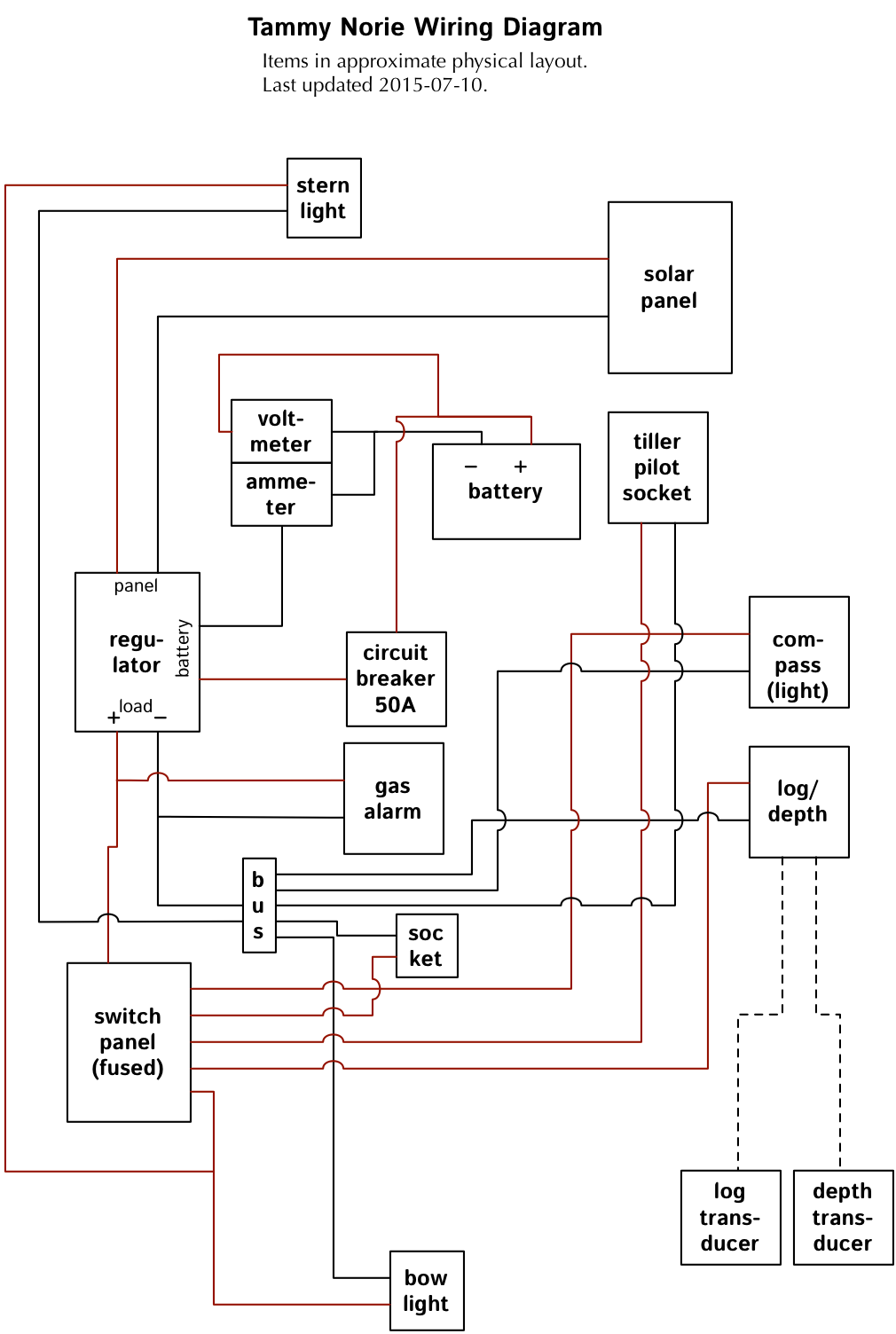
I've made this diagram for my blog, which includes how I wired up the volt/ammeter (almost the same as yours) as part of the general wiring. My boat is simple though — no engine, no bilge pumps, etc. — but you can see where I've put them in the scheme. My goal is to monitor battery voltage and drain.

See https://tammynorie.wordpress.com/2015/07/10/wiring-diagram/
 
Last edited:
I've made this diagram for my blog, which includes how I wired up the volt/ammeter (almost the same as yours) as part of the general wiring. My boat is simple though — no engine, no bilge pumps, etc. — but you can see where I've put them in the scheme. My goal is to monitor battery voltage and drain.

See https://tammynorie.wordpress.com/2015/07/10/wiring-diagram/

Your system works Ok with everything powered via the load terminals of the solar regulator ? Yes I suppose since it all falls within the 10A limit.
I would have ignored them and powered everything from the battery

should be able to display your wiring diagram easily enough

wiring.png
 
should be able to display your wiring diagram easily enough
<empty space>
Yes, I thought so too.

My boat is very low power. The regulator provides protection for the battery, cutting off the load if the battery voltage goes below 10.8V. This will save the battery if something is left switched on. And if I need something to keep running in an emergency I'll just do a quick rewire at the regulator — it's all easily in reach.

My dad killed my last battery by plugging in one of those Lidl coolboxes overnight. That should now be impossible. Admittedly he gave me the battery in the first place, so I can't really complain.
 
Last edited:
Top