How to remove an old water pump from the engine block?

I did not say whack the pulley - I said whack the pulley flange. It is a substantial piece of steel pressed tightly onto a 5/8 ish shaft. You wont break that with a length of hardwood and a hammer! If it wont shift any other way you are kinda captured, are you not?

If you do whack it and it does come off, if it is leaking as you say, the face seal is shot or the bearings are shot, so you will need a new one.

You can get the pulley flange pressed off to change the bearings and seal. A guy I know used a service kit for an East European light truck - Avia? - and used the face seal bits suitably modified for his particular water pump. The bearings were off the shelf.

Montego used a Perkins derived unit, not the old 2.2 BMC pushrod donk.

Dont be shy, tickling it wont work!


OK .... thanks, yet again!

Now ..... please excuse my deep, profound, ignorance of basic engineering terminology (sadly, we didn't cover flanges in my accountancy studies), but I think you mean that I need to 'whack' the pulley close to its centre (rather than its circumference)?

That is, of course, certainly what I would try to do, but I think getting some sort of relatively non-damaging drift near the centre will be extremely challenging, as the pulley sits quite close to the block, so space is very restricted. I'll take a closer look tomorrow.

The whole point of trying to remove the pump is so that the seals (water and oil), and the bearings can be replaced. They seem to be available from several sources.

Right, I need an early night to visualise tomorrow's challenges!
 
Last edited:
Have you unbolted the pulley? Usually 4 X 7/16 AF head UNF bolts.

With the pulley off, the thick flange it fixes to is of a much smaller diameter.

Of course you must not hit the thin pressed out and spot welded together pulley, that would be easily damaged.
 
You need to drive a wedge between the two faces of the pump and the engine block ideally in two or three well spaced areas so as to 'split' the gasket either through itself or from the face of the pump / engine block. The ideal tool is an old machine saw blade ground to a fine edge along its width which serves as a great wedge and also a scraper with which to clean the old gasket off the mating faces. In the absence of such a wedge the 'norm' is to sacrifice an old screw driver and drive that bit by bit with gentle taps in the gap occupied by the gasket so driving the two faces (pump ? engine block) apart slowly!
 
You need to drive a wedge between the two faces of the pump and the engine block ideally in two or three well spaced areas so as to 'split' the gasket either through itself or from the face of the pump / engine block. The ideal tool is an old machine saw blade ground to a fine edge along its width which serves as a great wedge and also a scraper with which to clean the old gasket off the mating faces. In the absence of such a wedge the 'norm' is to sacrifice an old screw driver and drive that bit by bit with gentle taps in the gap occupied by the gasket so driving the two faces (pump ? engine block) apart slowly!
I'm afraid that's not right. You run a real risk of damaging the faces. By all means use a wedge if you can find a suitable lump on the pump, just not on the faces.

The thread's getting quite hilarious. Just one decent whack would have had it off on Wednesday morning.
 
I did not say whack the pulley - I said whack the pulley flange. It is a substantial piece of steel pressed tightly onto a 5/8 ish shaft. You wont break that with a length of hardwood and a hammer! If it wont shift any other way you are kinda captured, are you not?

If you do whack it and it does come off, if it is leaking as you say, the face seal is shot or the bearings are shot, so you will need a new one.

You can get the pulley flange pressed off to change the bearings and seal. A guy I know used a service kit for an East European light truck - Avia? - and used the face seal bits suitably modified for his particular water pump. The bearings were off the shelf.

Montego used a Perkins derived unit, not the old 2.2 BMC pushrod donk.

Dont be shy, tickling it wont work!
Before we re-engined, we had one of these BMC 2.5s in the boat. The waterpump failed on us in Normandy and the faff dealing with the UK supplier for a replacement was a major impetus for replacing the engine.

I have dealt with a few leaky pumps and in service unfriendly parts of the world before, so the problem was not new to me.

The British supplier insisted I send them the old pump to be rebuilt as there were no replacements available. This meant we would be looking at a 6-8 week turnaround with shipping both ways while being stuck in Boulogne. I also thought the price for the rebuild rather steep, not to mention the additional shipping costs. They refused to just send me the bearing and seals.

So, I removed the pump, yes there are 4 bolts, yours is probably just stuck to the block, and after dealing with a sleaze bag of a harbour master who insisted that there was no diesel shop in Boulogne (biggest French fishing port on the Atlantic) and that his buddy would have to come down to tell me what was wrong with my engine while he translated (for a fee of course), I went across the road to the nearest atelier with my pump in hand.
There was an old fellow in the shop. He didn't speak English and my French is pretty rough, but he held out his greasy mitt to me, which I heartily shook to let him know I'm not afraid to get my hands dirty or associate with the working classes, and together we pressed out the bearing and seal at the hydraulic press where I would hand him the next tool before he asked for it and he knew that I knew what we were about. It took us an hour and for that he charged me the princely sum of 5 Euro. There was a chap who came in after me and while we were still chatting, and he, in a spotless French plaisanncier's outfit in modish pastels, declined to shake the offered had and I remember thinking that his bill will be no doubt considerably higher.

To the point: there are no standard bearings or seals in a BMC pump, at least none that were available in France or at the bearing specialist shop I went to next. The bearing man looked at the parts, mumbled something about "speciale", walked me out to the street and pointed down the road to a machine shop where, again, no one spoke English and I got to shake hands with every single, greasy-pawed employee. Here we re-designed my British pump to take two single bearings that fit the housing (instead of the single long one) and they would turn a new shaft to fit the new bearings' inside diametre and, best of all, they promised it by noon the next day.
Meanwhile, I cleaned up and painted the housing, hand-cut a new paper gasket and refurbished the ceramic seal by grinding it down and polishing it up with tooth paste on a piece of plate glass.
Noon the next day, I paid forty Euro for my new shaft & bearings, had it all pressed back together, gave the manager a bottle of decent red, shook hands in au revoir with all the employees and by two o'clock we were at sea again. The pump saw us out until we re-engined three years later.

All included, it cost me less than all the phone calls I had made to the UK to try and get some service. It also left me with quite some warm and fuzzy appreciation for French artisans who were extremely helpful, polite, willing to go the extra mile to make it happen, at a very reasonable cost, and graciously put up with my terrible French.
Be careful removing the pump in case you need it for a rebuild.
 
Just one decent whack would have had it off on Wednesday morning.

Knowledge and experience is a wonderful, confidence-inspiring thing ........ when you've got it!

Sadly, on this particular topic ....... I ain't!!!

Progress report: none.

I decided to focus on other things today, but, tomorrow? I'm going armed with, what an ignoramus like I calls, a bloody great hammer.
 
Last edited:
Knowledge and experience is a wonderful, confidence-inspiring thing ........ when you've got it!

Sadly, on this particular topic ....... I ain't!!!

Progress report: none.

I decided to focus on other things today, but, tomorrow? I'm going armed with, what an ignoramus like I calls, a bloody great hammer.
Way back when I was studying crystallography, one of my text books was "The New Science of Strong Materials". @JumbleDuck and I have often reminisced about it; it was one of the most amusing textbooks I had! But one chapter on adhesives and other means of joining things has the wonderful quote "When all else fails, use ruddy great nails!".

The discussion here has reminded me that there are times when a direct and unsubtle approach is appropriate!
 
Way back when I was studying crystallography, one of my text books was "The New Science of Strong Materials". @JumbleDuck and I have often reminisced about it; it was one of the most amusing textbooks I had! But one chapter on adhesives and other means of joining things has the wonderful quote "When all else fails, use ruddy great nails!".

The discussion here has reminded me that there are times when a direct and unsubtle approach is appropriate!

Oh yes ... subtle finesse V brute force ..... one of life's most challenging dichotomies, in so many scenarios!
 
Have you unbolted the pulley? Usually 4 X 7/16 AF head UNF bolts.

With the pulley off, the thick flange it fixes to is of a much smaller diameter.

Of course you must not hit the thin pressed out and spot welded together pulley, that would be easily damaged.

Damn, bugger and blast!

I've just got back from (yet) another unsuccessful session trying to separate the pump from the block.

I had a careful look round for handy lugs, or reliefs, on the pump body, to lever or hammer against: and found none.

So I thought I'd try Rotrax's suggestion of removing the pump's pulley.

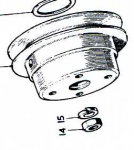
Hmmmm ....... the four 7/16 AF bolts are nowhere to be seen (just the bolt holes: exactly as shown below). I guess the function of those bolts is only to hold the fan-blades on the pulley when fitted in a radiator-cooled vehicle.

1637677231163.png


Presumably, the pump's 'flange' (that I want to try to hit) is the bit with four holes in (plus the bigger hole in its centre)?

Is the grooved bit, where the 'fan-belt' sits, separate from the flange? If it is, I can't see how to get the two bits apart.

Even if they were separated, I'm still not sure that there's room to give the flange a good, solid, horizontal 'whack'.

At that point, I decided to withdraw from the fray ......... and split my lower lip on the top of the secondary fuel filter. Very painful, lots of blood, and even more curses.

Ah well ......... The sun's shining, so I think a nice long run is called for to restore my equanimity.

If I can't shift the pump tomorrow, I'll have to admit defeat and call in someone who knows what they're doing (but I fear Rotrax's daily rate, + expenses, will be rather beyond budget).
 
Last edited:
Damn, bugger and blast!

I've just got back from (yet) another unsuccessful session trying to separate the pump from the block.

I had a careful look round for handy lugs, or reliefs, on the pump body, to lever or hammer against: and found none.

So I thought I'd try Rotrax's suggestion of removing the pump's pulley.

Hmmmm ....... the four 7/16 AF bolts are nowhere to be seen (just the bolt holes: exactly as shown below). I guess the function of those bolts is only to hold the fan-blades on the pulley when fitted in a radiator-cooled vehicle.

View attachment 126280


Presumably, the pump's 'flange' (that I want to try to hit) is the bit with four holes in (plus the bigger hole in its centre)?

Is the grooved bit, where the 'fan-belt' sits, separate from the flange? If it is, I can't see how to get the two bits apart.

Even if they were separated, I'm still not sure that there's room to give the flange a good, solid, horizontal 'whack'.

At that point, I decided to withdraw from the fray ......... and split my lower lip on the top of the secondary fuel filter. Very painful, lots of blood, and even more curses.

Ah well ......... The sun's shining, so I think a nice long run is called for to restore my equanimity.

If I can't shift the pump tomorrow, I'll have to admit defeat and call in someone who knows what they're doing (but I fear Rotrax's daily rate, + expenses, will be rather beyond budget).

Is yours exactly the same as the one in your picture Neil ? Does it have the nut in the centre, if so, have you removed it?
 
Not seen a pump like that on BMC 2.2 diesel before!

If the four holes are threaded that might well be the flange. As you say, for the fan blades in an automotive situation.

If the nut protrudes, fetch that a heavy blow with a piece of hardwood, in all directions, left, right and downwards - upwards if you have access.

Good luck!
 
Not seen a pump like that on BMC 2.2 diesel before!

If the four holes are threaded that might well be the flange. As you say, for the fan blades in an automotive situation.

If the nut protrudes, fetch that a heavy blow with a piece of hardwood, in all directions, left, right and downwards - upwards if you have access.

Good luck!

Good thought. If it doesn't protrude and it can't be undone and the pulley removed, perhaps put a socket into the hole, that does protrude and give that a good bash as you describe, but using a blunt chisel/drift.
 
Last edited:
Not seen a pump like that on BMC 2.2 diesel before!

If the four holes are threaded that might well be the flange. As you say, for the fan blades in an automotive situation.

If the nut protrudes, fetch that a heavy blow with a piece of hardwood, in all directions, left, right and downwards - upwards if you have access.

Good luck!

A million thank yous, again, rotrax.

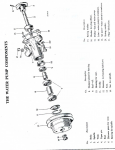
The pump looks exactly as in the pic (which is from the workshop manual: thanks again to vyv-cox for that).

Here's the whole pic:

1637690256157.png

The holes are threaded, and the nut in the centre does protrude.

So ....... that's another whacking day lined up for tomorrow
 
Last edited:
Good though. If it doesn't protrude and it can't be undone and the pully removed, perhaps put a socket into the hole, that does protrude and give that a good bash as you describe, but using a blunt chisel/drift.

Thanks for sharing your lateral-thinking Paul, but the nut does protrude.

If it does shift tomorrow, you'll probably be able to hear my screams of joy up in Suffolk.
 
Apologies ...... but yet another beginner's question .........

Is there any advantage to whacking the protruding nut, compared to whacking the side of the flange?

I have to admit that I've been trying to find a way of whacking the pump body forwards ie away from the crankcase, rather than up/ down or laterally.
 
Top