
How to pressurise fuel line to find air leak?

Keith-i

Well-Known Member
Joined
4 Jul 2012
Messages
1,474
Location
Jersey
Visit site
I've got a small air leak somewhere in my fuel line which results in a bubble of air collecting at the highest point in the line which happens to be just before the HPFP. There's no diesel leak apparent anywhere and it is not enough air to cause a problem running or starting the engine but its one of those little things I'd love to resolve in case it ever leads to a bigger problem.

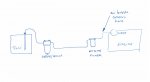
The attached sketch (not my best) shows the layout and the approximate heights of the main items relative to each other. Most of the line is rubber fuel hose, but there is a clear section just before the HPFP at the highest point which is where the air collects. As the fuel level in the tank is below the top of the engine filter and HPFP this part of the sytem would always be running under negative pressure in use. I've tightened all the connections and checked the obvious but to no avail. My suspicion is that it is somewhere downstream of the Separ filter.

Is there any practical way of pressurising the feed in the hope that any leak would show with diesel escaping? I think the practicalities of blocking off the tank vents, fill point and heater pickup would make pressurising the tank itself quite difficult.
 

Attachments

  • Fuel feed.jpg
    Fuel feed.jpg
    171.4 KB · Views: 53
How about a primer bulb before the primary filter, you can leave it in place and use it for bleeding the system. May need to block a downstream hose somewhere., preferably as far down the circuit as you can. It's also worth noting that return lines can allow air back into the system when it's at rest and as the pressure in the return circuit is under very little pressure with the engine running, they often don't leak diesel. If the spill pipes (from the injectors) are rubber, check them for damp spots.
 
I have twin fuel tanks, port and starboard. There's a cross connection pipe, so I can cross level by gravity. If I want to put all the remains fuel into the one tank, I block the breather on the tank to be emptied, and using the dinghy pump, and opening both tank valves, force the fuel across to the other tank. I'm sure you could do something similar to put a slight pressure in your supply pipework.
 
I would suggest pressurizing from the engine back, as you should have an isolation tap on the tank. The bubble is collecting before the HPFP, so it's somewhere between tank and engine (after the HPFP would result in a diesel leak).
So, take the line off the HPFP, turn off the tap at the tank and use a small hand pump (fender pump, bicycle pump etc) with a suitable (you may have to get inventive) fitting into the end of the HPFP line to seal it.

You don't need much pressure to find the leak. The vacuum is in the range of 2-3psi, do only 5-6 will be needed to find the leak. If it holds pressure fine, then the issue will be with the standpipe in the tank.

Tip - after you have pressurised it and found the leak, relieve the pressure by opening the tank valve, otherwise it has to come out your end of the pipe and you will end up with a shirt that smells of diesel - don't ask me how I know....!
 
How about a primer bulb before the primary filter, you can leave it in place and use it for bleeding the system. May need to block a downstream hose somewhere., preferably as far down the circuit as you can. It's also worth noting that return lines can allow air back into the system when it's at rest and as the pressure in the return circuit is under very little pressure with the engine running, they often don't leak diesel. If the spill pipes (from the injectors) are rubber, check them for damp spots.
Definitely the way to go. Revolutionised bleeding my system after filter changes.
 
How about a primer bulb before the primary filter, you can leave it in place and use it for bleeding the system. May need to block a downstream hose somewhere., preferably as far down the circuit as you can. It's also worth noting that return lines can allow air back into the system when it's at rest and as the pressure in the return circuit is under very little pressure with the engine running, they often don't leak diesel. If the spill pipes (from the injectors) are rubber, check them for damp spots.


I completely agree. I fitted a priming bulb just after the tank outlet shutoff valve that allowed me to pressurize the whole fuel system.

I had a leak on the input to my primary filter that would stop the engine running after about 10 minutes. I found it by pressurizing the line with my priming bulb
 
What are your fuel pipes made of and how old are they?
If copper (not sure how you see the bubble!) so that suggests clear plastic.
I would remove one section of the pipe at a time, give the unions a good clean and close inspection.
If it is clear plastic, then I would just replace the pipe and O rings.
If copper, check around the olives for stress fractures. When I had a leak that was the cause.
 
What are your fuel pipes made of and how old are they?
If copper (not sure how you see the bubble!) so that suggests clear plastic.
I would remove one section of the pipe at a time, give the unions a good clean and close inspection.
If it is clear plastic, then I would just replace the pipe and O rings.
If copper, check around the olives for stress fractures. When I had a leak that was the cause.

I would hope that there is not any clear plastic hoses in the fuel system, as you say if there is these need changing urgently for proper marine grade fuel hose & fittings.
 
What are your fuel pipes made of and how old are they?

I would hope that there is not any clear plastic hoses in the fuel system, as you say if there is these need changing urgently for proper marine grade fuel hose & fittings.

Pay attention at the back, from post #1

"Most of the line is rubber fuel hose, but there is a clear section just before the HPFP at the highest point which is where the air collects "
 
I would suggest pressurizing from the engine back, as you should have an isolation tap on the tank. The bubble is collecting before the HPFP, so it's somewhere between tank and engine (after the HPFP would result in a diesel leak).

An exception to that might be a return pipe, low pressure so might not leak, but could allow air back in at rest.
 
Pay attention at the back, from post #1

"Most of the line is rubber fuel hose, but there is a clear section just before the HPFP at the highest point which is where the air collects "

;) noted, thanks. I'll try to wake up now - maybe the reference to clear hose mortified me so much I scrubbed it from my mind! That is the first thing I would ditch, as well as any unnecessary joins or connectors in the line. Every joint is a potential source of leak..
 
An exception to that might be a return pipe, low pressure so might not leak, but could allow air back in at rest.

It could do, but I doubt that could get past the HPFP as they usually have check valves upstream to prevent them from draining back.

Air leaking in through the return line usually manifests itself as air at the injectors / in the HP fuel side, but this does depend on where/how the return line is routed as i've no doubt you well know.

edited to add: One benefit of pressurising the feed side from HPFP back to tank it it either confirms or eliminates a huge chunk of the fuel system in one go. If no leaks are found, it's then a case of investigating the return line and standpipe (if the return is connected or has a route through the feed circuit one method could be to isolate the valve on the suction side at the tank as I mentioned earlier, and then just pressurise the entire feed & return line via the return hose connection at the tank)
 
It could do, but I doubt that could get past the HPFP as they usually have check valves upstream to prevent them from draining back.

Air leaking in through the return line usually manifests itself as air at the injectors / in the HP fuel side, but this does depend on where/how the return line is routed as i've no doubt you well know.

Yep, all true. He might even have steel return lines, which are lass likely to leak. I've know some engine with rubber spill pipes to let air back into the system and cause poor starting, mostly on car engines though.
 
Lots of helpful ideas, thanks. All parts of the fuel feed are roughly 7 years or younger. I replaced everything from the Separ up to the HPFP a couple of years ago when I last tried to tackle this issue and also the pipe between tank pickup and Separ including the shutoff valve last year. Threaded joints are sealed with Loctite 577 and pipes are clamped onto hose tails with jubilee or similar.

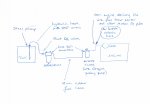
The attached annotated diagram shows the various components with a bit more detail. From the engine filter onwards it is all VW/Mercruiser oem fit which is the section that has the clear pipe in it (presumably to check when its been bled). The fuel filter has a built in priming pump so there is no need for any permanent additional priming bulb or pump.

It looks like the bubbles rise up from the engine filter as you can see air being pulled along when you start the engine. On this basis I'm thinking it is located towards the engine end of things rather than the tank end and as such I'd rather somehow pressurise from the tank end to identify the leak point as otherwise I might disturb the leak and never find the culprit if I start dismantling at the engine end.

The return pipe runs from the fuel rail (common rail) straight back to the tank so I don't think it could be a culprit.
 

Attachments

  • Fuel feed 2.jpg
    Fuel feed 2.jpg
    368.9 KB · Views: 21
Last edited:
Lots of helpful ideas, thanks. All parts of the fuel feed are roughly 7 years or younger. I replaced everything from the Separ up to the HPFP a couple of years ago when I last tried to tackle this issue and also the pipe between tank pickup and Separ including the shutoff valve last year. Threaded joints are sealed with Loctite 577 and pipes are clamped onto hose tails with jubilee or similar.

The attached annotated diagram shows the various components with a bit more detail. From the engine filter onwards it is all VW/Mercruiser oem fit which is the section that has the clear pipe in it (presumably to check when its been bled). The fuel filter has a built in priming pump so there is no need for any permanent additional priming bulb or pump.

It looks like the bubbles rise up from the engine filter as you can see air being pulled along when you start the engine. On this basis I'm thinking it is located towards the engine end of things rather than the tank end and as such I'd rather somehow pressurise from the tank end to identify the leak point as otherwise I might disturb the leak and never find the culprit if I start dismantling at the engine end.

Thanks Keith.

I get what you are saying, and don't disagree, but you may find it is very difficult to find a place to shut off the fuel lines at the engine end, and may end up needing to take off a connection in order to achieve this.

I used to have to do this quite a lot (worked for MAN and VP dealers as a commissioning engineer for their OEM's) and we used to get fuel leaks on new installs that were often tricky to find. The common method was to pressurise from the engine back to the tank as it is quickest and easiest, however a set of pipe clamps are needed if you want to do it the other way. It is almost impossible to properly seal a solid line as you need the right end connector - remember that if you have leaking pressure you may chase the lines just to find out it is a bad seal at the end of the pipe.

The air will always collect in the highest point of the line, irrespective of where it is coming from, so you may well be correct in your assumption but whilst going through this effort you may just as well check the entire fuel line and all the elements - you may find another weak point or even multiple leaks - it has been known!
 
Can you break the length of the feed into discreet sections say after the first filter up to where the air bubble appears, bung the one end and pressurise with a foot pump, any air leaks may be spotted with soapy water.

This is an interesting problem, I have a super small leak of diesel on a common rail doesn't cause a problem just can't find the cause, replaced pipes etc still appears after a few days.
Interested in your solution.
 
The common method was to pressurise from the engine back to the tank as it is quickest and easiest, however a set of pipe clamps are needed if you want to do it the other way. It is almost impossible to properly seal a solid line as you need the right end connector - remember that if you have leaking pressure you may chase the lines just to find out it is a bad seal at the end of the pipe.
Will the HPFP allow fuel to leak through if I pressurise from the tank end? I'm guessing it would hold a low test pressure because the other side of the HPFP the fuel rails are at some pretty high pressure like 300 bar. Unless I somehow managed to exceed this I would have thought the return line would remain closed.

The difficulty I have is that I would rather not disturb the connection on the HPFP, partly because it is very awkward to get to and partly because it is a banjo so I'm not sure how I would connect some form of pressure testing pump onto it .

Given the added info, it would look at the seals on the priming pump.
But the joints from rubber hose to clear hose has also to be suspect.
I did replace the filter holder (with integral priming pump) just in case but it made no difference. So although not entirely ruled out as a cause (the new one could also have been duff), it seems unlikely. Similarly I replaced the section of line with the clear hose in. This is a factory produced part that runs from the filter/primer pump on to a temp sender in rubber and then from the temp sender onto the HPFP. The connection on the HPFP is a banjo type. The section of clear tubing within its length is factory crimped. Thinking about it, I'm pretty confident this part doesn't leak as its downstream of the priming pump which I can pump and pressurise without any leaks showing.
 
Will the HPFP allow fuel to leak through if I pressurise from the tank end? I'm guessing it would hold a low test pressure because the other side of the HPFP the fuel rails are at some pretty high pressure like 300 bar. Unless I somehow managed to exceed this I would have thought the return line would remain closed.

The difficulty I have is that I would rather not disturb the connection on the HPFP, partly because it is very awkward to get to and partly because it is a banjo so I'm not sure how I would connect some form of pressure testing pump onto it .

Noted. In that case with solid lines and a banjo fitting it won't be very easy. I am not sure about how the HPFP is on your engine, but normally they are a vane pump so fuel could leak past potentially. The entire fuel system is designed to allow fuel to get to the engine easily, so I am not sure how easily it would hold up under pressure.

The suggestion above sounds like a sensible one - break the fuel line into sections and test them each.

Good luck!
 
Top