How to power a laptop

Cheeky Girl

Well-Known Member
Joined
23 Feb 2004
Messages
298
Location
Stirling, Scotland
Visit site
Hi
Whats the best way to power a laptop when not connected to the shore power?
I have a small invertor that I sometimes use in the car for this. Is this the best way?

Thanks for any suggestions.
 
Something like this 90 Watt DC Universal Laptop Car Charger Inverter for Computer Asus Acer Dell HP Lenovo Sony Sumsung Toshiba Battery Power Supply 18.5V 19V 20V w/Dual USB 5V 2.1A 1A for Smart Cell Phone Tablet PSU 90 Watt DC Universal Laptop Car Charger Inverter for: Amazon.co.uk: Electronics would work if the laptop doesn’t have too much current draw. This one Hama | Laptop Power Supply For Car Use, Universal, 120 W https://www.amazon.co.uk/dp/B0002W6C2G/ref=cm_sw_r_cp_tai_aaWPEbV0AF70H is if your laptop needs more than 90 watts.

I‘ve used one of the second type and found it works fine. Alternatively, a suitable inverter will work fine but you’re stepping the voltage up only to step it down again for the laptop.
 
I have a 12v 'Lavolta' adaptor that plugs into a cig lighter socket for my Dell - works a treat. There is a dedicated cig lighter socket powered directly from the service battery just for this purpose. It minimises RFI so that I can listen to the radio while tapping away.
 
One of these universal adapters with variable output voltage that you match to the output of your computer's mains supply - check the black box, it'll be around 20 volts. I use these to power laptop and to charge HH VHF from 12v cigarette socket. This will be more efficient than using an inverter...
 
Definitely avoid an inverter. They are inefficient and power supplies hate the cheap ones. I suggest you check whether a 12V power supply is available for your computer - I have them for Thinkpads and the Dell Chromebook which I now use on board.
 
Definitely avoid an inverter. They are inefficient and power supplies hate the cheap ones. I suggest you check whether a 12V power supply is available for your computer - I have them for Thinkpads and the Dell Chromebook which I now use on board.

I think this is poor advice. By all means avoid cheap inverters for all sorts of reasons, of which reliability, fire-hazard and RFI are important. But pretty much all power adapters for charging first rectify the mains to DC, using a bridge. Then they use a rather trivial buck converter to generate the Voltage required (anywhere between about 7 and 20 V depending on model of PC). Thus the waveform of the AC is pretty much immaterial. Don't get hung up about it.

Efficiency: my laptop - on which I'm typing this - has a 55 Whr battery. The worst inverter is about 85% efficiency, and the best around 95%. Let's take the lower figure and do some sums, assuming (I rather doubt it) that you charge from 0% to 100%. 55Whrs X (.95 - .85) = 5.5Whrs. From a 12.4V battery (mid charge) that's 5.5 / 12.4 = 0.44 Ahrs. OMG, that'll make all the difference to your battery bank...
 
If you have something that works in your car, it will work on the boat. But a proper DC-DC charger is more efficient. I've tried both, and even though I'm a tight git I found it £20 well spent to get a proper 12v PSU for my laptop.
 
I always try to get an OEM 12 volt charger for my laptops - Dell makes them, and i'm sure others do as well.

Newer laptops are fairly finicky about charging, and if you are depending on the thing it's best not to screw around with non-OEM solutions unless you must. And, i don't feel that way generally - it's just that I hate having charging problems with laptops.
 
You don't say what dc voltage your laptop runs off of.
Some laptops will run direct off a boat 12v supply, then all you have to do is make up a power cable.
You can also buy dc to dc step up power converters - where is Maplins when you need them :)
 
I think this is poor advice. By all means avoid cheap inverters for all sorts of reasons, of which reliability, fire-hazard and RFI are important. But pretty much all power adapters for charging first rectify the mains to DC, using a bridge. Then they use a rather trivial buck converter to generate the Voltage required (anywhere between about 7 and 20 V depending on model of PC). Thus the waveform of the AC is pretty much immaterial. Don't get hung up about it.

I write from experience. My official IBM Thinkpad chargers hated running from a cheap ("beer can") invertor, as did my phone charger. They worked, after a fashion, but kept cutting in and out.

Efficiency: my laptop - on which I'm typing this - has a 55 Whr battery. The worst inverter is about 85% efficiency, and the best around 95%. Let's take the lower figure and do some sums, assuming (I rather doubt it) that you charge from 0% to 100%. 55Whrs X (.95 - .85) = 5.5Whrs. From a 12.4V battery (mid charge) that's 5.5 / 12.4 = 0.44 Ahrs. OMG, that'll make all the difference to your battery bank...

Again, I could see the effect on my battery of needlessly generating 240V AC in the middle of the process. Direct DC-DC conversion definite has less effect,

Inverter plus mains charger is OK, and I still have the beer can on board for visitors, but DC-DC is much neater.
 
Invertors have a fixed as well as variable overhead and become far less efficient the closer they get to their rating. I really want to try to avoid using them for long running loads (like working all day on a laptop) on my new boat unless I'm on shore power. Cheapo low wattage invertors are also a bit of a fire risk. TMy previous boat was 24V, and the step down to 12V was probably less efficient than the Mastervolt (around 80% vs 95%) with another device stepping up in the way too.
 
I complete agree with the advice to avoid cheapo inverters, but this applies to almost all equipment in all walks of life!

I think the issue depends very much on the size of boat, its other electrical equipment and generation capacity. My custom, which suits me but may not suit all, is, when coming aboard, to turn on the instruments and autopilot (maybe 0.5A with radar off), the VHF (ditto), the fridge (2 - 4A depending on external temp) and the 110V inverter which supplies a few to sockets for charging things (0.24A according to the data sheet).

So the inverter adds 0.24/(0.24+0.5+0.5+(2+4)/2) = 6% to the load when at anchor or on the mooring. Lest you're wondering why 110V, I just think it a bit safer to have 110V on all the time, a bit like UK building sites. The boat was built in the UK and shore power and so normal mains sockets are 230V, which are used for any load above about 200W.

Another way to look at it is that we have a couple of 100W solar, so the extra 3W or so of the unloaded inverter is not that important.
 
So in summary:
Typical laptop requirement these days is 18-20 volts. If you have a laptop that is natively 12 Volts DC then you are quids in.
For the rest of us:
Option 1: convert from 12 volts dc to 240 AC . (incur losses) Then convert from 240 V Ac to 18 VDC (incur losses)
Option 2 : DC to DC converter from 12VDC to 18 VDC. (incur losses))

Thing is that efficiencies from option 1 need to be really high to compete with option 2.
Say for example that all conversion efficiencies above were 80%
Then option 1 will take 1/(0.8x0.8) = 1/0.64 = 1.5624 x laptop power requirement from your battery.
Option 2 will take 1/0.8 = 1.25 x laptop power requirement from your battery.*

Conclusions:
1. Efficiencies matter a lot!
2. Minimising the number of conversion steps will help reduce power losses .
(I know there may be conversion steps within the voltage conversion black box, but it is the external nameplate conversion efficiency that we are concerned with.)

Postscript : Dell and others supply as standard an AC power supply that works from 100 Volts to 240 Volts. i.e same power supply can be used in USA and UK, just change the plug. I suspect based on subjective evaluation of heat production of these units at differing supply voltages that the power supply may be more efficient at american 110 volts. If you want to use an inverter, maybe you would be better off with a 110 Volt unit.

Regards
John
 
I don't know if that's the best way but it's what I do and it works OK.

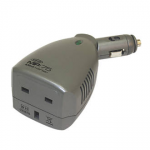
Mine is like this:

Ring Mini Inverter 12V

View attachment 89259
I had one of those (excellent)and one day I was lost between Portsmouth and Manchester and I did not have a sat nav so I powered up my laptop (with no internet) and as I had Autoroute on my laptop I was able to work out where I was and get a route sorted out.
When I bought mine it was £9 not £24 as sold by Ring. who I believe have been taken over.
 
The best way is to get a DC to DC converter. There are potted sealed units available on Ebay. Efficient, cheap, silent and marine proof. I’ve got them all over the place.
 
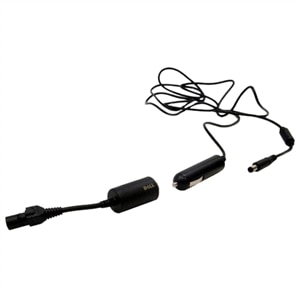
I use these:

Dell 90-Watt AutoAir Adapter | Dell UK

I paid much less on ebay - dell OEM, for my dell laptops

I am a racing navigator, and have used them for 1000's of ocean miles - I have never found the need for a portable inverter, and i avoid them. This unit works very well. my main problem is that increasingly boats don't have cigarette adapters - although they are easy to fit. Some larger boats now run built-in inverters 24/7 - in that case, i just plug in to AC. in some cases a 24-12volt converter might be needed. I think at least one boat had that.

450-AELT.jpg
 
Last edited by a moderator:
Top