How to mount stanchions?

Geem
How do you know what weight glass cloth I am using?:). I don't think I need anything like 6mm (¼ in.)
I'll start laying up and continue until I think the strength is adequate.

I could of course lay it up in a "U" shape which would give it extra strength.
I don't know what you are using but common sense when laying up flat glass sheets to make backing pads is you would use heavy cloth. Probably the heaviest cloth you are likely to use when boat building. From experience, the heaviest cloth most supplier carry. It's quicker to do than say using 7 oz cloth that will take 20 layers or so to get to something substantial enough for the job in hand. Good luck
 
I bought my boat to use it.
As I do.
But I tend to "use" not "abuse". I find that things tend to last longer & look nicer that way. It is just a question of pride I take in my boat.
But to each his own & It is not for me to say that you are right or wrong in what you do. I only expressed my method for the wider audience to consider - or not- as they wish.
 
As I do.
But I tend to "use" not "abuse". I find that things tend to last longer & look nicer that way. It is just a question of pride I take in my boat.
But to each his own & It is not for me to say that you are right or wrong in what you do. I only expressed my method for the wider audience to consider - or not- as they wish.
Agreed. It may come down to robustness of each installation. I was fortunate enough to be able to specify my toerail. Substantial aluminium extrusion with M8 bolts every 100mm along the toerail. Beefy stanchion bases bolted to toerail upstand with two M6 bolts and then a single M8 bolts through the base, toerail and solid glass section of deck. The use or as you describe 'abuse' was discussed with the manufacturer of the toerail and supplier of stanchions/bases so they were fully aware of how they would be loaded. If you design for it, it isn't abuse
 
Clearly you have already decided on what path to take - that is your perogative- so further comment is only creating unnecessary animosity.
I would make the point, however, that the question of money never crossed my mind. It was certainly not meant to create a dispute, Only point something out that may have been missed.

I'll try again (I just lost my reply)
There is certainly no animosity on my part! :) The point I was trying to make that he wouldn't lie as we are talking about a pittance in cost. I'm against SS because of the weight and cost.

I'm listening to you guys and that is why I started the thread. My thoughts have evolved since reading your posts and I am now considering f/g beams just like this. (hope I don't lose my reply this time. I'll take a copy just in case )

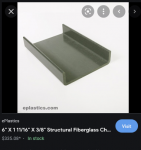
What do you think of this? (They would be very easy to make. I could churn out X3 one foot long channels per layup)

Screenshot 2021-09-28 at 18-35-32 fiberglass channel beam - Google Search.png
 
Last edited:
Bloody hell, talk about over thinking. You have been given lots of information from many people that concurs, is supported by West Epoxy Repair Guides and a link to a site that describes a water tight solution. Just get on with it. You are sailing a tub, the extra weight difference between GRP and stainless, and the cost difference, is negligible. As we say in Scotland, your now fannying about!
 
Bloody hell, talk about over thinking. You have been given lots of information from many people that concurs, is supported by West Epoxy Repair Guides and a link to a site that describes a water tight solution. Just get on with it. You are sailing a tub, the extra weight difference between GRP and stainless, and the cost difference, is negligible. As we say in Scotland, your now fannying about!
When you build a yacht you are always wary of unnecessary weight: it all adds up.
I've seen a yacht of the same design as mine just about dragging the transom in the water because they installed a larger motor than the hull was designed for.

What has "West Epoxy Repair Guides" got to do with my plans?:unsure:
 
When you build a yacht you are always wary of unnecessary weight: it all adds up.
I've seen a yacht of the same design as mine just about dragging the transom in the water because they installed a larger motor than the hull was designed for.

What has "West Epoxy Repair Guides" got to do with my plans?:unsure:

It would be worth downloading their free guides. They show how mounting hardware through cored decks can be done securely, and many other relevant topics. The advise given on here concurs with what West claim is good practise. As someone who has done a lot of DIY on boats, the West Guides are good sources of information on GRP work. I am surprised that you don’t know about them as they usually pop up when googling for advice.

That’s what they have to do with your plans.
 
How much does a piece of 5mm ally plate weigh, or a piece of 3mm stainless plate, against a 6mm piece of GRP of the same size ?
The difficulty with both of these materials is they are hard or very hard to drill insitu. It is possible to pre-drill them but then getting them in the correct place can be tricky. I would go the grp route for this reason. Having had to re-drill the aluminium backing pads that I are glassed in to my deck to reinforce the Genoa tracks, I can confirm that drilling through grp then in to aluminium is a complete nightmare. The grp blunts the drill bit. We had to sharpen drill bits a hundred times.
 
Can I ask who does your shoe laces up for you each morning? :rolleyes:

You don’t need permission to ask, as you have just asked. Indirect insults, another symptom of fannying about, as you can’t get to the point.

In case you think I am insulting you, the term fannying is based on the Victorian fan etiquette. They used all sorts of complex styles of fan use and manipulation to communicate social messages, that could have just been made by saying No, or Yes. Hence the term, fannying about.
 
This is one of those funny threads where the general consensus is fairly agreed, but the OP decides to do something different. The result is a forgone conclusion.

I know I wouldn't bother wasting time with plastic/grp backing pads, o-rings to seal or any of that faff & hassle, but good luck to the OP.
 
The difficulty with both of these materials is they are hard or very hard to drill insitu. It is possible to pre-drill them but then getting them in the correct place can be tricky. I would go the grp route for this reason. Having had to re-drill the aluminium backing pads that I are glassed in to my deck to reinforce the Genoa tracks, I can confirm that drilling through grp then in to aluminium is a complete nightmare. The grp blunts the drill bit. We had to sharpen drill bits a hundred times.

Drill oversize (clearance) holes in the backing plates, then use a form A or form C washer between the backing plate and nut. It's a fairly well tried & tested method. It's what I would do with SS. For alu, I've never had a problem with drilling through GRP then alu sheet up to 5mm, so not sure what the issue was with yours - was there other material there (some hulls have kevlar woven in)?
 
This is one of those funny threads where the general consensus is fairly agreed, but the OP decides to do something different. The result is a forgone conclusion.

I know I wouldn't bother wasting time with plastic/grp backing pads, o-rings to seal or any of that faff & hassle, but good luck to the OP.

My stanchion bases are fitted to deck with with three M6 machine screws, with penny washers under the deckhead. Some sealant between the base and the deck and the nuts and washer are lightly glassed over. They have not leaked in the 40 years since the boat was built. If i was to refit them i'd likely make some ally backing plates and fit as you describe in post #55. Some people do seem to like over thinking things.
 
How much does a piece of 5mm ally plate weigh, or a piece of 3mm stainless plate, against a 6mm piece of GRP of the same size ?

I'm pretty sure if I skipped breakfast for a couple of days it would make up for it.

If I wanted to reduce the installation weight I'd start with those stanchions that look somewhat agricultural for a weight saving application.
 
I'm pretty sure if I skipped breakfast for a couple of days it would make up for it.

If I wanted to reduce the installation weight I'd start with those stanchions that look somewhat agricultural for a weight saving application.

How can you say that when you don't know wall thickness?:rolleyes:
 
Top