
How to mount stanchions?

coopec

N/A
Joined
23 Nov 2013
Messages
5,211
Visit site
I have 900mm stanchions which must be bolted to a cored deck. (Where the stanchions are located there is ply pad insert)
In an attempt to avoid leaks I had planned to insert a neoprene gasket between the stanchion base and deck with butyl around the bolt holes.
Screenshot 2021-09-27 at 11-42-21 2 x Neoprene Rubber Sheet 300mm x 215mm x 1 5mm Gasket Mater...png

(The mounting bolts will be torqued up quite firmly)
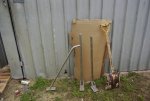
imgonline-com-ua-resize-uh3mEjO8pa.jpg

Will this avoid leaks? Is there a better method?
Advice will be appreciated.
 
I have 900mm stanchions which must be bolted to a cored deck. (Where the stanchions are located there is ply pad insert)
In an attempt to avoid leaks I had planned to insert a neoprene gasket between the stanchion base and deck with butyl around the bolt holes.

View attachment 123161

(The mounting bolts will be torqued up quite firmly)

View attachment 123162

Will this avoid leaks? Is there a better method?
Advice will be appreciated.
Do you have an aluminium toerail? My stanchions bolt to the toerail and through it. Super strong. My experience of stanchions bolted through decks is that the eventually leak if they get leaned on
 
Do you have an aluminium toerail? My stanchions bolt to the toerail and through it. Super strong. My experience of stanchions bolted through decks is that the eventually leak if they get leaned on

No my toe-rail is fiber glass- timber capped. But it is only about 60mmhigh anyway. Yes, potential leaks worry me.

I have any amount of 10mm black PTFE sheeting from which I could make a large "backing plates" (say) 10cm X 20cm to spread the load on the deck. (There is no "give" in the deck at all if you jumped on it)
 
I would get some thin epoxy into the drill holes in the ply before bolting down. Possibly even overdrill, fill with epoxy and re-drill. I would not trust PTFE as a backing plate: I'd prefer a hefty alloy plate or epoxied ply, if ply ideally tapered at the edges and glassed or epoxied to the underside. Looks like you are trying to do a better job than most production boatbuilders, which is good.
 
With almost 1m of leverage you're going to want something exceptionally strong and pretty large under the deck. I agree with jwilson that PTFE is not sufficient and arguably ply is also insufficient. Imagine your bolt with a 90cm crowbar and all your weight leaning on the end of it. Then imagine instead of pulling the end of the crowbar you jumped on it!
Not sure I'd bother with the neoprene, just plenty of whatever sealant you like best
 
Drill/fill/drill, even with ply. Eventually movement will allow a leak and the ply will rot, so best to start off with a solid epoxy core section. I also advocate a stainless steel backing plate.

I would advise ditching the neoprene gasket and go with butyl bedding tape for the stanchion base and bolts. The gasket will allow an amount of flex, which may be greater than you think at 900mm up (and could be quite disconcerting, even if fine). It will also break down/ease up over time.

Stanchions get a very hard life so the best you can do to solidly mount them is better, IMO.
 
With almost 1m of leverage you're going to want something exceptionally strong and pretty large under the deck. I agree with jwilson that PTFE is not sufficient and arguably ply is also insufficient. Imagine your bolt with a 90cm crowbar and all your weight leaning on the end of it. Then imagine instead of pulling the end of the crowbar you jumped on it!
Not sure I'd bother with the neoprene, just plenty of whatever sealant you like best

Yes I agree it has to be installed to take tremendous forces. Stanchions seem to be a problem on non steel/aluminum yachts.
Maybe keeping the lifelines taut will help. I will consider bigger backing "plates". Thanks
 
The neoprene is not a good idea as it will likely trap moisture by flexing sufficiently to allow a small gap to open and close. I would use butyl on the base. Rebedding Deck Hardware With Bed-It Butyl Tape - Marine How To

Apply Butyl Tape To Hardware Base

Step 5 – Apply a thin layer of marine butyl tape to the rest of the base. It is perfectly ok to stretch and pull on the butyl while laying it on in order to make slightly thinner. The tape I use, Bed-It Tape, is 1/2″ wide by 1/16″ thick and is specifically formulated for sealing deck hardware. I make Bed-It Tape available for purchasing for the readers of this site.

I have been using this method when hardware has to be refastened on my boat, so far, it has been working well on brackets for the wind generator and deck eyes for the spinnaker sheet blocks.
 
This is outside my range of experience but is it not the case that the cored deck will be the cause of problems unless the gap is filled with something solid?
 
I like the idea of the neoprene. It can be glued. It will possibly allow some movement. However, unlike butyl it will not be extruded over time but return to its original position, thus retaining its restance to leaks. It depends on the butyl. I would not use thick tape but an extruded mastic that would be very thin once the base had been tightened up.

Comments about applying massive pressure to the stanchion may sound reasonable but in 18 years I do not think that I have ever placed much weight on mine. I did bend one once when it caught on a dock wall as I moved foreward. But that was all. Most of the time they really just give a feeling of security as I run my hand along the top wire when moving along the deck.
Climbing aboard from a dinghy can be undertaken opposite a shroud or the stern. If someone goes overboard that is a different situation & the post would get repaired later anyway. Someone falling against a guardrail does not happen that often & the wires stretch across more than one stanchion. The worse case most encounter, is an idiot heaving themselves out of a dinghy by swinging on the rail. That is easy to stop.

So I think that one can overthink the weight problem, especially as , from the picture, the OP has decent plates to the posts.
As for bolting through the deck the OP could over drill the holes by 2.5 * diameter & fill with west epoxy, so it soaks into the ply. That will give room to get the epoxy into the hole & agitate it. Then when fully cured drill & bolt down with a sika mastic to the bolts making sure that the hole is well filled around the bolt.
On the underside a plate bedded on some epoxy with filler to ensure even loading would be best. Although a couple of SS straps across pairs of bolts would be far easier & possibly just as good
 
This is outside my range of experience but is it not the case that the cored deck will be the cause of problems unless the gap is filled with something solid?

From my understanding of the OP, the core has been removed where the stanchions bolt down, and replaced with a ply pad. This is quite common for cored decks where fittings will go.

The challenge with stanchions is that the leverage is so great that it is almost inevitable they will loosen over time, so doing something proactively now to protect the ply, and fitting a big metal packing pad can only help ?
 
With almost 1m of leverage you're going to want something exceptionally strong and pretty large under the deck. I agree with jwilson that PTFE is not sufficient and arguably ply is also insufficient. Imagine your bolt with a 90cm crowbar and all your weight leaning on the end of it. Then imagine instead of pulling the end of the crowbar you jumped on it!
When is one ever going to get that situation & how often?
 
Stanchions are problematic, and I tend to think that it's not actually possible on a fibreglass boat to mount them as strongly as one would wish. In a heavy fall (from windward rail down to leeward while heeled well over) I expect them to work like motorway Armco posts - hold the wires in position to catch you, then bend or break as the load is taken at the ends of the wires. They may also get bent or strained inwards during some kind of berthing cockup (yours or someone else's), and you may also have guests who insist on levering themselves aboard using the guardrails, despite being asked not to.

Given the above, I would treat leaks from a through-bolted stanchion base as something to keep out as long as possible, but which can't be avoided forever. So you need to make sure that when they do leak, it won't compromise the deck structure. That means drilling the holes oversize, filling them with thickened epoxy, then redrilling the proper size through the filled part. That way no water can migrate into the deck core from the hole. I would also give a thought to future access when building the interior. They don't need instantly-removable access hatches, but nor should it require dismantling half the boat to get at the fixings.

Pete
 
This is outside my range of experience but is it not the case that the cored deck will be the cause of problems unless the gap is filled with something solid?
Thanks John. Yes it has 20mm Marine ply inserted where the core normally is so it can easily take the "crushing effect" of highly torqued bolts. But as other have stated the loads on a stanchion are enormous if they have to stop the full weight of a person.

I have just come across a thread on another forum and they echo pretty much what OP are saying on this thread! I'll have to take very careful notice of what people are saying. They suggest using G10 as a backing plate. They also discuss the use (for/agains)t of neoprene gasket:D
 
But the OP said that the deck is cored with plywood where the fixings go. Is that not solid enough?

It's strong enough, but I'd want something that's impervious to water. Ply is better than balsa, but on our previous boat I dug out and replaced a ply deck pad that had the consistency of spongecake due to water ingress.

Pete
 
But the OP said that the deck is cored with plywood where the fixings go. Is that not solid enough?
It should be, but even marine ply won't last if it gets wet and stays wet. The trick is to drill the holes oversize, soak the exposed ply with thin epoxy and fill the hole with thickened epoxy. Now drill through the epoxy for the mounting bolts. I'd then countersink the holes and fill the countersink with butyl sealant. That'll give you the best chance of avoiding leaks. On a small boat, penny washers may be adequate underneath, but a SS plate would be stronger if it's practicable.
 
It should be, but even marine ply won't last if it gets wet and stays wet. The trick is to drill the holes oversize, soak the exposed ply with thin epoxy and fill the hole with thickened epoxy. Now drill through the epoxy for the mounting bolts. I'd then countersink the holes and fill the countersink with butyl sealant. That'll give you the best chance of avoiding leaks. On a small boat, penny washers may be adequate underneath, but a SS plate would be stronger if it's practicable.
Really??
Hmm-- Clearly the last part of post #10 was totally wrong then :eek:
Or was it?:rolleyes:
 
My final tuppenceworth - I want my stanchion bases solid, so that the weak point in the case of an issue (flogging sheets, big wave, caught on a dockline, a heavy-handed well-meaning "helper", etc, etc, etc) would be the stanchion bends and doesn't compromise the mounting.
 
- Drill holes oversized & fill with thickened epoxy. Then redrill correct size. This seals the core & prevents water damage.
- Make up suitable backing pad. Aluminium & SS works. I would use G10 if possible. Good guide for thickness is the diameter of fasteners. (when using G10, stainless gets away with less)
- If using G10 its preferable to taper it at the edges. This reduces the chances of cracking around it
- Bonding them to the underside of the deck with thickened epoxy will not only take care or surface irregularities but also increase the strength

Or just drill & bolt them on, with penny washers. That's what most boat builders did in the past. Bonus points if you encapsulate the nuts.
 
Top