How to clean a fuel tank with no inspection hatch?

Cardo

Well-Known Member
Joined
3 Oct 2005
Messages
4,231
Location
In a plastic tub!
www.yacht-tinkerbell.co.uk
We got caught out in some real rolly stuff the other day, the biggest swell we've encountered so far. Boat was tipping over to some quite extreme angles. First time we've had our LJs on and been clipped on!

Unfortunately, even though the swell was huge, there was no wind, so motoring it was.

The following day as we were motoring along in far milder stuff, I discovered the engine would start hunting when I revved her up to the higher end of the spectrum. I've experienced this before, so knew it was likely to be fuel starvation.

Once we'd arrived at our destination, I changed both fuel filters (CAV and engine). Both looked grim. I then pumped some fuel into a bowl, and the first couple of bowls full were really grubby, with loads of black crud mixed in with the fuel. The rolly stuff from the other day had clearly mixed up the crud from the bottom of the tank and a fair quantity of this had been sucked into the outlet.

Everything's working as normal now, but I'm concerned we could once again have issues if we get caught out in some nasty stuff. I'm also not massively keen on replacing fuel filters each time we go through a bumpy patch.

So, after that tail of woe, the query, as per the title of this thread, is thus:

Our stainless steel fuel tank doesn't have an inspection hatch. Only various "inlets" (filler, return fuel, Eberspacher pickup, breather) on the top and a single outlet on the side approx 5cm from the bottom.

How do we get this begger cleaned up?
 
Sorry but this is a bit of a useless reply but we were faced with a more severe problem (diesel bug) and after discussion with our yard who are first class marine engineers they said only way was to cut an inspection hatch and then steam clean the tank. In our case because of the distances involved it was cheaper to have them do it but had I been closer I think it is a diy type job. Cannot think of a way of doing it without risking getting some swarf in so it would have to be really cleaned well afterwards.

Judging by the amount of sludge that accumulates in our jerry cans it is probably worth doing anyway (note to self: our tank probably needs cleaning).

It could be that you have stirred up most of your sludge and now the filters have caught it maybe you will be ok anyway.

As I said, fairly useless reply - sorry ;)
 
You could remove the heater dip tube which should give you a 25mm hole in which to insert a good sized tube right to the bottom then pump the dirty fuel & crud out and filter it back in after settling, not perfect but should get most of it out if you move the tube around to stir up the crud before and during pumping. Or fit an inspection hatch if access is good, not too onerous a task.
 
Afraid pmagowan is right - cut a hatch.

Ariam has had crud in the tank since we bought her, with the filter blocking even on the "delivery trip" from the Hamble to the Itchen (we coasted onto an empty berth in Ocean Village). We've been dealing with it for a season and a half, but it hasn't got any better. Finally, two weeks ago, having fitted the last spare filter just outside Chichester Harbour (and been forced to buy a volvo-branded one at five times the price), I decided enough was enough and installed a hatch. It took a day to make it and a day to fit it (and clean out the tank) but fingers crossed the problem should be no more.

Pete
 
Davids reply makes sense to me. Perhaps a job for end of season before topping up for winter? Has anyone done this?

Yes, several times (though through the sender hole rather than the heater supply as the latter is welded in).

The diesel that came out looked filthy, so it must have done some good, but it didn't stop the filters blocking and the bottom of the tank was still coated in black furry stuff when I cut the hatch. And our tank is about the best case for this technique (tall, relatively small, no baffles) so others will probably fare less well.

A hatch is the only effective way to get rid of a serious bug infestation.

Pete
 
I cleaned my 12 gallon s/s tank by removing it from the boat and connecting a hired steam wallpaper stripper to it. I spent 2 days doing it and moved the tank into different positions several times. A lot of black crud came out. I carried on until clear water only came out.
 
A couple of questions
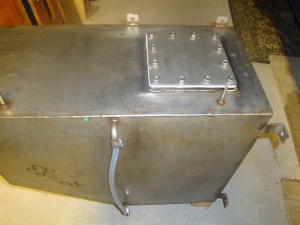
What exactly is an inspection hatch? It sounds as if it is a see through window but presumably can be opened to clean the tank.

My tank is 7 galls I haven't had any problems such as described and I do use Fuel Set. However, I must assume that there is some dirt on bottom even if not much and a clean now and again must be a good idea. I thought about pumping out the diesel through the inlet hole after stirring around perhaps a gall or half a gall at a time. Am I asking for trouble? I do not think it would be easy to take the tank off the boat for routine maintenance.
 
What exactly is an inspection hatch? It sounds as if it is a see through window but presumably can be opened to clean the tank.

Anything that lets you open a big enough hole to reach into the tank by hand. Not usually see-through - the idea did occur to me after I finished fitting mine, but I'm not sure what kind of transparent plastic would be strong enough and suitable for long-term contact with diesel.

This is a random image off Google, but it looks somewhat similar to my home-made hatch:

fuel-tank-001.jpg


You can also get ready-made screw-on versions, which are a bit quicker to open:

IMG_1278.jpg


...but I hope that opening mine will be an "every five years" kind of job, so a couple of minutes to undo the fourteen nuts shouldn't matter.

Pete
 
This is not (or at least is not reported as) a bug infestation but rather general crud, I have removed heater dip tubes and pumped small tanks (< 100l)) out to remove crud on a number of occasions to cure heater issues and with some success, usually on boats coming from still waters to coastal, not ideal as I said earlier but a simple process and worth a shot if it is not bug in which case it will not be of any permanent or ever efficacious effect.
 
Last edited:
This is not (or at least is not reported as) a bug infestation but rather general crud, I have removed heater dip tubes and pumped small tanks (< 100l)) out to remove crud on a number of occasions to cure heater issues and with some success, not ideal as I said earlier but a simple process and worth a shot if it is not bug.


How did 'crud' get into the tank?
 
We got caught out in some real rolly stuff the other day, the biggest swell we've encountered so far. Boat was tipping over to some quite extreme angles. First time we've had our LJs on and been clipped on!

Unfortunately, even though the swell was huge, there was no wind, so motoring it was.

The following day as we were motoring along in far milder stuff, I discovered the engine would start hunting when I revved her up to the higher end of the spectrum. I've experienced this before, so knew it was likely to be fuel starvation.

Once we'd arrived at our destination, I changed both fuel filters (CAV and engine). Both looked grim. I then pumped some fuel into a bowl, and the first couple of bowls full were really grubby, with loads of black crud mixed in with the fuel. The rolly stuff from the other day had clearly mixed up the crud from the bottom of the tank and a fair quantity of this had been sucked into the outlet.

Everything's working as normal now, but I'm concerned we could once again have issues if we get caught out in some nasty stuff. I'm also not massively keen on replacing fuel filters each time we go through a bumpy patch.

So, after that tail of woe, the query, as per the title of this thread, is thus:

Our stainless steel fuel tank doesn't have an inspection hatch. Only various "inlets" (filler, return fuel, Eberspacher pickup, breather) on the top and a single outlet on the side approx 5cm from the bottom.

How do we get this begger cleaned up?

I had exactly the same problem and solved it as described in this thread
http://www.ybw.com/forums/showthread.php?314108-Fuel-Polishing&highlight=

No need to go to all the expense and hassle of cutting a large hole for an inspection hatch.
I just drilled 2x 10mm holes (one for each half of the baffled tank) and used a length of 8mm copper fuel pipe to poke all around the bottom of the tank until it started to come through clear.

To seal the tank afterwards I tapped the holes and used a set screw with o-ring on, it's been fine.

The tanks have stayed bug and grime free ever since. I've now had the same fuel filters on since last season and just returned from a 300m trip including a couple of good rolly sea legs of 8-9 hrs each.
 
Thanks for all the useful replies. It does sound like an inspection hatch would be the most suitable solution. To be honest, I guess it shouldn't be overly difficult to fit one of those purpose made ones to the top of our 200l tank.

However, in the meantime, I might see if I can get the crud out through the hole for the sender (forgot that was also there!), which I think is the biggest existing hole. What would be the best way to pump out the existing diesel/crud?
 
What would be the best way to pump out the existing diesel/crud?

When I was attempting that, I simply used the Pela sucker I usually use for oil. I tried with both the standard dipstick tube (which tended to get blocked) and a length of narrow copper tube. You do need something to empty the diesel into as the Pela only holds a few litres and you probably won't have finished hoovering up crud by the time it's full.

Don't expect complete success from this - as I said, there was still a hefty carpet of muck on the bottom of our tank when I opened it, with just a series of squiggly trails through it where the most recent suction effort had passed.

Pete
 
Thanks for all the useful replies. It does sound like an inspection hatch would be the most suitable solution. To be honest, I guess it shouldn't be overly difficult to fit one of those purpose made ones to the top of our 200l tank.

However, in the meantime, I might see if I can get the crud out through the hole for the sender (forgot that was also there!), which I think is the biggest existing hole. What would be the best way to pump out the existing diesel/crud?

The set up I used on my Westerly Oceanlord through the filler cap in the cockpit floor was as follows:

1. electric drill on fast speed.
2. One pump such as this:
http://www.ebay.co.uk/itm/like/3710...f11=ICEP3.0.0&ff12=67&ff13=80&ff14=108&ff19=0

3. 15 mm coper pipe

4. 2 pieces of clear plastic pipe to connect copper to pump and pump top container.

Without disturbing the bottom, using the copper pipe move it round the bottom whilst the pump is running at full speed. This will skavenge the **** - provided its not inches thick (as seen in a 1980's moody). This one had a hatch and we had to scrape it out by hand!

I use large water bottles, but it really depends how much **** you are removing. If they are see through containers, you will see the nature of the ****.

I do this process once a year to keep the tank spotless. You need to see what is settling off the Bio diesel that we are now having to use in the Med! This is an accident waiting to happen.
 
The set up I used on my Westerly Oceanlord through the filler cap in the cockpit floor was as follows:

1. electric drill on fast speed.
2. One pump such as this:
http://www.ebay.co.uk/itm/like/3710...f11=ICEP3.0.0&ff12=67&ff13=80&ff14=108&ff19=0

3. 15 mm coper pipe

4. 2 pieces of clear plastic pipe to connect copper to pump and pump top container.

Without disturbing the bottom, using the copper pipe move it round the bottom whilst the pump is running at full speed. This will skavenge the **** - provided its not inches thick (as seen in a 1980's moody). This one had a hatch and we had to scrape it out by hand!

I use large water bottles, but it really depends how much **** you are removing. If they are see through containers, you will see the nature of the ****.

I do this process once a year to keep the tank spotless. You need to see what is settling off the Bio diesel that we are now having to use in the Med! This is an accident waiting to happen.

That drill pump certainly looks handy!

I'd imagine the tank has not been cleaned out since it was fitted probably around 15 to 20 years ago. We seem to have been lucky and not suffered from diesel bug thus far, but this black crud could become a problem. We're also in the Med, so the quality of the diesel is likely to be suspect at times.
 
Top