How to attatch a removeable inner forestay to the mast.

graham

Well-Known Member
Joined
16 May 2001
Messages
8,108
Visit site
Some time this winter I intend to lower the mast to fit a new tang to take a moveable inner forestay for setting storm jib and lightweight genoa on.

What is the best way to attatch it to the mast? I think the options are rivets or possibly a bolt right through with two tangs shaped to meet at the front.

Any tips gratefully received.
 
I would imagine some sort of wraparound fitting best as with a storm jib it would carry appreciable loads!
 
Most chandlers will have a double tang as you suggest that wraps around the mast sufficiently to enable through bolt from side to side so that bolt loads are in shear. You need to be careful about where the halyards you past the bolt. One style I have seen for dinghies has an external halyard pulley built into the tang. Of course internal halyard is more desirable but means more holes in the mast. good luck olewill
 
My gut says that rivets would be nowhere near strong enough. At least bolt through, preferably wrap around. Not a rigger, just gut feel.
 
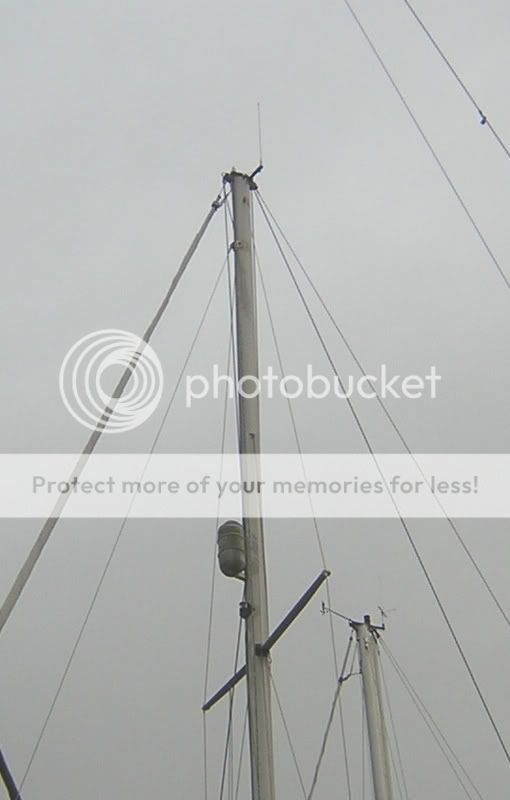
I had hounds made up by a local engineer,using a shaped st/st plate, which works the same way as shaped tangs, but has more surface area to spread the rivet holes. A lug was welded to the front to shackle the inner forestay to, and a fairlead on the mast (just above and slightly to one side) to give the right angle for a masthead halyard. Pic isn't very clear but you can see the hounds are fairly close to the masthead and the inner stay is almost parallel to the forestay

hounds.jpg


You would need to ensure that the mast can't bow forwards by siting it near the mast head or spreaders, or by having backstays or jumper struts at the same height.

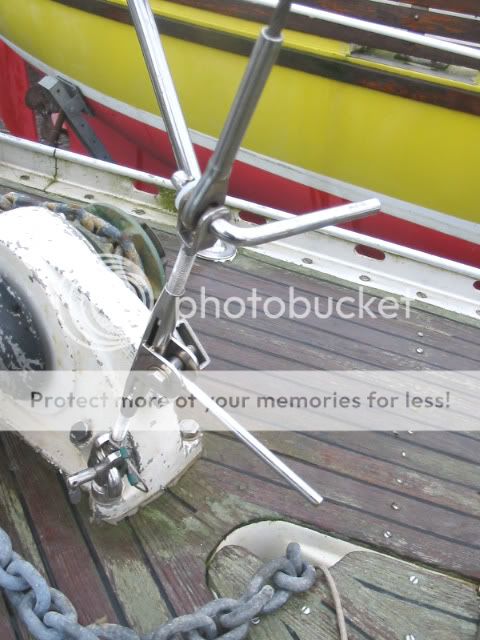
I replaced a windlass bolt with an eye bolt for attaching the foot of the stay, and a wire strop and turnbuckle below carries the stress to a glassed-in web in the anchor locker. A simple backing plate on the deck is unlikely to be sufficient unless there is some structure below deck to counteract the upwards tension.

Tensioner made from a turnbuckle:

innerforestayfitting.jpg


(Apologies for the state of the deck - a warning to those who sand teak decking /forums/images/graemlins/frown.gif )

Come and have a look next time you visit... /forums/images/graemlins/smile.gif
 
You will probably find that mast winches and jammers, amongst other fittings, are fitted with monel rivets. If you can work on the mast on the ground, with the cap off, you may be able to reach in to put nuts on bolts. If a bolt goes right through then without a spreader tube inside you won't be able to do it up very tight without compressing the sides of the mast.
 
I have two made this way (one is for a removable forestau , the second for a removable staysail), it is a wichard double tang requiring a slot to be cut in the mast profile, then the two halves are inserted and riveted each on its own side, the yellow spots are insulating paste before being cleaned /forums/images/graemlins/blush.gif

no problems in quite a few years

P1020145.jpg
 
Totally agree with Roberto. I have this system on my boat (as advised by local riggers) and it has proven perfect for our cruising, including a couple of transats.

I fitted it myself and, assuming you are reasonably handy with tools and can get access to a lazy tongs or lever rivet puller able to take 6.4mm rivets, it's an east DIY job.

Mine goes to a 'U' bolt deck fitting which is 'back-to-backed' with an identical 'U' bolt fitting below via a 200mm sq 3mm alloy plate bedded in epoxy paste. The lower 'U' bolt is then connected to a similar item bolted to the base of the chain locker bulkhead via an adjustable s/s wire strop. No load is therefore carried by the deck (which I consider a non starter) as the forestay, deck fitting and bulkhead fittin are all in line.

Just my views, but supported by many thousands of off-shore and ocean miles.
 
I fitted an inner forestay using a T bar fitting which went on the INSIDE of the mast. An oval hole large enough to pass the fitting through which was then riveted. Therefore all the load is on the inside fitting, not the rivets. I have used this setup successfully in loads of wind. Shown Here half way down on the right hand side.
 
I have information (2 pages hard copy) of how to fit and what - don't go with 'feelings' do it right - will e-mail or fax if you like.

Some things appear - the deck fitting should be well back from the bow - centre of effort stuff/what ever

Any stay set up half way between the spreaders and the top of the mast MUST have some corresponding mast support in the form of adjustable or standing runners OR jumper bracket and associated stay. Without these the mast will be pulled out of column and compression in mast could lead to collapse.

If putting a fitting at top of mast - DON'T put it any lower than 300mm from the headbox.

I can't remember which supplier supplies the bits - might be Selden but will have a rummage around - ask Brendan too - he is an inveterate rummager on the net.

PM me tel no or e-mail - will fax to you or e-mail

Here's one - no need for iron bars through the mast or calipers!

http://www.seateach.com/RIFK.asp

Some more

http://pdf.nauticexpo.com/pdf/selden/hints-and-advice/21696-6227-_52.html

These have tensioners too and other interesting stuff

http://www.marinemegastore.com/category-Nylon--Polyester-Rope-by-the-Metre-ROPNYL005.htm

BOL
 
I'm doing the same in the next couple of weeks. I will be using a T bar fitting which is set into the mast. Its relatively simple and I'm told strong enough!

Regards
TonyM
 
Fitting an inner forestay can be done in a number of ways, most already covered in the thread.

However if the mast fixing point is more than about 300mm from the current forestay, without running backstays or stiffening jumpers, you'll invite mast failure and your insurers will turn down any claim.
 
I used a riveted plate to hang the inner forestay and associated halliard pulley on. Plus a seperate bolt with two smaller tangs to attach running backstays. Then fitted a self tacking staysail which we use more and more. You don't need a staysail track, I've done it with one piece of rope and two U bolts which provides the track and sheet, with a small pulley on the staysail clew. You need to ask your mast maker for the correct fittings.
 
Many thanks for all the informative replies. Will be doing it in the New Year so Santa can bring me all the neccesary bits. /forums/images/graemlins/smile.gif
 
This is how I attached the removable forestay to my mast when I built it from a Sailspars 'Bare pole' kit.

It is fitted about 500mm from the top of the mast.

Please excuse the quality of the photo as it is raining just now up here.

PB060234.jpg


The fitting on the mast is a Gibb 840-8 it is fixed by three monal rivets. I was able to fit the backing plate through the hole I had cut in the extrusion.

The lower part for the hailyard is a Holt Allen part. It also can be fitted from the outside, once the slot is cut.

The hole required in the mast for the backing plate is circular and is thus relatively easy to cut.

I use 8mm rigging wire but the fittings are available in sizes from 6-12mm.

There is also a retaining plug available to ensure the shroud terminal does not fall out if tension is released.

The removable forestay with the swaged terminal was supplied by s3i. Other parts came from Sailspars.


Iain
 
Top