How tight to torque my chainplates

iamtjc

Well-Known Member
Joined
21 Sep 2018
Messages
86
Visit site
I have replaced my chainplate U-bolts (actually V-bolts). The new ones are bedded in Butyl sealant, the excess of which is slowly oozing out as I tighten them down.
They are not fully tightened down yet.
There are countersunk holes and the U-bolts have a domed recess, so there should be space enough that the butyl doesn't all squeeze out.

IMG_20260107_143716012 sm.jpg
Under the deck in a stainless backing plate with a welded rod transferring the pull to a bulkhead.
The deck is around 15mm thick. It is solid with fibreglass skins and a Lantor Coremat core impregnated with resin.
I have had 3 concerns.

1) To avoid galling - having read the forum, I plan to loosen the nuts one by one and do the final tightening using Tef-Gel as an anti-seize. I saw Loctite Molypaste recommended but could only find it in larger packaging that made even Tef-Gel seem cheap.

2) How much to torque the bolts. It's my rigging so I want them tight but I don't want to crush the deck. The U-bolts are 10mm 316 stainless.

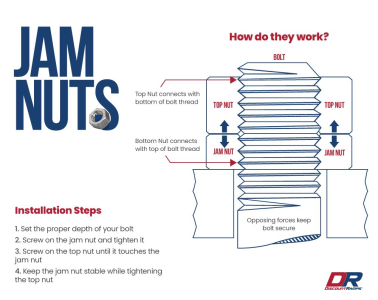
3) How to ensure they don't come undone if the butyl oozes more in hot weather and relieves the tension in the bolt. There isn't room between the bottom of the deck and the headlining for a second nut or similar.

Any thought and suggestions are welcome.
 
a. Also, go slow when tightening. Galling is about heat.

b. The compression load should be taken by the cylinder of epoxy used to seal the core. If the bolts are not tight enough (pre-load) to handle 100% of the MAX sailing load, including all shock loads, they will move. Bolt torque is about pretensioning the bolts so that they do not stretch under load. Hopefully you know the load for your rig. Typically, it is 15% of the breaking strength of the wire. Double that for the sailing load (30% of BS), since it is all on one side. You want the total clamping force ( two bolts) to equal 30% of the BS of the wire.

The same is true, by the way, of standing rigging. It should be tight enough that the lee shrouds are not slack hard on the wind.

Example: If it is 1/4" wire, 30% BS is 2500 pounds. If the bolts are 1/4"-20, about 49 ft-pounds (lubed) (1320# clamp load each, 2640# for the pair) should get you there. Pretty snug, SAE standard torque (316 is typically a little stronger than grade 2, but not grade 5)

Yes, that will crush a cored deck if you have not replaced core. Backing plate too. You have some distribution on the top. Curiously, because of preload, the compression on the top is the same as the bottom on the lee side when sailing.

tightening-torque_orig.gif
 
AS I understand it bolts/metal with repeating loads no loads are stretched to give permanent load so that additional load adds to stretch but loss of load dose not result in no stretch. This to reduce risk of fatigue failure.
Now this works well in things like cylinder head bolts where the bolt is stretched against the solid strength of the cylinder head.
However in OP case I don't believe the deck or indeed the cylinder of epoxy has any where near the crushable strength required to stretch the metal of the vee bolts to avert fatigue failure. This follows for stretching the wire itself against a non solid boat structure.
You simply need to have metal strong enough to not stretch under rig loads. The tightening of the nuts is purely a function of stopping them from loosening. This might best be achieved by using nyloc nuts, lock wire through holes in the nut pins through the exposed bolt part or even epoxy or sealer. (my opinion) ol'will
 
I know this may wrankle some die-hards ... but I would not bother with torque figs ... I would tghten the fixings until sealant is squeezed out .. metal plates are basically closed up to the GRP .... and make nuts reasonably tight ....
After a short period of use - go round and check all is tight with a spanner again ...

You are not talking cylinder head bolts on an engine where temp changes require torquing of fastenings to counter ...
 
I know this may wrankle some die-hards ... but I would not bother with torque figs ... I would tghten the fixings until sealant is squeezed out .. metal plates are basically closed up to the GRP .... and make nuts reasonably tight ....
After a short period of use - go round and check all is tight with a spanner again ...

You are not talking cylinder head bolts on an engine where temp changes require torquing of fastenings to counter ...
I hardly ever bother with torque specs, so much so that if I didnt already have a torque wrench I doubt I would buy one.

A calibrated bungee or bit of bicyce inner tube used with ordinary spanners would serve my needs quite adequately and fits in places my torque wrench wont. (eg car cam pulley bolt)

I thought that was die-hard?
 
AS I understand it bolts/metal with repeating loads no loads are stretched to give permanent load so that additional load adds to stretch but loss of load dose not result in no stretch. This to reduce risk of fatigue failure.
Now this works well in things like cylinder head bolts where the bolt is stretched against the solid strength of the cylinder head.
However in OP case I don't believe the deck or indeed the cylinder of epoxy has any where near the crushable strength required to stretch the metal of the vee bolts to avert fatigue failure. This follows for stretching the wire itself against a non solid boat structure.
You simply need to have metal strong enough to not stretch under rig loads. The tightening of the nuts is purely a function of stopping them from loosening. This might best be achieved by using nyloc nuts, lock wire through holes in the nut pins through the exposed bolt part or even epoxy or sealer. (my opinion) ol'will
I agree. Our shroud plates are through bolted and exactly the way the OP describes. However, they have locknuts on them to stop them undoing.
 
Top