How strong a halyard for MOB retrieval?

Update;-
Being alongside on a beautiful benign afternoon, we tried a few lifting experiments. Dry body, lightly clad sitting on the pontoon.
Halyard direct with a two speed winch and a Jimmy Green rescue sling.- painful but bearable under the arms but swmbo could manage only a couple of feet.
Same again with a four part handy billyrigged to advantage. About the same.
Perversely, rigged to disadvantage, slightly better (downwards pull?).
Tried the halyard taken through a clutch, single turn round a winch on the mast, under the horns of the Sampson post (stainless and slippy) and round the drum on the anchor winch. Very successful.
Observations;-
A bit complicated to rig, especially in a panic. The rig could also be used for deploying and recovering the dinghy which is kept on the foredeck. This would ensure family regular practice.
I don't like electric winches having heard tales of lost body parts during our mast climbing demonstration but this is different. The winch is not self tailing meaning the hands are away from the winch.
The route round the Sampson post ensures a fair lead at all points.
Tailing away from the winch ensures good visibility of the MOB hopefully avoiding collisions with the hull.
It is necessary to disengage the gypsy drive which might well be forgotten.

I advocate heaving to with a gybe or a tack for recovery. With only two aboard, keeping sight is very difficult.

Comments?
 
Yes, I'd suggest body weight plus gravity gives the advantage, forget the theory!
Actually, that is exactly what the engineering theory would say. Your downward pull is lifting you, without a friction loss.

I wouldn't touch the windlass method with a 10' pole. There are far too many things to go wrong.

Get a Mastmate, A Goblin as a safety grab, and a harness. Then just climb the mast. Really.

Here are some tips, from my expereince.

Camp Goblin. I've been using one of these climbing mast and rock for 10 years. I've used all of the common rope grabs, and this is MUCH better. Unlike the others, this is actually designed and RATED as a fall arrest device.

 
Actually, that is exactly what the engineering theory would say. Your downward pull is lifting you, without a friction loss.

I wouldn't touch the windlass method with a 10' pole. There are far too many things to go wrong.

Get a Mastmate, A Goblin as a safety grab, and a harness. Then just climb the mast. Really.

Here are some tips, from my expereince.

Camp Goblin. I've been using one of these climbing mast and rock for 10 years. I've used all of the common rope grabs, and this is MUCH better. Unlike the others, this is actually designed and RATED as a fall arrest device.

I think you've replied to the wrong post!
The topic is MOB not mast climbing!
 
Last edited:
I like the idea of using the boom as a crane, however controlling the boom would need some careful thought. MOB in any seaway will cause some pretty horrid rolling, meaning the boom will have to be stopped from swinging somehow.
Why God made preventers . . .
 
If you read the complete thread the actual real life MOB reported make chilling reading. Even MOB that are found and then brought alongside the yachts died in the water or soon after. If you fall overboard you are very likely to die, wear a harness and always clip on and then you might not become a MOB.

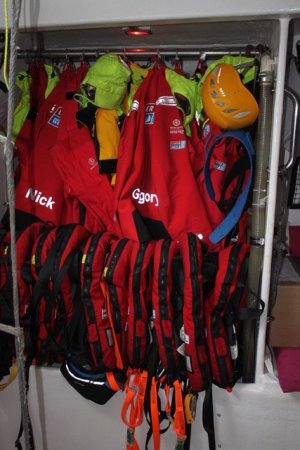
Add a helmet to your emergency gear. If the MOB is not conscious when you get them alongside then you probably will need a man in the water. Without a helmet you risk having 2 dead crew members. Helmets are invaluable if you do mast work.

A Clipper yacht safety kit 'wardrobe'

IMG_6717.jpeg

Jonathan
 
Update;-
Being alongside on a beautiful benign afternoon, we tried a few lifting experiments. Dry body, lightly clad sitting on the pontoon.
Halyard direct with a two speed winch and a Jimmy Green rescue sling.- painful but bearable under the arms but swmbo could manage only a couple of feet.
Same again with a four part handy billyrigged to advantage. About the same.
Perversely, rigged to disadvantage, slightly better (downwards pull?).
Tried the halyard taken through a clutch, single turn round a winch on the mast, under the horns of the Sampson post (stainless and slippy) and round the drum on the anchor winch. Very successful.
Observations;-
A bit complicated to rig, especially in a panic. The rig could also be used for deploying and recovering the dinghy which is kept on the foredeck. This would ensure family regular practice.
I don't like electric winches having heard tales of lost body parts during our mast climbing demonstration but this is different. The winch is not self tailing meaning the hands are away from the winch.
The route round the Sampson post ensures a fair lead at all points.
Tailing away from the winch ensures good visibility of the MOB hopefully avoiding collisions with the hull.
It is necessary to disengage the gypsy drive which might well be forgotten.

I advocate heaving to with a gybe or a tack for recovery. With only two aboard, keeping sight is very difficult.

Comments?
Comments ? Then buy and fit an electric halyard winch, as would do a similar job but better and always ready to go at the halyard end.
PS We use the electric halyard winch to lift a person up the mast. Entirely safe if use the rule we ALWAYS apply with the electric winch, when hoisting sail or anything else. NEVER use the self tailer, but hand tail (ideally with two turns only) then if hit it any obstructions it stops before any damage done.
 
Comments ? Then buy and fit an electric halyard winch, as would do a similar job but better and always ready to go at the halyard end.
PS We use the electric halyard winch to lift a person up the mast. Entirely safe if use the rule we ALWAYS apply with the electric winch, when hoisting sail or anything else. NEVER use the self tailer, but hand tail (ideally with two turns only) then if hit it any obstructions it stops before any damage done.
"always ready to go at the halyard end."
If under sail, the halyard is probably in use!
If an electric halyard winch were fitted, there would be a temptation to use it for hoisting halyards (🤤).
On our MastaClimba demonstrations at boat shows, we heard grim stories about crushed and lost fingers,
nearly all the operators fault save for jammed on solenoids.
Although counterintuitive, using the drum on the anchor winch, tailed from the recovery position, avoided that. Security is provided by the clutch.
Each to his own. This works (will work?) for us.
 
Last edited:
"always ready to go at the halyard end." => yes always ready
If under sail, the halyard is probably in use! => most have some spare halyard such as spinnaker which can be deployed
If an electric halyard wincch were fitted, there would be a temptation to use it for hoisting halyards (🤤). => yes, what designed for, but with a stopper also can be freed up in seconds
On our MastaClimba demonstrations at boat shows, we heard grim stories about crushed and lost fingers, => there have been a very small number of recorded cases, but afaik all would have been avoided by not using the self tailer
nearly all the operators fault save for jammed on solenoids. ==>. Extremely rare occurrence, but ease tension and the drum can turn harmlessly
Although counterintuitive, using the drum on the anchor winch, tailed from the recovery position, avoided that. Security is provided by the clutch. => it’s exactly the same principle, manual tailing can act as a “clutch” - but massively easier and safer to control lift from the cockpit, close to helm
Each to his own. This works (will work?) for us.
 
=> yes, what designed for, but with a stopper also can be freed up in seconds
ER, what happens to the sail?
It is the same case with using the mainsheet. You need to drop the sail. By then you will probably have lost sight of the MOB.
I have yet to practice the full evolution.
My plan, to be practised for real, is to luff up (to windward or leeward - there are arguments for and against both), which, I think gives the best chance of keeping an eye on the MOB, hit the MOB button, deploy the sling (which has a tethered buoyant line) and, if necessary, circle the MOB and recover s previously demonstrated.
We sail as a couple.
 
Prevention is always preferable to a cure. Think of the sea as a pool of boiling lava. 1200 deg C. Or concentrated hydrochloric acid. Like that you will never fall in. So avoid going forward, harnesses , short tethers and jackstays well designed and tested.
 
Prevention is always preferable to a cure. ... you will never fall in. So avoid going forward, harnesses , short tethers and jackstays well designed and tested.

I don't think you can guarantee that, no matter what mind games you play, or systems you use, except by not going sailing. What are you going to do if someone does fall in?
 
Last edited:
I thought the halyard you intended to use was holding a sail up?

Yes, but you can free the winch up for other work, either by dropping the sail, or by removing the halyard from the winch and keeping the sail hoisted. In this latter case, if the halyard runs through a cam cleat, easy, if not, you need a stopper knot or other line tied on with hitch, to take the strain when the halyard is released from the winch.

Example, you have a winch loaded with the halyard and it does not run through a cam cleat / jammer. Take a line, tie onto the halyard with a rolling hitch on the tension side of the halyard. Then take the tail of the line and secure it to somewhere, as in line as you can with the halyard to winch lead. Then slip the halyard from the winch and let the rolling hitch take the strain on the halyard, freeing up the winch, but keeping the sail hoisted.

I am not sure what is meant by halyard stopper, but for sure there is more than one way of freeing up the winch.
 
I thought the halyard you intended to use was holding a sail up?
This is one reason to have a full-strength topping lift. It is a spare halyard.

Also, some boats have a spinnaker halyard, which will (a) not be in use in heavy weather, and (b) if it was in use, the sail had to come down before recovery started. It has the advantage of being mounted to a swivel.
 
Top