How much rain will cure hosepipe issues/canal depth/reservoir levels?

There are some good charts here. Only one station in Bedfordshire but that was 7.5" below average for 2011 and so far 2.2" below average for 2012. Anual average is 25.5" or about 2.1" per month. So we are short of about 4.5 months average rainfall. So if it rains twice as hard as normal for the next 19 weeks then everything will be fine again!
 
You would think that by now science would have worked out a way to make it rain continuously every night inland above 1 mile from the coast all round the country!
 
How many more people are using the same water supply here than 25 years ago? 15-20% ? So we need the same amount more rainfall, but apparently there's considerably less, so either we figure out how to make it rain more, or use less.
 
How about tidal-powered reverse-osmosis?

I'm in very deep water here - no idea what I'm talking about. But...

If there were floating platforms or pontoons, secured to massive posts in a sheltered area of considerable tidal range...

...and if at high tide, quantities of water are allowed to fill tanks aboard the pontoons...which are secured as the ebb drops away...

...would there not be 'x' tonnes of seawater, whose considerable burden, five meters above the low-water level, would easily pressurize a proportion of that water through a reverse-osmosis membrane or filter?

Even if it were only a few percent, a sixteen meter-long pontoon, six wide and one deep, would produce tonnes of desalinated water with each tide, without any need for energy input or pollution.

I daresay there's a sound reason why it wouldn't work, or perhaps such systems already exist?

Even if it doesn't suit desalination, it could create power. How many kw hours are required to lift 100 tonnes through five meters?

I recognise that a few tonnes of unsalted water per day, won't solve the water shortage...but mightn't it be scaled up?

Yours in total naivity,

DC
 
I'm in very deep water here - no idea what I'm talking about. But...

If there were floating platforms or pontoons, secured to massive posts in a sheltered area of considerable tidal range...

...and if at high tide, quantities of water are allowed to fill tanks aboard the pontoons...which are secured as the ebb drops away...

...would there not be 'x' tonnes of seawater, whose considerable burden, five meters above the low-water level, would easily pressurize a proportion of that water through a reverse-osmosis membrane or filter?

Even if it were only a few percent, a sixteen meter-long pontoon, six wide and one deep, would produce tonnes of desalinated water with each tide, without any need for energy input or pollution.

I daresay there's a sound reason why it wouldn't work, or perhaps such systems already exist?

Even if it doesn't suit desalination, it could create power. How many kw hours are required to lift 100 tonnes through five meters?

I recognise that a few tonnes of unsalted water per day, won't solve the water shortage...but mightn't it be scaled up?

Yours in total naivity,

DC

My drilling contractor uses very saline water from a well with about 100 psi surface pressure. The water has to be pumped at much higher pressure through the filters. Your 5 m scenario would only produce just less than 10 psi head when full of water.

There is also significant pre treatment required before the sea water actually passes through the reverse osmosis filters. All the creatures, sand and silt has to the removed first.

Another problem with the capacity is that a lot of the flow rate is returned back to the sea after cleaning filters and diluting the highly salt concentrated waste water. Its not that an efficient process and it takes a lot of energy to clean up sea water.
 
Anything built on the coast has potential to mess with sand movement. You only need to spend a few minutes walking along past a pier, groyne or some such to see what a devastating effect on the shoreline something like that can have.

How often do parts need changing on a reverse osmosis setup? I suspect that could be a limiting factor.
Another possible issue is size and cost - how big a filter would you need to produce a significant quantity?

Interesting idea.


I'm in the "stop the sodding leaks!" camp... with leanings towards "why do we flush toilets and wash cars with drinking water" and "with all this rain, why aren't more of us collecting it?"... I sometimes speak to someone who has a pump with attached hose hanging just outside the bathroom window. After taking a bath she pumps the water from the bath onto the garden.

Back to leaks though - we should be very, very angry about that waste. If the water monopolies were threatened with an angry mob dragging them from their offices/homes/beds if they didn't stop leaking our water all over the place I suspect the problem would go away reasonably swiftly.
 
Okay...plan B...

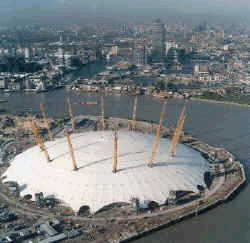
...turn this:

millenium_dome.gif


...into a big one of these:

Solar-Still.jpg


:D
 
Gets my vote.
I've never liked that thing on principle... and I wasn't even out of my teens (and very apolitical) when they started wasting our money on that pile of junk.

It'd be nice to see it used for something worthwhile.

If I was ever offered a free punch at Tony Blair for a single issue... that'd make the shortlist.
 
Gets my vote.
I've never liked that thing on principle... and I wasn't even out of my teens (and very apolitical) when they started wasting our money on that pile of junk.

It'd be nice to see it used for something worthwhile.

If I was ever offered a free punch at Tony Blair for a single issue... that'd make the shortlist.

Longest short list in history!
 
Not ever enough so long as the water companies fail to deal with leaks in the main pipe system.
!
As an ex water company engineer, it infuriates me when ill-informed statements such as this are made. Water companies have already spent millions on leak finding and repairing. The majority of remaining leaks are below ground and not visible from the surface. The only realistic solution is a program of replacement of ageing pipelines over a period of years - starting with the oldest some of which are over a century old. The problem is that Ofwat will not grasp the nettle and endure the resulting flack from customers whose roads are dug up and water charges raised. Yes, this is going to cost a lot of money! and the cost would not be spread equally over the whole population.
The current approach is to improve the instrumentation on service networks and identify where the flows are greater than theoretical predictions, indicating leakage as well as improved response to reported surface leaks but repair of one leak on an aged system often results in the water finding the next weak spot.
Water is an undervalued resource and fantastically good value at under £1 per cu metre. How much would a similar amount of the bottled variety cost?
Rant over
 
Whatever is or was a gas-pig?! :confused:

Ghostlymoron, as a professional, your view must be of considerable significance here...

...is it likely to be a worthwhile benefit, if homeowners use the contents of rain-waterbutts (or seawater if available), to flush loos?

If dedicated cistern-tanks sat in attics, and were filled by rain (or pumped full from the sea), mightn't we reduce drinking water wastage?
 
Even if it doesn't suit desalination, it could create power. How many kw hours are required to lift 100 tonnes through five meters?

DC


back to school physics

potential energy = mgh

100,000kg x 5 meters x g (9.8)= 4.9 Mega Joules

assuming 100% efficency and released over 4 hours (Ignoring slack water) would only give 340Watts:(
 
Mega joules? Okay. I said at the start, I was out of my depth. :o

Does your calculation imply that 340 watts would be sufficient power to elevate 100 tonnes through 5 meters, during the 6 hours of a rising tide? I'd have imagined more would be needed, and that conversely, more could be extracted, by that weight descending.

If a platform raised 100 tonnes of water every twelve hours, and then, that water then poured back through a fairly traditional water-mill-wheel, turning a dynamo, would it only generate a third of a kw?

Presumably the benefit would be that it needn't be limited to 100 tonnes, and wouldn't rely on any energy input, and wouldn't vary in its output, because (aside from differing neaps and springs) lunar activity isn't inconsistent in the way wind and solar are.
 
Mega joules? Okay. I said at the start, I was out of my depth. :o

Does your calculation imply that 340 watts would be sufficient power to elevate 100 tonnes through 5 meters, during the 6 hours of a rising tide? I'd have imagined more would be needed, and that conversely, more could be extracted, by that weight descending.

If a platform raised 100 tonnes of water every twelve hours, and then, that water then poured back through a fairly traditional water-mill-wheel, turning a dynamo, would it only generate a third of a kw?

Presumably the benefit would be that it needn't be limited to 100 tonnes, and wouldn't rely on any energy input, and wouldn't vary in its output, because (aside from differing neaps and springs) lunar activity isn't inconsistent in the way wind and solar are.

I was quoting 100% efficency the actual power generarted would be much lower.

Coincidently I have a 335Watt pump which quotes 140L/min at 5Mtr head
To pump 10 tonnes would take 11 hours or approx 50% efficency which is very good .


These things have to be scaled v large to make ecconomic sense.
There was talk of daming the severn estuary and generating power doing exactly what you are suggesting
 
I hope your Severn idea wasn't a joke? I reckon it's excellent good sense!

I suppose my earlier idea (and you've confirmed the slow thoughts I had, since) is equivalent to a 10m x 5m x 2m swimming pool being filled from a point 5 meters below...

...that would only require a Rule 3600gph bilge pump, running at maximum capacity for 6.5 hours. Sounds entirely possible, and as you say, not a huge amount of power is required or recoverable, for lifting/dropping that quantity.

But presumably it would be possible, using what in effect would be a 'tidal-pump', to fill a reservoir ashore, (ideally well above ground level, for greater pressure)...

...not pretty, but an asset, if at a moment's notice, you can let thousands of tonnes of brine pour back to the sea, driving very big dynamos as it goes? Just like a hydro-electric dam, but without waiting for rain to fill the lake.
 

What a poor, myopic, unadventurous, ill-fated, past-facing bunch we are. Every time something could be done that might sort out our troubles, we think better of it for silly reasons, and rely instead on systems that we had already shown to be inadequate!

There's a windfarm-theme on the forum at the moment, about the IoW/Dorset coast site. I'd thought only of the disagreeable view, and the possible inconvenience to mariners...but right here and now, I hope it will go ahead.
 
Whatever is or was a gas-pig?! :confused:

Ghostlymoron, as a professional, your view must be of considerable significance here...

...is it likely to be a worthwhile benefit, if homeowners use the contents of rain-waterbutts (or seawater if available), to flush loos?

If dedicated cistern-tanks sat in attics, and were filled by rain (or pumped full from the sea), mightn't we reduce drinking water wastage?
Agree that using potable quality water for flushing toilets doesn't make sense but unfortunately we would need to duplicate the internal plumbing in everyone's house. A lot of commercial properties these days do include rainwater harvesting (B & Q for instance) and have a display showing the amount and percentage. It's a lot cheaper to install in new build than existing properties.

Pigging (they can't touch for it) is difficult in street water mains where the majority of leaks occur due to the number of service connections. I don't know whether this technique is used by water companies.
 
Top