How much can a boat safely tow?

Homer J

Well-Known Member
Joined
19 Jun 2017
Messages
554
Visit site
I have a 37ft AWB (sailing yacht) with a Yanmar 3GM30. I have just bought a 17ft speed boat with a 100hp engine with a total weight of just over 600kg

I’d like to be able to tow the speed boat behind the yacht so that I can use it at our final destinations. Am I mad to even be considering that this is possible / advisable?

if I do tow it is there an advisable way to make the attachments so I don’t rip the cleats off?
 
Controlling the boat under tow might be an issue?

Could it be easier to tow the yacht with the speedboat? :)
 
In the slightest sea, or even not, it will skim about, yaw, snatch unless you tow it really fast, and can get it on the back of your second wave, maybe. You'll want a rigid towbar.....
 
The speedboat will probably have the drag factor of a bingo hall at towing speeds, as the weight will be at the back dragging the transom?

I would forget the cleats and fit a stout towing eye low down on the bow of the speedboat.
We've towed heavier RIBs in moderate conditions no probs, but the drag is not small, and I'd say a typical RIB is probably less arse-heavy than how I'm imagining your boat?
You have to take the view that if the conditions get poor, you just drive the RIB alongside and swallow the petrol bill. Pick your weather and don't go too far basically.
 
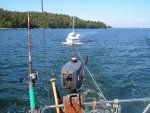
031-August72007_SA018.JPG

Thats my 25ft Sunrider with Perkins 4-107 towing an Alacrity in Swedish Isles. That tow was for approx half day as we needed to get to next stop quickly ...

Setup :

If you look carefully at bottom right of picture - you can see the tow line is made fast to a bridle line. That bridle line is made off to a mooring cleat either side of cockpit. The two line is NOT allowed to move along the V ..

OK .. before making any thing fast - the tow line was made up. The bridle line (14mm braid) was halved and an eye made in the hand. The end of the tow line (again 14mm braid) was then made to that eye with a double Sheetbend locking it in place.
The bridle ends were then made of to the mooring cleats making sure the free end was on top so if necessary I could disengage. Normal fig 8 mooring style with a half hitch to secure.

For really heavy tows and bad weather expected ... then extra length to the bridle lines and make fast not only to aft cleats - but in series forward on the boat as well ... to spread the load ...

The towed boat should have a good mooring post or major mooring cleat forward - if any concern on its capability - then a strop made fast to it and then tight to other cleats would increase its load bearing. Make tow line fast but not with a fixed eye ... it should be able to be unmade and cast of if emergency. (this of course is if towed boat is manned !).

As with towing a car ... take up slack easy easy and avoid sudden throttle ... increase speed in steps watching the towed boat ... if too fast - the boat will start to snake and play about ... ease of and settle at speed that all runs nice.

When you get to destination .. you can either :

Take in tow line as you reduce speed on approach ...
or
make a wide arc so that tow line doesn't drop under you and get along side towed boat to sort...
or
towed boat if manned can unhitch tow line as you slow down ... and glide on to final point / wait you to go alongside to sort.

With my 25ft'r ... I've towed a 26ft Centaur .... 23ft Seamaster ..... 19ft Alacrity .... speedboats ... all with similar setup.

The things to take into account :

1. Make sure tow line is nice and long - if you have floating rope - fine but not essential.
2. Make sure tow line is good diameter ... at least similar to your mooring line size
3. Think about the load and possibly spreading it across multiple cleats on both boats
4. A small boat can tow a big boat .. its a case of just taking it easy - no Schumacher throttle jobs !!
5. If there are heavy seas / swell causing snatch ... try to work the waters by throttle and wave angle ... to minimise snatching.
6. If you do need to stop ... make a wide arc turn so towed boat doesn't ram you !!

Once you sort out a system - its easy peasy and you'll wonder what all the fuss was about.
 
Colregs Rule 24 may apply. You should be able to warn other vessels, as if you stop the AWB the speedy boat will veer all over the place.

As Refueler suggests, but I'd add a loose contingency line in case the tow parts.
 
I've done quite a bit in all weathers and sea states and apart from having at least two secure attachment points on both tug and towed boat, a long tow line with large funnel incorporated is best ; I have used truck inner tubes as shock absorbers. Remember that your boat suddenly becomes a 50m long monster and take time to speed up and slow down.
 
Back to the exact question, how much can it safely tow, anything you can get moving, basically, but throw in wind or other circs and it gets more difficult. You could tie your stern to the shore and run the engine all day, should do no harm. I towed a boat 4 x my tons with no problem, and put him alongside the quay at the end, but a FV is better organised, big prop, 3:1 reduction etc. 'Safely' is the issue....
 
A few years back I encountered a rib with 7 POB (and a dog) off the Mull of Kintyre adrift, and took it in tow. I found...
* it had serious drag. Wind was about 10-15kn, swell about 2m.
* I broke the tow once, I'd used 12mm polyester. Substituted 15mm nylon and that worked.
* A bridle was essential, to both side genoa winches (at towing end)
* I could do 2 knots max
* Tow boat: Rival 32, on engine only, MD2030, 29HP
* Towed boat Rib of about 8m? (loaded with sick people - and a dog)

I've towed a few others at times, and from these experiences, I'd say towing a boat of these sizes is an emergency solution not a planned one.
 
A few years back I encountered a rib with 7 POB (and a dog) off the Mull of Kintyre adrift, and took it in tow. I found...
* it had serious drag. Wind was about 10-15kn, swell about 2m.
* I broke the tow once, I'd used 12mm polyester. Substituted 15mm nylon and that worked.
* A bridle was essential, to both side genoa winches (at towing end)
* I could do 2 knots max
* Tow boat: Rival 32, on engine only, MD2030, 29HP
* Towed boat Rib of about 8m? (loaded with sick people - and a dog)

I've towed a few others at times, and from these experiences, I'd say towing a boat of these sizes is an emergency solution not a planned one.
A seven person RIB can be very heavy. I'd guess way over a tonne, but that depends on the length. 8m could be over 2T. Seven bodies is another half a tonne.
Much heavier than say a ski boat.
As above, with the engine and transom dragging, it's an ugly shape underwater.
My mate had a little 4.5m RIB, we tried out my 2HP yamaha outboard as a 'get you home motor' before doing sea trials, If we sat forwards to one side to get the worst of the transom out of the water (while keeping the prop in), it did about 3knots, maybe 3 1/2.

I've done my share of being either end of a tow rope on racing boats without engines. Something that weighs a tonne will break the rope if it goes tight with a bang when a wave hits it. Doesn't take that much steady force to hold 4 knots, but the impact of a wave is like a big hammer unless you've got a long stretchy rope, a weight in the middle or some other means to allow it to give. one turn around the samsom post and surge it by hand works, you just have to keep pulling it in, between waves. Skilled use of the throttle is another option...
 
Like others, I don't like the sound of this. At the very most, I might pop around the corner on a calm day for a water-ski...but then, why not just take the speedboat? The idea of deliberately setting off for a voyage, even a local day trip, like this seems very fraught and I wouldn't do it. Even on a calm day, it only takes a single ship or semi-displacement MOBO passing to give you a headache. Let alone a worsening of conditions.

Think: are the equipment costs, set-up time, slow travel, stress and risk of damage (which the insurers may consider excluded under standard exclusions of seamanlike behaviour) justified by the fun you are going to have?
 
A few years back I encountered a rib with 7 POB (and a dog) off the Mull of Kintyre adrift, and took it in tow. I found...
* it had serious drag. Wind was about 10-15kn, swell about 2m.
* I broke the tow once, I'd used 12mm polyester. Substituted 15mm nylon and that worked.
* A bridle was essential, to both side genoa winches (at towing end)
* I could do 2 knots max
* Tow boat: Rival 32, on engine only, MD2030, 29HP
* Towed boat Rib of about 8m? (loaded with sick people - and a dog)
Couldn't you just ditch the dog? :unsure:
 
Thanks all. I was interested in the thinking but there are (as usual) a number of differing points of view. I don’t need to tow it I can get my kids to take it separately but it’s not very sociable.
I was t considering major voyages under tow but simply Lymington to East Head / Witterings for example but would only be in reasonable weather.
i guess I will give it a go somewhere shelterEd and get an idea

thanks for your thoughts.
 
Thanks all. I was interested in the thinking but there are (as usual) a number of differing points of view. I don’t need to tow it I can get my kids to take it separately but it’s not very sociable.
I would have thought that far more "sociable".
Kids get to drive the boat & actually do something "interestingly serious", rather than sit on the yacht looking at their smart phones. Mum gets to watch them & worry like h..ll, whilst blaming dad for letting them out on the ocean in a boat on their own. " Why did we come out her when you knew it would be rough?". Whilst dad gets to sail the yacht, without having d..med kids sitting fed up all the time saying, " are we there yet?"
Proper Sunday day out with the family. All you need is a bit of sunburn and a 2 hour traffic jam on the way home & you have got it made (y)
 
An old but very useful trick to avoid the heavy snatch on the tow line when towing between 2 fairly heavy vessels is to tie a car tyre into the tow line about one third of the distance from the towed boat. The stretching of the tyre then avoids the shock loads that can rip out cleats etc. Also should the towed boat try to advance towards the towing boat, then the drag of the tyre in the water deters it from doing so.
 
Probably not relevant, but I'm reminded of the time I towed a 12ft lightweight inflatable dinghy behind my Centaur. The dinghy was so light, it was skipping over every little wave, until it flipped right over. Then it flipped again and again, collecting water every time. Eventually it sank just below the surface, and behaved like a huge drogue, slowing me to one or two knots. It took monumental effort to drag it back aboard, and I never tried it again.
 
Top