How much anchor weight and chain for a summer only mooring in west highlands

Samoddie

Member
Joined
5 Oct 2021
Messages
23
Visit site
Hi. I have been trying to specify and install a mooring at a our place in west highlands. The only supplier that is vaguely local is XX. It has been suggested to me that they will over specify the tackle. When I approached them, they have come back with two 15kg anchors, and 2 lengths of 22mm chain of 18m each, plus riser chain etc. Now, this doesn’t cost an arm and leg, but it will be way to heavy for me to install from my 22 foot boat. So far as I can tell this would mean each of the two ground chains would weigh around 200kg. (Obviously they would have to be joined in order for me to install the whole thing. Which would be fine if I was clearly able to get someone local to put it in. I am not wild about spending the >>£1k either, for what seems well over the necessary spec. Anyone got any thoughts?
 
Most mooring areas have recc'd specs based on Harbour Masters guidelines.

I would suggest a trip to HM office and have a word with them. Not only that - but any Clubs in the vicinity ? Worth having a word with them.
There are many factors to take into account ... how sheltered is location, how deep, is it drying mooring, mud, shingle, sand bottom, these all come to affect what is best.

At end of day - IMHO winter or summer ? makes no difference ... bad weather knows no bounds of season ...
 
You need to become a Wham fan. West Highland Anchorages and Moorings Association
They know all about moorings in your area and are far and away your best source of information.

On here, as your post mentions the word 'anchor', the anchor Jesuits will be along soon, hell bent on saving you from the satanic torment which is buying the 'wrong' anchor.
Wham will give you a more informed and objective opinion.
 
I have sheltered from 60 kts gusts in Oban, summer and frequently gale strength winds, also in summer elsewhere on the West Coast. Summer only mooring suggests you want to go light weight. I think that would be a mistake, its either up to the job or it is isn't for the wind strengths.
 
I have sheltered from 60 kts gusts in Oban, summer and frequently gale strength winds, also in summer elsewhere on the West Coast. Summer only mooring suggests you want to go light weight. I think that would be a mistake, its either up to the job or it is isn't for the wind strengths.
Agree. And suspect any mooring light enough to be self deployed from a 22 foot boat would be too light weight to be safe. Most moorings are laid from large workboats or custom rafts with large winches.
In a gale rarely wish had a lighter mooring system
 
Agree. And suspect any mooring light enough to be self deployed from a 22 foot boat would be too light weight to be safe. Most moorings are laid from large workboats or custom rafts with large winches.
In a gale rarely wish had a lighter mooring system

I often moved . laid large concrete sinkers using my boat ... the trick is to have the sinker IN the water while being moved reducing its weight for boat to hold.

Sinker - last Uk Club I was in ... were riubd concrete affairs .. 1m diameter and about 20cms thick with serious U metal set into centre. At low tide - sinker would be moved onto slipway ... as tide came in ... boat would move over the sinker while ropes were made to the U ..... tide would then raise the boat and sinker ....
Slowly out to required position and then a choice ..... slip the sinker and let it go .... can be dangerous if rope let go or cut ! Or anchor and let boat and sinker settle as tide goes out ... Release sinker ... tide in and boat away. Sinker has a rope and buoy marker.
Next day ... out in dinghy and with chains / spades etc.
Tide out ... stand on sinker and dig away at sides and 'rock' it into the mud..... fasten chains on ... job done.

I've moved those blocks with a Snapdragon 23 and my present Sunrider 25. Others have done same with Pageant ... etc.

I even 'lifted / moved' from one location to another ... but that needs care ... You must dig away around the sinker at low tide ... connect boat to sinker ..... then let tide lift boat .... one sinker I moved - nearly threw my mate of the boat when sinker finally lifted and boat shot up !! I had warned him !!

I agree its not a job for the faint hearted or those who haven't seen it done ...
 
It depends on how exposed the location is, depth of water and the type of seabed. Local advice is recommended.
When I layed my mooring on the Exe I used 3/4" stud link wrought iron chain that hardly corroded at all in 10 years. The anchors were fabricated by a local blacksmith and about 15kg and it was all laid singlehanded from a large inflatable. At LAT the water was only 4ft deep so I could walk it out of the dinghy and onto the seabed only having to handle 4ft of chain at a time.
When I finally left the mooring I could only get one of the chains up as the other was completely buried in the mud (winching up onto a 2.6T boat with the stern out of the water).
If the water is deep then things can quickly get out of control if you have a large weight hanging down and you will need some sort of crane or winch to handle it.
 
Quite a few years ago I was heading for the anchorage on Muck. Weather forecast was not good so changed plan and went into Loch Moidart, anchoring in the pool about 0.3 mile NE of castle Tioram. My anemometer only goes up to 60 knots. The following morning it was hard against the stop for well over an hour until the wind backed and we were in the lee of the island. However judging by the sea state in the bit of the loch we could see the wind strength was sustained for most of the day.
While fully exposed to the wind I was concerned that we might drag down onto a boat on a mooring astern, then realised that its range was increasing. The boat would sheer beam on to the wind as it took its mooring shorewards. Fortunately, the wind backed before it reached the shore.
More recently we had similar conditions in Loch Dunvegan while anchored below the village. A friend was tied to a mooring buoy further into the loch and more exposed to wave action. Both his mooring lines broke under the strain and he needed assistance from the lifeboat to get back to the buoy.
Perhaps not typical, but quite possible, summer conditions for you to take into account.
 
It is only a slight oversimplification to say that if you can lay the mooring from your own boat it is not heavy enough. As well as the initial laying of the mooring you will also have to think about regular inspection and maintenance/replacement. (Some insurance companies specify annual inspection by a professional.) You don't say where on the west coast this will be, and in many of the more out-of-the-way places you may find that there is little choice of mooring contractor as some place geographical limits on where they will work. If you have fish farms nearby you may find a contractor who will be willing to do your work when they are in the area on other jobs. If your insurance company requires an annual certificate that your mooring is fit for purpose, this is unlikely to be forthcoming if you have skimped on the initial outlay.
 
Another problem is:

What ever you use to secure the mooring, railway wheel, lump of concrete, Danforth anchor (quite commonly used for moorings) is that with time they sink into the seabed and that 15kg Danforth will need a much increased tension to release than when it was first laid. If you try to deploy your own mooring you would sensible go for 'performance' when first laid - the performance will increase with time as the 'anchor' settles in. The chain, swivel etc need to be designed to accept this extra tension and what ever was used to deploy the mooring might no longer be adequate (strong). You will need to service the mooring as the various components will deteriorate - just think of abrasion.

If your, self deployed, mooring fails and your errant vessel damages something you will be liable. If your professionally deployed mooring fails than as long as you maintain, service annually the damage will be covered by the mooring contractor's insurance.

Have it done professionally.

Jonathan
 
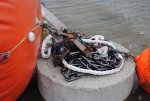
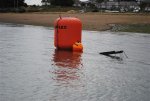
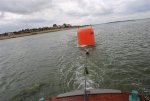
If you want to place the mooring yourself then use a concrete sinker. I lay about 30 at the start of the season with a 20 ft work boat. I have 2 air bags but you can hire them for a week from the isle of White. They inflate with a simple blower ( cost£18-00) to 3 PSI.
Put the sinker & tackle on the foreshore. That may be an issue for you but ours weigh up to 2 ton plus tackle- many are smaller & we use a tractor.
The air bag fixes on top. The tide lifts it up. I come in with the launch, tow it off the beach & take it to the drop position & release the sinker & tackle. It is a faff for one person but would save a bit on the £1K the OK is suggesting. There is a method for recovering with the airbag to lift it on the tide but complicated for this post
DSC_0011 (600 x 402).jpg

Beach (600 x 402).jpg
Under tow (600 x 402).jpg
 
What you use for a mooring, weight or anchor, depends on the sea bed. There are also a number of variations possible in the configuration of riser chain and surface buoys. However, having laid my own moorings in Shetland waters, and rigged moorings for oceanographic instruments, I would suggest that weights can bounce along the sea bed and one or two anchors plus weight at the bottom of the riser would be a sensible precaution.

Looking at the OP spec, I would not consider it over sized, but the riser chain size is more important than the sea bed span. The greatest risk is the rising chain as it will be eroded by bottom sediment where the tide causes it to rise and fall on the sea bed plus the motion of the boat. A sandy bottom is obviously the worse. I have inspected mooring chains by diving; they look fine until you open the wearing surface between the links near the sea bed. It was not uncommon to see half or more of the metal worn away. Mooring failures are often due to worn links that superficially look OK.

My preference was for a heavy riser chain supported by a surface buoy, then a lighter riding chain (at least one size heavier than the boat's anchor chain) to the boat. If the mooring was not in use during the winter I would always remove the main buoy and riding chain then drop my riser chain on to the seabed to reduce wear, leaving a pick up rope on the riser to the surface.
 
The way I would be looking at the issue is this; if you go with your own design / specification for the mooring AND it subsequently fails resulting in the damage to someone else's property (another boat owner?) your insurance co will have very good grounds to reject the claim. At this point; you, personally, will be directly liable to pick up the costs.

Question therefore is; would any likely claim be more or less than the £1k for a "professionally designed and laid" mooring?

In this case, I would almost certainly pay the professionals.
 
In this case, I would almost certainly pay the professionals.
A sensible philosophy, as an accountant told me, "Always make sure there is someone to sue if things go wrong".

However, there are parts of the world, even around the UK, where there are no professionals available and if you want something done you get on and do it. (Normal islander thinking) I always tended to make my moorings overweight/oversize, not because I was concerned about the risks you consider but because I have sat in a car sheltering from the spindrift watching one of my boats in the headlights pitching its bows underwater into every other wave. That boat was on its own anchors and chain in a more sheltered location than many west coast mooring sites..
 
If you want to place the mooring yourself then use a concrete sinker. I lay about 30 at the start of the season with a 20 ft work boat. I have 2 air bags but you can hire them for a week from the isle of White. They inflate with a simple blower ( cost£18-00) to 3 PSI.
Put the sinker & tackle on the foreshore. That may be an issue for you but ours weigh up to 2 ton plus tackle- many are smaller & we use a tractor.
The air bag fixes on top. The tide lifts it up. I come in with the launch, tow it off the beach & take it to the drop position & release the sinker & tackle. It is a faff for one person but would save a bit on the £1K the OK is suggesting. There is a method for recovering with the airbag to lift it on the tide but complicated for this post
View attachment 149849

View attachment 149847
View attachment 149848
I'm curious - how do you release the sinker from the airbag?
 
Top