How many batteries?

zoidberg

Well-Known Member
Joined
12 Nov 2016
Messages
6,935
Visit site
And how much usable capacity?
I'm told to start with 'How much do you need?' and get bogged down after navlights, domestic lights, basic instruments, VHF, AIS, VHF/FM, CD player, handheld charger, tablet charger, phone USB-C charger, autopilot.... et al. No radar, thrusters, powered winches, widescreen TV, Starlink, u/w status lights...

I'm happy enough to have 100Ah Optima AGM for Start, 2 x Optima 100Ah for 'domestics', a plain vanilla 70A alternator, 2 x 100W or more PV panels - and a legacy towed generator! Should I later want to fit more battery capacity - e.g. another 2 x 100Ah Optima jobs - how best should I arrange that...?
 
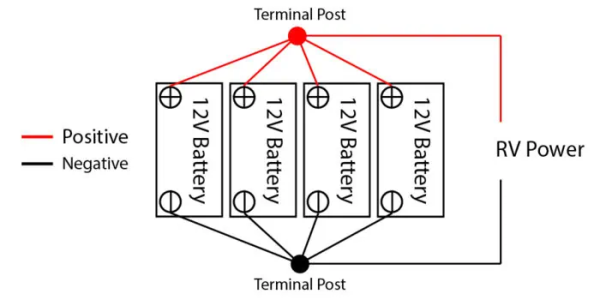
Simply wire them in parallel ensuring all battery cables are equal resistance like the image below as an example as this will ensure all batteries are working equally
 

Attachments

  • 1749824966475.png
    1749824966475.png
    81.8 KB · Views: 7
Unless you are running a fridge, anything in the range you suggest will do. Most of the ones you have are in milliamps or at least not much, and less if you have LED cabin and nav lights. With a fridge, depending on the installation you'll need more. We have+/- 200A/hr and a mere 36w solar panel and can generally run the fridge for up to a week at a low setting.
 
Initially we had 2 x 110 Ah domestic bank running a fridge 24/7 in Greece. In the morning the voltage would be down to 12.1. I then added a third 110Ah, bringing the morning voltage to a far more satisfactory 12.4 volts. Without the fridge the original 2 x 110Ah was quite satisfactory.
 
Not sure you need more than 200ah for house but it really depends on how long you want to remain independent. The key figure is the balance between your typical consumption and your charging. The battery is the buffer between the 2. So if you have a daily deficit of say 20Ah then you have a sustainable 5 day buffer. My only other observation is that you don't need a start battery that large - half that capacity will do - but no reason to change it.
 
Simply wire them in parallel ensuring all battery cables are equal resistance like the image below as an example as this will ensure all batteries are working equally
I believe there is a better wiring diagram and method for multiple batteries in parallel?

Sorry, I cannot find it at moment. Probably in a discarded old PBO magazine.
 
And how much usable capacity?
I'm told to start with 'How much do you need?' and get bogged down after navlights, domestic lights, basic instruments, VHF, AIS, VHF/FM, CD player, handheld charger, tablet charger, phone USB-C charger, autopilot.... et al. No radar, thrusters, powered winches, widescreen TV, Starlink, u/w status lights...

I'm happy enough to have 100Ah Optima AGM for Start, 2 x Optima 100Ah for 'domestics', a plain vanilla 70A alternator, 2 x 100W or more PV panels - and a legacy towed generator! Should I later want to fit more battery capacity - e.g. another 2 x 100Ah Optima jobs - how best should I arrange that...?
Don’t know your boat or it’s size or your total consumption.

But batteries are pretty cheap and easy to maintain if one visits the boat regularly.

Adding an extra battery therefore would ‘ stress’ the other batteries to a lesser degree, perhaps?

Two domestics going down to 12.3v opposed to three going down to a higher voltage?

Does relieving the stress on batteries make them last longer (so economically a good thing)?

As to adding two more batteries, would they not simply be wired in parallel to the domestic bank?

I am no expert by the way as may be obvious and would welcome more knowledge.
 
Not sure you need more than 200ah for house but it really depends on how long you want to remain independent. The key figure is the balance between your typical consumption and your charging. The battery is the buffer between the 2. So if you have a daily deficit of say 20Ah then you have a sustainable 5 day buffer. My only other observation is that you don't need a start battery that large - half that capacity will do - but no reason to change it.

Exactly how I look at it (and about those figures for us). How much deficit per day off shorepower gives how many days before action needs to be taken (i.e. to go and plug in or run the engine). At anchor or moored without power the main draw is fridge. Under way it is autopilot and radar, so the issue then is how many hours sailing before having to start engine.

For me, as I expect for many the battery capacity is limited by the space to put them. That might change with LIFPO4.
 
Don’t know your boat or it’s size or your total consumption.

But batteries are pretty cheap and easy to maintain if one visits the boat regularly.

Adding an extra battery therefore would ‘ stress’ the other batteries to a lesser degree, perhaps?

Two domestics going down to 12.3v opposed to three going down to a higher voltage?

Does relieving the stress on batteries make them last longer (so economically a good thing)?

As to adding two more batteries, would they not simply be wired in parallel to the domestic bank?

I am no expert by the way as may be obvious and would welcome more knowledge.
Also non-expert, to put it mildly. I added a third battery to the original two after a couple of years for the sort of reasons you state. I got the impression that voltage drops were considerably lessened, with the anchor windlass, always with engine of course, being the largest short-term drain, and my batteries have lasted much longer than the originals.
 
Also non-expert, to put it mildly. I added a third battery to the original two after a couple of years for the sort of reasons you state. I got the impression that voltage drops were considerably lessened, with the anchor windlass, always with engine of course, being the largest short-term drain, and my batteries have lasted much longer than the originals.
Interesting, thank you.

Any common sense I possess lead me to think that more batteries meant less stress or voltage drop per battery and so on.

But common sense is not detailed specific knowledge, hence my post.
 
For lead acid, I take daily consumption and roughly multiply by 3.5-4. The idea is to cycle batteries between say 60-70% SOC and 80-90%. Chargers (be it alternator or solar panels) will work in bulk and be relatively fast, from time to time a day long motoring or marina hook-up will bring them to 100%.
 
Two domestics going down to 12.3v opposed to three going down to a higher voltage?

Does relieving the stress on batteries make them last longer (so economically a good thing)?
Very much so. Cycling to 12.4 V the battery life could be double that for 12.1 V. Plus with deep cycling the risk of sulphate loss is greater, which will kill the battery instantly.
 
Thank you.

So for the OP, adding two more batteries (assuming his charging can keep up) means his batteries will all last longer?

Sounds economically sensible I. my h. o. and longer periods of swapping out batteries.
 
"Don’t know your boat or it’s size..."
"....I expect for many the battery capacity is limited by the space to put them. That might change with LIFPO4."


It's clear my daily Ah consumption will mostly be modest. I may have to power a CPAP machine on occasions. That will require more Ah, and I will be able to calculate that, or otherwise make provision - perhaps a dedicated small LiFPO4 unit, which I bring aboard only on occasions when needed.

The boat, and the available space, is quite limited. Under the settee-berths P&S is the obvious answer - one, or perhaps two, on each side.
I understand, but can't manage, 'mrangry's optimum layout - there isn't room for them all on one side, and I would not want a snakes' nest of cables running P&S.

Perhaps an effective answer is: keep the existing Optima AGM Start battery on Port, where it is at present. Group 3 x 100Ah Optima AGM units on Starboard, in parallel, to provide services. Store beers, wine, etc on Port to address weight imbalance.

Whadayoureckon?
 
"Don’t know your boat or it’s size..."
"....I expect for many the battery capacity is limited by the space to put them. That might change with LIFPO4."


It's clear my daily Ah consumption will mostly be modest. I may have to power a CPAP machine on occasions. That will require more Ah, and I will be able to calculate that, or otherwise make provision - perhaps a dedicated small LiFPO4 unit, which I bring aboard only on occasions when needed.

The boat, and the available space, is quite limited. Under the settee-berths P&S is the obvious answer - one, or perhaps two, on each side.
I understand, but can't manage, 'mrangry's optimum layout - there isn't room for them all on one side, and I would not want a snakes' nest of cables running P&S.

Perhaps an effective answer is: keep the existing Optima AGM Start battery on Port, where it is at present. Group 3 x 100Ah Optima AGM units on Starboard, in parallel, to provide services. Store beers, wine, etc on Port to address weight imbalance.

Whadayoureckon?
I reckon the port and wine and beer are important.

Drink only costs money and replacing batteries only costs money and it sounds like you have it planned it out well that so your batteries won’t be damaged by excessive pull down.

Go forth !
 
Thank you, Cerebus, for your wurds of encouragement.
I noted you have trancated your closing salutation....! :LOL:
 
I noted you have trancated your closing salutation....! :LOL:

I am not a smart person; I have Googled “go forth” in case I made a spelling mistake and Googled “truncated” which I thought meant “shortened” but I am at a loss as to what you mean.

I feel stupid.
 
Dear 'C'...

Shurely shumwun shood have, by now, indicated the assumed but not voiced suffix... 'and multiply'

:cool:
 
"Don’t know your boat or it’s size..."
"....I expect for many the battery capacity is limited by the space to put them. That might change with LIFPO4."


It's clear my daily Ah consumption will mostly be modest. I may have to power a CPAP machine on occasions. That will require more Ah, and I will be able to calculate that, or otherwise make provision - perhaps a dedicated small LiFPO4 unit, which I bring aboard only on occasions when needed.

The boat, and the available space, is quite limited. Under the settee-berths P&S is the obvious answer - one, or perhaps two, on each side.
I understand, but can't manage, 'mrangry's optimum layout - there isn't room for them all on one side, and I would not want a snakes' nest of cables running P&S.

Perhaps an effective answer is: keep the existing Optima AGM Start battery on Port, where it is at present. Group 3 x 100Ah Optima AGM units on Starboard, in parallel, to provide services. Store beers, wine, etc on Port to address weight imbalance.

Whadayoureckon?
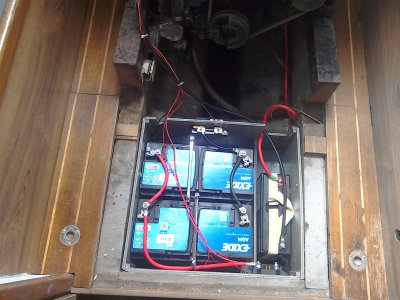
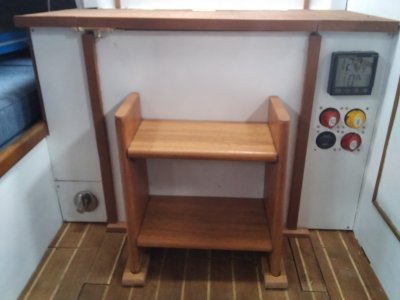
If the 3 are suitable to make a larger house bank then see if there is room for a 50Ah car starter battery - something recommended for a small Citroen Diesel for example and only use that for engine start. You don't say how you charge from the alternator or the solar, nor what switching arrangements you have as that is important to determine how you use the batteries. If you have deep pockets you could also consider a small high power engine start AGM like a Red Flash or an Odyssey. The photos show my arrangements with 2*95Ah house and an Odyssey in a very confined space. controlled by the BEP marine switch cluster which includes a VSR and an emergency parallel switch. no solar as I am marina based and use shorepower to keep them charged between trips. Not fully wired when the photo was taken.
 

Attachments

  • IMG_20220413_150908.jpg
    IMG_20220413_150908.jpg
    1,017.5 KB · Views: 6
  • IMG_20230223_132529.jpg
    IMG_20230223_132529.jpg
    1.9 MB · Views: 6
OP does not seem to be running a fridge. So the only long term current drain might be auto pilot assuming he has LED lights. It seems to me that he might actually be ok in practice with what he has. If he actually finds he is short of battery capacity then sure add another one. Or as said buy a new engine start battery and move the old engine start battery to parallel to house battery so increasing capacity. Just because others speak of large battery capacity it is the fridge that will demand capacity so you don't need to follow a trend.
As for special wiring arrangement for parallel batteries. It is a nice way to ensure resistance of wires is equal to all batteries so that on high demand all batteries are discharged (current) equally. The design essentially has all batteries in parallel but positive taken from one battery and negative from the other battery. However especially for domestic battery with decent wire size and modest current drain this will not be a concern. So just wire in parallel as is convenient to you. ol'will
 
Top