How long will this stern gland keep going.

Sorry, but you are not showing any "knowledge" in the sense that you have no hard evidence that this component degrades and fails in a specific timespan. On the other hand all the empirical (not anecdotal) evidence supports the view that at least as much as 20+ years of use shows no sign of any degradation of the rubber moulding - only possible wear on the lips. The one in the OP is 17 years old (or rather has been in use for 17 years - at is likely a year or 2 older).

I have not made any assumptions, unlike you who made the assumption that they will fail based on your knowledge of the well evidenced failures of different kind of rubber attachments made in a completely different way, of different material and performing a different function.

I prefer to look at what evidence is available on the performance of the specific item rather than on what happens elsewhere and not rely on a catchall phrase such as "all rubber degrades" The last may well (or not) be true, but that does not show wisdom.

BTW I am not calling for any help so your veiled threat that it would be denied because of a challenge to your unfounded claim of superior knowledge and wisdom.
 
My PSS failed at 8 years due to stiffening of the bellows and nearly sank the boat. The manufacturer recommends changing at 7/8 I think. Maybe this doesn't apply to a Volvo gland, but be sure about that as this is a failure that can do a bit more than ruin your day.
Precisely which is why I would never fit such a design - too complicated, too many points of failure and nearly 3 times the price.
 
I'm not missing the point, you made an assumption. I have seen failures from straight rubber connectors, not just bellows types. Rubber will degrade in time, there is no "may"

You continue to use anecdotes to argue against knowledge. That's fine, but don't call for help if you ignore good wisdom and later have a problem.
I think you need to define what specific material you mean by "rubber" and over what timeframe you are referring to.
 
Last edited:
I'm not missing the point, you made an assumption. I have seen failures from straight rubber connectors, not just bellows types. Rubber will degrade in time, there is no "may"

You continue to use anecdotes to argue against knowledge. That's fine, but don't call for help if you ignore good wisdom and later have a problem.
The seals are not made of rubber, per se. It is a very durable synthetic.

Experience tells me that the design, construction and wall thickness means they will have a long life.

Which has proved to be so, witness the OP.

Everything will degrade in time, that was NOT the question.

I think the question has been answered with only one naysayer.

I'm done on this one!
 
Sorry, but you are not showing any "knowledge" in the sense that you have no hard evidence that this component degrades and fails in a specific timespan. On the other hand all the empirical (not anecdotal) evidence supports the view that at least as much as 20+ years of use shows no sign of any degradation of the rubber moulding - only possible wear on the lips. The one in the OP is 17 years old (or rather has been in use for 17 years - at is likely a year or 2 older).

I have not made any assumptions, unlike you who made the assumption that they will fail based on your knowledge of the well evidenced failures of different kind of rubber attachments made in a completely different way, of different material and performing a different function.

I prefer to look at what evidence is available on the performance of the specific item rather than on what happens elsewhere and not rely on a catchall phrase such as "all rubber degrades" The last may well (or not) be true, but that does not show wisdom.

BTW I am not calling for any help so your veiled threat that it would be denied because of a challenge to your unfounded claim of superior knowledge and wisdom.
My knowledge comes from 30+ years in the marine industry, with manufacturer qualifications. Over this time I have witnessed many stern seal failures, many due to lack of, or poor maintenance. The company I work for now has a material science department, and we develop rubber materials for our own products. I am not a material scientist, however I feel I am more than adequatly "knowledgable" in this area, and I happy to support known, proven science in regard to rubber materials. What I have been saying is freely available to anyone who knows how to use a search engine, but here is a little more detail from some of our work:

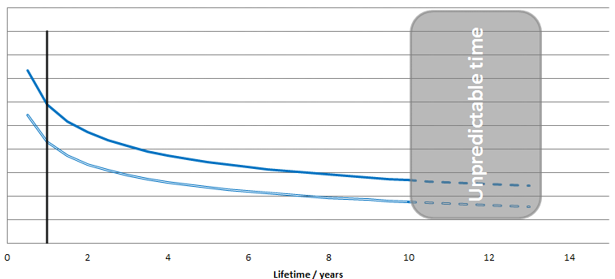
The VP seal is primarily made of nitrle rubber (NBR). NBR typically has a lifetime between 5 and 15 years.

Rubber materials change properties due to
–Time - the rubber relaxes
–Temperature - the rubber deteriorates
–Hardening by attack of oxidising agents (e.g., oxygen in air)
–Swelling or softening by absorption of chemicals in the fluids
–Openings – mechanical deterioration


The graph below shows NBR estimated lifetime. These are for specific grades that we develop so I've had to redact some information. What is important is that the material becomes unpredictable in regards to lifetime after around 10 years. The graph below is for a water/water application and does not account for any chemical effects.

1748330417805.png

Given that these seals are exposed to all of the factors that affect material property, it supports why the manufacturer suggests to replace around 7 years. That many are still going at 15+ years speaks highly of their quality, but the fact is the material is unpredictable at this age, so the risk needs to be weighed up with the cost (and hassle) of an unexpected failure. I take issue with bad advice that has such a potentially harmful outcome.
 
My knowledge comes from 30+ years in the marine industry, with manufacturer qualifications. Over this time I have witnessed many stern seal failures, many due to lack of, or poor maintenance. The company I work for now has a material science department, and we develop rubber materials for our own products. I am not a material scientist, however I feel I am more than adequatly "knowledgable" in this area, and I happy to support known, proven science in regard to rubber materials. What I have been saying is freely available to anyone who knows how to use a search engine, but here is a little more detail from some of our work:

The VP seal is primarily made of nitrle rubber (NBR). NBR typically has a lifetime between 5 and 15 years.

Rubber materials change properties due to
–Time - the rubber relaxes
–Temperature - the rubber deteriorates
–Hardening by attack of oxidising agents (e.g., oxygen in air)
–Swelling or softening by absorption of chemicals in the fluids
–Openings – mechanical deterioration


The graph below shows NBR estimated lifetime. These are for specific grades that we develop so I've had to redact some information. What is important is that the material becomes unpredictable in regards to lifetime after around 10 years. The graph below is for a water/water application and does not account for any chemical effects.

View attachment 193913

Given that these seals are exposed to all of the factors that affect material property, it supports why the manufacturer suggests to replace around 7 years. That many are still going at 15+ years speaks highly of their quality, but the fact is the material is unpredictable at this age, so the risk needs to be weighed up with the cost (and hassle) of an unexpected failure. I take issue with bad advice that has such a potentially harmful outcome.
I was on passage on a yacht where one failed which was only 5 years old. The one on my own boat was 15 years old, and was changed at the next lift out after that incident.
 
I take issue with bad advice that has such a potentially harmful outcome.


Volvo type seals have been around for over 35 years. Many manufacturers fit as OE.

During exhaustive research by myself, backed up by Tranona's research, there appear to have been no catastrophic failures of the Volvo type seal causing the loss of a vessel or life.

However, I personally know of-and as you have also experienced- failures of the rubber 'cuff' joining a conventional 'squash a bit of string around the shaft' type and the stern tube.

I also know of two catastrophic failures of the bellows of face seal types, plus a couple more 'heresay' ones from fellow club members. One sunk on its mooring, writing it off, one only just made it to a safe haven where it was quickly lifted, saving it from the same fate. Had not the owner, a fellow vintage motorcyclist, well versed in the art of bodging temporary repairs, not used a thick plastic bag, 3mm line and gaffer tape to 'wrap' the bloody lot up, stemming the flow to a just manageable level, that would have gone down too.

The Volvo seal IS NOT a universal panacea. As for it being made of nitrile rubber, I have a large selection of synthetic rubber 'O' ring seals in my workshop, including nitrile. Some are over thirty years old. Stored in their compartmented box, in the dark for most of the time, away from UV rays, they appear as good as the day I bought them. I certainly use them when required without hesitation. As I do the viton ones, used for their resistance to racing fuels.

The Volvo seal is, however, in my direct and extensive experience, the best of what is available.

Regarding its durability-try cutting one with a stanley knife with a new blade-I did, it is bloody tough stuff!

We shall agree to differ on this, direct experience against theoretical knowlege.

Prudence means I shall change mine before it is ten years old. But only when the cutless needs doing again, not because the seal is leaking or defective. I shall fit a new cuff too. A cuff is required on my installation as I moved it 8 inches forward for better access.

I am fortunate to own a serious high end boat. If it were a 30 year old AWB, my philosophy might very well be different. Horses for courses.

I repeat, there is no documented record of a Volvo seal causing loss of a vessel or life. I wish it were so for other types of seals.
 
I was on passage on a yacht where one failed which was only 5 years old. The one on my own boat was 15 years old, and was changed at the next lift out after that incident.
The Volvo one failed? What was the nature of failure? Catastrophic or increased drip/flow rate?
 
The Volvo one failed? What was the nature of failure? Catastrophic or increased drip/flow rate?
Yes, the Volvo seal, it wasn' t catastrophic at all. It was a much increased drip flow, but still just drips, the owner of the boat stated he had changed it 5 years previously. The boat was lifted out, a new one delivered and then fitted by the owner and another friend.
 
Yes, the Volvo seal, it wasn' t catastrophic at all. It was a much increased drip flow, but still just drips, the owner of the boat stated he had changed it 5 years previously. The boat was lifted out, a new one delivered and then fitted by the owner and another friend.
I reported on one (above) which the engine installer had damaged. It began to drip a few months later.

When I was in Almerimar the English bloke who ran the yard told me to be very careful to use the boot to insert the shaft. I think he must have seen/done it incorrectly.

Good to hear that it was just a drip, albeit increased.

My view is Volvo would take the engineering approach and - if they expect it to last 15 years or more - will say change at half that period.
 
direct experience against theoretical knowlege
I have direct experience, and knowledge - much like you. FWIW, I agree with you on the quality of the VP seal, your own approach on your boat is also the same as I advised.

ISO 2230 states NBR rubber is given a 7 year storage shelf life in ideal conditions for good reason.
 
So Volvo are selling an off the shelf item which may have been on the shelf for several years then telling customers to keep it in place for 7 years?
 
So Volvo are selling an off the shelf item which may have been on the shelf for several years then telling customers to keep it in place for 7 years?

That not the only piece of marine equipment with a shelf-life that could have been on the shelf for some time

Replacement batteries for EPIRB; s also has a shelf life but with no manufacturing date so we cannot tell how much life is left

This also applies to EPIRB, s then selves,

Shelf life depends on the conditions of storage, and the life of any product also depends on the usage conditions.

This also applies to any produce best before date like life rafts. life jackets and first aid kits

Where the manufacturer sets a best before / service date there is always a increase incentive in an income / increase in sales motive

Every time my car goes in for a service the service agent always reports my brakes need relining and disks need replacing. When I check then myself, I find plenty od brake lining left and no disk damage
 
So Volvo are selling an off the shelf item which may have been on the shelf for several years then telling customers to keep it in place for 7 years?
Volvo Penta are very good at inventory management in my experience. All the rubber items they produce/sell from factory will have a DOM (date of manufacture). They will control stock in their own facilities and won’t risk obsolete stock.

When I ran a dealership, we had regular opportunities for stock return, VP were very good with this and it meant we could ensure we had good rotation. In addition, they were very helpful with stock levels for fast, seasonal and slow moving items and we had good systems to help us manage - this was 15 years ago, so it must be much better now. I can’t speak for every dealer, but we didn’t have any stern seals or saildrive diaphragms over a year old on the shelf.
 
Just for Moodysailors information.

I have already mentioned my workshop box of nitrile rubber seals, I have had them for over 30 years. A few popular sizes have been topped up, but the majority are as bought from the supplier in 1994 when I had the Fairford Motor Company.

I also have some new 30mm nitrile rubber 'O' rings which fit a deck filler on our boat. I chose a new one and an old one of the same size-30mm-and subjected them to a simple destructive test.

A 6mm rod was clamped in my bench vice. 6 inches of 6mm rod was used as a puller. My spirit level, marked with measurements in mm was placed where stretch could easily be measured.

There was absolutely no difference in the point the nitrile rubber snapped between the old one and a newish one. Both stretched in excess of 90% in length and required a very strong pull to break it.

Just sayin..........................

The 'Shelf Life' or reccomended use life is often a requirement of Insurance Companies due to punative damages awarded in the USA. For example, one I know about from working for a major motorcycle firm :-

Most motorcycle disc brakes are marked with 'Minimum thickness 9mm' or similar. The discs are perfectly safe below 9mm but American Product Liability law suits mean if a failure occurs and the disc is 8.9mm, the company is in the clear. It is ass covering, pure and simple.
 
Last edited:
Top