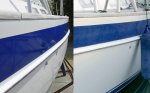
How long does it take to wash, polish and then wax grubby oxidised gelcoat?

Does anyone feel that the benefits of compounding a hull is often short lived ?

It seems true in my own case but I have tended to purchase older boats. I bought a boat one time where if you looked closely at the gelcoat topsides , you could see the wiggly strands of polyester. Possibly the boat was compounded every year.

There was a family close to my berth who spent a number of weekends compounding and polishing a blue Beneteau that looked fantastic when finished. Unfortunately, after a couple if years it returned to it's original state. A dark colour is probably not the best example but I wonder if a hull, after so many years , should be just cleaned and polished. Or perhaps it's to do with the quality of the materials used to build the boat.
Regular compounding can’t be a good thing, I never use a cutting compound unless absolutely necessary. Polish only. The key to longevity, I think, is multiple coats of wax. Never wash with detergent.
 
Regular compounding can’t be a good thing, I never use a cutting compound unless absolutely necessary. Polish only. The key to longevity, I think, is multiple coats of wax. Never wash with detergent.
I wouldn’t use an abrasive unless definitely needed. As I said, my topsides still only need cleaning and waxing after 22 years but my HR blue line went a bit dull from ten years ago. The ultimate cure for this is to overpaint it, as many have done, so I started using a cutting compound from that time and have got it back to looking pretty good through the season, in fact it doesn’t look noticeably dull even now. My reasoning was that I can be as rough as I wish because the worst that could happen is that it will need painting, which would have happened anyway.
 
Does anyone feel that the benefits of compounding a hull is often short lived ?

It seems true in my own case but I have tended to purchase older boats. I bought a boat one time where if you looked closely at the gelcoat topsides , you could see the wiggly strands of polyester. Possibly the boat was compounded every year.

There was a family close to my berth who spent a number of weekends compounding and polishing a blue Beneteau that looked fantastic when finished. Unfortunately, after a couple if years it returned to it's original state. A dark colour is probably not the best example but I wonder if a hull, after so many years , should be just cleaned and polished. Or perhaps it's to do with the quality of the materials used to build the boat.
It depends very much on the quality of the gelcoat. I have seen a number of dark blue Beneteaus where after a number of years the colour faded to a much lighter blue, while at the same time the gelcoat became dull.
But spare a thought for owners of blue GRP boats. There is nothing so frustrating as polishing a blue hull. In the first place a dark hull shows up all the dings, scuffs and scratches in a way that a white hull never does. Polishing causes you to be so close to the boat's hull that you become acutely aware of every minimal blemish. Secondly, when you think you are ready and take a few steps back to judge and hopefully admire the result, you will inevitably see any number of imperfections, which you will try to remove. Before you know it, you have embarked on another pass all around the boat. It always takes a conscious decision to stop and no longer look for imperfections. Fortunately, once you get a good shine and move further away, the shine is what catches the eye.
(written on the basis of 11 seasons worth of polishing a blue boat that has a good quality gelcoat)
 
Do you have a link to your tower?
I’ve contacted Clyde Tool Hire but it’s good to consider alternatives. Likely to be doing it in March/April before season launch so inclement Scottish weather is always going to be a gamble ?
Sorry for the delay, I am having trouble pasting the link. Its something like the one in the link below but slightly higher. The allow tubes are quite thin and light which is good but may be a bit light for commercial use. It should be on view at Kip Marina and also in the shed at JWD some time from Feb onwards.


Youngman Minimax Alloy Tower Base Pack (midlandladders.com)
 
It depends very much on the quality of the gelcoat. I have seen a number of dark blue Beneteaus where after a number of years the colour faded to a much lighter blue, while at the same time the gelcoat became dull.
But spare a thought for owners of blue GRP boats. There is nothing so frustrating as polishing a blue hull. In the first place a dark hull shows up all the dings, scuffs and scratches in a way that a white hull never does. Polishing causes you to be so close to the boat's hull that you become acutely aware of every minimal blemish. Secondly, when you think you are ready and take a few steps back to judge and hopefully admire the result, you will inevitably see any number of imperfections, which you will try to remove. Before you know it, you have embarked on another pass all around the boat. It always takes a conscious decision to stop and no longer look for imperfections. Fortunately, once you get a good shine and move further away, the shine is what catches the eye.
(written on the basis of 11 seasons worth of polishing a blue boat that has a good quality gelcoat)
I met a chap earlier in the year who had just taken delivery a of a new blue topsided yacht . It was hard to tell, but it was vinyl wrapped . He reckoned he would get three to five years before the wrap had to come off. After five years he planned to buy a new different yacht anyway. His thinking was when it was time to sell he could still get top dollar.
 
Fibreglass polish is an abrasive isn't it?

A very bad hull might even need sanding, but I'd leave that to a pro...
For many years I assumed that ‘polish’ is what one used, because that’s what one did with the car. Only later did I realise that all good gelcoat needs is wax. Some of my boat, such as the stern, is in less good condition, from exposure to sun probably, so I treat this and some stained bits of cockpit, with Starbrite Color Restorer (sic) polish first which is like a mild cutting compound and very effective and easy to use, before waxing over it. I generally use polish on the coachroof because it tends to absorb dirt.
 
In my experience, if neglected the hull may need a light cutting back then polishing.
From then polishing with a high wax polish and application of a UV wax on an annual basis keeps the topsides looking as new - until at least 25 years (then sold!)
As John Allison says, the blue line, upon purchase at 11 yr old and neglected took 2 years of light cutting and polishing to get to standard.
Once pukka, polish annually. I have covid to thank and waiting until 'release ' in July. Dry weather for the impressive as new result.
Unfortunately file is too large to load to show result.
 
I used to use 3M finishing compound and could wash, use compound, wash compound off and get a coat of wax and polish up on the hull (36') in one day - one side only!
At the end of two days I was knackered as I only had a ladder to get access to everything and the machine polisher had a small pad and was heavy. Hull looked good tho'

Eventually I paid one of the contractors to do it and he used a lighter weight polisher with a bigger pad and simply applied polish and cleaner in one go and that was a bit over £200. Eventually I got a different contractor who did the whole thing as I did rather than a single step.

I always did the coachroof and bits myself and last time after washing it simply used one of the starbrite PTFE polishes and didn't use the machine at all. Justy applied and polished off by hand. Boat came up like new.
 
I used to use 3M finishing compound and could wash, use compound, wash compound off and get a coat of wax and polish up on the hull (36') in one day - one side only!
At the end of two days I was knackered as I only had a ladder to get access to everything and the machine polisher had a small pad and was heavy. Hull looked good tho'

Eventually I paid one of the contractors to do it and he used a lighter weight polisher with a bigger pad and simply applied polish and cleaner in one go and that was a bit over £200. Eventually I got a different contractor who did the whole thing as I did rather than a single step.

I always did the coachroof and bits myself and last time after washing it simply used one of the starbrite PTFE polishes and didn't use the machine at all. Justy applied and polished off by hand. Boat came up like new.
Fast work. Wanna job?
 
This was my boat, taken in April and a week ago. I have lightened the recent one to make it look much worse than it actually does. A day of work and it will look like the left-hand picture again, actually more like two days for both sides.
P1120280.jpg
 
That’s it though isn’t it ?
Working daylight hours ( the gym by the water ) when the weather is right and good for the job in hand . And splash the boat ready for the season.
Works for me too
I guess it depends, if you are hobby “working” on your own boat in your own time a lazy days “working” is wonderful. If I am working a paid days work then the former ! 0800-17:30 essential breaks only.
 
Top