How long anchor rope/rode for UK inshore wandering?

You are probably right regarding the physics and geometry but somehow it does seem to work!
I don't have any formula but understand after decades of experience that less scope is fine in greater depth.

Probably we don't need a precise formula. Catenary rules!

I am a big fan of Steve Dashew and have adopted all kinds of his ideas, but one thing I differ with him about is the significance of catenary. Dashew advocates saving weight by using lighter, high strength (G70) chain. His reasoning is that in ultimate conditions, the catenary is gone anyway. This neglects the fact that in deep water, the effect of catenary with heavy chain is immensely powerful.
 
I don't have any formula but understand after decades of experience that less scope is fine in greater depth.

Probably we don't need a precise formula. Catenary rules!

I am a big fan of Steve Dashew and have adopted all kinds of his ideas, but one thing I differ with him about is the significance of catenary. Dashew advocates saving weight by using lighter, high strength (G70) chain. His reasoning is that in ultimate conditions, the catenary is gone anyway. This neglects the fact that in deep water, the effect of catenary with heavy chain is immensely powerful.
While it is true that heavy chain has more catenary a similar effect of dampening movement can be achieved by using lighter chain and a snubber. Many modern boats are not able to use heavy chain either because of a restricted locker size or the negative impact of the additional weight in the bows on sailing performance. Catenary effectively disappears in winds of greater than the high 20s knots when the chain becomes just the link between the anchor and the boat. Lighter chain is more than strong enough to perform that function. Vyv Cox who posts frequently here as well as writing in YM and PBO has done empirical testing that confirms this as have Practical Sailor in Australia.

Dashew is not alone in his views on catenary and chain size. Peter Smith who designed the Rocna has similar views petersmith.net.nz/boat-anchors/catenary.php
 
While it is true that heavy chain has more catenary a similar effect of dampening movement can be achieved by using lighter chain and a snubber. Many modern boats are not able to use heavy chain either because of a restricted locker size or the negative impact of the additional weight in the bows on sailing performance. Catenary effectively disappears in winds of greater than the high 20s knots when the chain becomes just the link between the anchor and the boat. Lighter chain is more than strong enough to perform that function. Vyv Cox who posts frequently here as well as writing in YM and PBO has done empirical testing that confirms this as have Practical Sailor in Australia.

Dashew is not alone in his views on catenary and chain size. Peter Smith who designed the Rocna has similar views petersmith.net.nz/boat-anchors/catenary.php
An "interesting" half hour read.
Unless I mis-read (and I don't plan to read again) he mentions in passing the benefit of the weight of chain in helping the anchor to set, and maintain a horizontal pull as loading increases, but he doesn't seem to take this into account in his conclusions. Beyond this, he seems to imply that rope or chain doesn't make any difference, but bases all his tests/conclusions on all-chain. He considers the reduction in scope from 7.5:1 to 4:1 as not significant as the depth increases - in my thinking, it makes a big difference to the amount of rope/chain you need to carry in a small(ish) boat.

Anyway, I'm shopping for 100m of 12mm polyester.
 
.......I don't have a winch, so it will all have to be hauled by hand

I think my options are:
  1. Add the 40m length of 16mm nylon to the existing 20m chain (by far the cheapest/simplest option).
  2. Buy 100m of 16/14mm? nylon and add to the 20m chain.
  3. Buy 100m of something else (polyester) and add it to the chain.
  4. Relegate the chain to "spare" and buy 100m of new chain........

Do 1 and save your money. Don't splice it, then you have a long warp for other uses

Buy 40 - 50 metres of chain when the existing goes rusty. The only time you will possibly have to add a bit of rope, off the south coast, is in the Bay of St Malo

.
 
…….

30m is enough for 6:1 in 5m of water (well, 5m of water plus height of the bow roller), which should allow the OP to anchor on all chain in most cases. …..
Except you are being vague / over simplistic. 5m at chart datum might be at least 9m at HW with a modest 4m tide, 10m at the bow roller.
And if thinking 5m at HW, we would be aground at LW.

Plus life is rarely simple with a nice wide flat bottom at perfect depth. If got 40m chain out then the boat is doing a c50m arc - as the rudder is perhaps 10m behind the bow roller.
Keeping a safe distance from the shallows / rocks / hazards at LW often means being further out - and then the water gets deeper.
Plus in many places the inshore spots are occupied by moorings.

Hence it can be rare in many places to find an anchoring spot in 5m at chart datum. Hence often pushed out to 10m + tide.
 
An "interesting" half hour read.
Unless I mis-read (and I don't plan to read again) he mentions in passing the benefit of the weight of chain in helping the anchor to set, and maintain a horizontal pull as loading increases, but he doesn't seem to take this into account in his conclusions. Beyond this, he seems to imply that rope or chain doesn't make any difference, but bases all his tests/conclusions on all-chain. He considers the reduction in scope from 7.5:1 to 4:1 as not significant as the depth increases - in my thinking, it makes a big difference to the amount of rope/chain you need to carry in a small(ish) boat.

Anyway, I'm shopping for 100m of 12mm polyester.
He is writing from the perspective of cruising boats maybe larger than yours, although the principles remain the same. The jury is out on whether chain helps anchors set and/or heavier chain is better for setting. This idea largely comes from experience with older style anchors particularly the CQR which often has difficulty setting because of its geometry and fluke shape and a more horizontal pull with heavy chain seems to improve setting. The "lots of heavy chain" school of thought comes from this period when the CQR was king. However almost all the tests of anchors and anchor setting tend to confirm the CQR behaves in this way but most other anchors particularly what are known as New Generation do not, but set almost instantly with either all chain, all rope or mixed.

For your use and boat it is a toss up whether a mixed rode with 20m+ of 8mm chain and 50m rope or an all chain of smaller size is better. I prefer the latter but better with a windlass. The reality is that virtually all anchoring around the UK is good in terms of seabeds and shelter. Most pleasure sailors avoid extreme weather and success in anchoring is as much to do with technique as the gear you use. Choosing your spot, deploying the correct scope and making sure the anchor has set, if necessary applying load in reverse should ensure a good night's sleep.
 
An "interesting" half hour read.
Unless I mis-read (and I don't plan to read again) he mentions in passing the benefit of the weight of chain in helping the anchor to set, and maintain a horizontal pull as loading increases, but he doesn't seem to take this into account in his conclusions. Beyond this, he seems to imply that rope or chain doesn't make any difference, but bases all his tests/conclusions on all-chain. He considers the reduction in scope from 7.5:1 to 4:1 as not significant as the depth increases - in my thinking, it makes a big difference to the amount of rope/chain you need to carry in a small(ish) boat.

Anyway, I'm shopping for 100m of 12mm polyester.
My preference would be for a all chain rode. It takes up less space than rope, it doesn't suffer from chafe and it doesn't knot in the chain locker.
Experimenting with second anchors set in a Y pattern when we have been in nasty weather, I have run out a lightweight aluminium Fortress anchor on all rope rode. The anchor doesn't set well in a hard bottom. Add 10ft of chain and the anchor will set far more effectively.
It would be interesting to work out the physics of why this helps but it certainly does.
 
My preference would be for a all chain rode. It takes up less space than rope, it doesn't suffer from chafe and it doesn't knot in the chain locker.
Experimenting with second anchors set in a Y pattern when we have been in nasty weather, I have run out a lightweight aluminium Fortress anchor on all rope rode. The anchor doesn't set well in a hard bottom. Add 10ft of chain and the anchor will set far more effectively.
It would be interesting to work out the physics of why this helps but it certainly does.
I agree that about 5 metres of chain on a rope warp seems to help a Fortress to set in some bottoms, although I believe that Fortress deny this.

However, as Tranona suggests, modern anchors seem to work well on far smaller scopes than used to be recommended. I have sat out some quite strong winds with a Rocna on 4:1 scope on chain and once, due to a misunderstanding over length markings, withstood a full gale for more than 24 hours on a Fortress at 3:1 scope, 5 metres depth, 5 metres 8 mm chain and 10 metres 16 mm Octoplait.
 
I agree that about 5 metres of chain on a rope warp seems to help a Fortress to set in some bottoms, although I believe that Fortress deny this.

However, as Tranona suggests, modern anchors seem to work well on far smaller scopes than used to be recommended. I have sat out some quite strong winds with a Rocna on 4:1 scope on chain and once, due to a misunderstanding over length markings, withstood a full gale for more than 24 hours on a Fortress at 3:1 scope, 5 metres depth, 5 metres 8 mm chain and 10 metres 16 mm Octoplait.
We sat out 35kts with 2.5:1 scope. I had reversed the chain as one end was getting rusty. I cooked up the markings when I did this and didn't realised until we decided to remark the chain a couple of weeks later. 30kg Spade anchor
 
Musketeer (Moody 29) came with about 20m of chain, with a short (about 2m) tail of 16mm rope. As far as I can see, this seems to have been the standard fit from new? Most of the sea around here pretty rapidly drops to 20-30m once you clear the cliffs/rocks, and, with a typical 5m (6m springs) tidal range that doesn't seem much use!

What length rode do most people use? I'm thinking about adding some 16mm 3-strand nylon to the 20m chain, so how much?

Thanks.
PS. no discussions on anchor types ;)
We are moored just up the river from you with a 30’ Beneteau and find 20m chain and 40m nylon rode plenty for local-to-Isles of Scilly anchoring.
 
I agree that about 5 metres of chain on a rope warp seems to help a Fortress to set in some bottoms, although I believe that Fortress deny this.

I .....once ......withstood a full gale for more than 24 hours on a Fortress at 3:1 scope, 5 metres depth, 5 metres 8 mm chain and 10 metres 16 mm Octoplait.
Oh, the vagaries of the Cooley-Tukey FFT Algorithm and the power of the Book of Common Prayer!

:cool:
 
We are moored just up the river from you with a 30’ Beneteau and find 20m chain and 40m nylon rode plenty for local-to-Isles of Scilly anchoring.
My hope if for Isles of Scilly next year. My concern is 20+40m might be a bit on the short side for a lot of Cornish coastal anchoring. The bay outside my front door pretty soon gets to 20m, although there is a charted anchorage closer in with 4-5m charted (so need to allow for 10m).

I'll look out for you next time I'm there (I visit the boat a couple of times most weeks, although I don't necessarily sail anywhere).
 
My hope if for Isles of Scilly next year. My concern is 20+40m might be a bit on the short side for a lot of Cornish coastal anchoring. The bay outside my front door pretty soon gets to 20m, although there is a charted anchorage closer in with 4-5m charted (so need to allow for 10m).

I'll look out for you next time I'm there (I visit the boat a couple of times most weeks, although I don't necessarily sail anywhere).
As a Bristol Channel and S Cornish coast anchorer I assume 12 to 6m tides on top of local LT depth and its at HT I am most exposed. Thus 5m LT depth means I might need 3*17=51m

I would never have less the 50m of chain. Even that would not do if I urgently needed to anchor mid Plymouth sound or by the Lizard due some emergency - which actually happened when complete fuel system failed when passing the Lizard the previous year and the nearest I could sail to rocks and some shelter was still 25m to 30m deep. It might be ok for Lake Solent, but not down where I am

I dare say 30m of chain plus 40m of plait would do nearly as well as 50m of 8mm, but having finally got the pleasure of a capstan set for 8m chain I wouldnt want the bother of swapping half way from plan drum to toothed gypsy
 
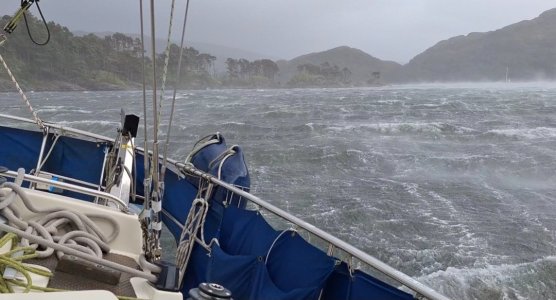
Storm Floris, 50m chain out in 5m of water. 10m in reserve in case i had to replace the bridle. Rope V bridle, home made from reading this forum. Terrifying but it all held.
Screenshot_20250806_212654_Gallery.jpg
My advice is to have a decent length of chain (50-60m), probably 6mm if no winch. Mark it properly. Have a long length of line you can shackle on if it's ever needed. Then you can also use it as a separate long line or kedge.

Oldmanofthehills comment about tide rise/fall is very relevant. My choice for Storm Floris used the fact that the tide was neap and I could set and swing in shallow water. I avoid deeper (15m+) anchorages mainly because the bottom substrate is less certain.

If you can always run to a marina when bad forecasts happen, then disregard.
 
Last edited:
Storm Floris, 50m chain out in 5m of water. 10m in reserve in case i had to replace the bridle. Rope V bridle, home made from reading this forum. Terrifying but it all held.
View attachment 197354
My advice is to have a decent length of chain (50-60m), probably 6mm if no winch. Mark it properly. Have a long length of line you can shackle on if it's ever needed. Then you can also use it as a separate long line or kedge.

Oldmanofthehills comment about tide rise/fall is very relevant. My choice for Storm Floris used the fact that the tide was neap and I could set and swing in shallow water. I avoid deeper (15m+) anchorages mainly because the bottom substrate is less certain.

If you can always run to a marina when bad forecasts happen, then disregard.
Where were you anchored?
 
Storm Floris, 50m chain out in 5m of water. 10m in reserve in case i had to replace the bridle. Rope V bridle, home made from reading this forum. Terrifying but it all held.
View attachment 197354
My advice is to have a decent length of chain (50-60m), probably 6mm if no winch. Mark it properly. Have a long length of line you can shackle on if it's ever needed. Then you can also use it as a separate long line or kedge.

Oldmanofthehills comment about tide rise/fall is very relevant. My choice for Storm Floris used the fact that the tide was neap and I could set and swing in shallow water. I avoid deeper (15m+) anchorages mainly because the bottom substrate is less certain.

If you can always run to a marina when bad forecasts happen, then disregard.
I also have 60m of plait plus 20m of chain and have used that for a V anchoring system with my kedge to sit out a storm in Scilly on our previous 32footer Westerly and I could conceivably add that to my primary anchor rode, though having sat happily on our new generation 11kg Manson Supreme as a single in the last blow as it howled through Porth Conger at 38+ knots I dont foresee such a need unless holding very poor

Our old 7.5kg Bruce spare is now stowed on the stern rail a/ to keep weight away from bows, b/ it still enables me to launch on the 60m warp it from the safety of the cockpit in an emergency without carrying a 7.5kg jagged lump along rolling narrow side deck - though I would still need to pull bitter end of the warp to the foredeck unless I accepted anchoring by the stern in our pointed end LM27
 
Last edited:
Where were you anchored?
Loch Moidart, behind Riska.
I also have 60m of plait plus 20m of chain and have used that for a V anchoring system with my kedge to sit out a storm in Scilly on our previous 32footer Westerly and I could conceivably add that to my primary anchor rode, though having sat happily on our new generation 11kg Manson Supreme as a single in the last blow as it howled through Porth Conger at 38 knots I dont foresee such a need unless holding very poor

Our old 7.5kg Bruce spare is stowed on the stern rail a/ to keep weight away from bows, b/ it still enables me to launch it from the safety of the cockpit in an emergency without carrying a 7.5kg lump along rolling narrow side deck - I would still need to pull bitter end of the warp to the foredeck unless I accepted anchoring by the stern in our pointed end LM27
I had a kedge ready to go but at its height the motion of the boat (pitching, heeling) would have made it very difficult to set. You could tie it at the bow and lead it aft? I didn't set two anchors as in the night hours before it started the tide swings the boat plus the wind shifted 180 degrees during the storm and I didn't want tangled rodes.

Back to the OP, a lot to be said for a good solid well sized anchor, rode and snubber that will deal with (almost) anything.
 
Wowvlooked wild for such an enclosed area of water
I chose it because it was landlocked and I knew the holding was good. I think the downside was the squalls funnelling between hills. I was amazed by the waves generated in such a short fetch and have only seen wind and sea like that in films about Chile.

Really hoping it was a once in a lifetime experience!
 
Top