How good is your solar?

geem

Well-Known Member
Joined
27 Apr 2006
Messages
9,096
Location
European side of the pond
Visit site
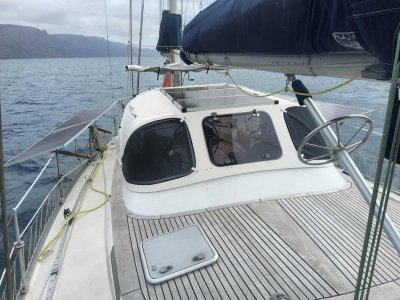
I previously had 4x180A 12v panels wired in series pairs and 4x50w crappy flexible panels giving me a total of 920w of solar. This winter I upgraded to 4x250w 12v bifacial panels and 3x100w 24v panels. The 250w panels are only 75mm longer and 50mm wider than the old 180w panels.
We have no gas onboard. All electric cooking, 240l/hour watermaker, immersion heater all running off a 3kw inverter. The boat is 24v. The maximum solar output we have seen so far is 42A at 24v. Over 1100w of output or 84A in 12v money. The 5kVA diesel genset is effectively redundant. We keep it as back up should we have an inverter problem. The genset is currently getting 20 minute run time per month under load to exercise it. We carry a spare inverter just in case.
Solar is truly amazing. We can run the boats day to day loads, fossil fuel free. No noisy wind turbine any more and no towed generator. The solar easily runs our loads. Long hot showers everyday are now the norm🙂
 
good for you!

need to replace/upgrade my 2X300W 48V rigid panels on the hardtop, they are 8yo and I feel they don't produce what they did when freshly installed. However, since I've changed quite a few things in the meantime, I cannot be really sure... maybe next year.
Over a month onboard this summer and generator was 3.5h in total (the one h was yesterday for the watermaker as sun is a bit low and not getting many hours now in Sept)
 
good for you!

need to replace/upgrade my 2X300W 48V rigid panels on the hardtop, they are 8yo and I feel they don't produce what they did when freshly installed. However, since I've changed quite a few things in the meantime, I cannot be really sure... maybe next year.
Over a month onboard this summer and generator was 3.5h in total (the one h was yesterday for the watermaker as sun is a bit low and not getting many hours now in Sept)
My old panels were P type cells. The new cells are N type. Supposed to be far more efficient. Panel tech is improving
 
I have about a kw on my cat, feeding the inverter and the electric propulsion. Works great. I am in a bit of a transition from a 24v to 48v system at the moment so there is rationalisation to be done - but it is getting there. I am less certain how good it will be over winter - but I tend to use marinas a bit more then, so if I can plug in it won't make much of a difference. I am aiming for fuel free boating...

of note on the cat my rigid panels seem to do most of the work (about 800w, and produce between half and 90% of rated output depending on the time of day). the semi flex panels bonded to the deck add sub 100 watts in total even at the best of times, despite them being 300w in total.

My contessa 26 has 80w of solar on board. A far cry from the cat - but she is a lot more traditional in her load out so this has proven adequate both summer and winter for a couple of years.
 
Last edited:
We have a similar result. In areas of reasonable insolation, our 1005W provides all our electrical power, including electric cooking, hot water heating, watermaker, etc. We have no generator.

If you have the room, solar, especially rigid solar panels, are the best electrical power source for cruising yachts.

BTW, the first solar panel we fitted to a cruising yacht was over 35 years ago. It was only 42W but still provided all our electrical needs. We have become greedier in the meantime :).
 
We have a similar result. In areas of reasonable insolation, our 1005W provides all our electrical power, including electric cooking, hot water heating, watermaker, etc. We have no generator.

If you have the room, solar, especially rigid solar panels, are the best electrical power source for cruising yachts.

BTW, the first solar panel we fitted to a cruising yacht was over 35 years ago. It was only 42W but still provided all our electrical needs. We have become greedier in the meantime :).
We have sailed from the UK to the Canaries and solar has powered everything. We have an excess of solar generation so we can get through a few days of cloudy weather relying on the large lithium bank.
 
We have an excess of solar generation so we can get through a few days of cloudy weather
This is one of the important criteria for a successful solar installation for boats without a generator, unless you are prepared to tie up to marinas or run the propulsion engine frequently.

The other important feature is to install electrically efficient systems.

If you wish to sometimes cruise areas of poor solar insolation, you will also need non-electrical backups for heavy-demand electric devices such as electric cooking and hot water heating.
 
This is one of the important criteria for a successful solar installation for boats without a generator, unless you are prepared to tie up to marinas or run the propulsion engine frequently.

The other important feature is to install electrically efficient systems.

If you wish to sometimes cruise areas of poor solar insolation, you will also need non-electrical backups for heavy-demand electric devices such as electric cooking and hot water heating.
We do. It's a 5kVA generator🙂
 
Out of interest, what is the total surface area occcupied by your panels
The total surface area is quite easy to calculate:

The surface area ( in sqm) ‎ =  The wattage of the array/1000 x the efficiency.It is important to use the panel efficiency, not the cell efficiency. Solar panel efficiency varies between about 15% to 22%.

My 6-year-old panels have an efficiency of 21%. I have three panels totalling 1005W.
Therefore, the area taken up (if the panels are butted together) is:

1005/(1000 x 0.21) = 4.7 square meters.

You can plug in the numbers for any wattage you require and solar panel efficiency that you can buy. How you find the room on a small boat, especially room that is relatively shade free, is a much harder question.
 
Last edited:
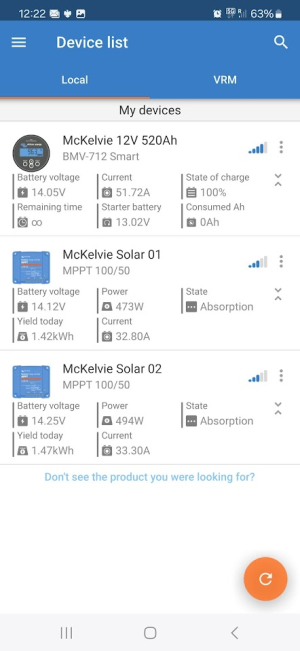
We have 4 x 315W Half-Cut bifazial panels each at 35-42V (Total 1,26kW) on a solar arch on the stern ... they are currently feeding a bank of 4 x LA Gel batteries (520Ah). Panels are in a 2/2 series/parallel configuration. They are limited mainly by what the LA batteries will accept but here they are delivering around 1kW in the Adriatic - almost 3kWh generated by midday.

I went for 42Voc panels because my Li setup will be 48V .. need a bit of headroom above Vbatt for the MPPTs to function efficiently.

Next phase is to add the 10kWh of 48V LiFePO4 batteries, a 5kW inverter charger, and an Integrel 48V, 9kW generator. Will probably see more from the solar once the MPPTs are feeding Li instead of LA.

PS - For the pedants, this screenshot was taken before I set up the BT network that allows sharing of Vbatt by the shunt ... now they all see the same Vbatt and charging is coordinated between the MPPTs.

1757430700553.png
 
  • Like
Reactions: vas
The total surface area is quite easy to estimate:

The surface area ( in sqm) ‎ =  The wattage of the array/1000 x the efficiency.It is important to use the panel efficiency, not the cell efficiency. Solar panel efficiency varies between about 15% to 22%.

My 6-year-old panels have an efficiency of 21%. I have three panels totalling 1005W.
Therefore, the area taken up (if the panels are butted together) is:

1005/(1000 x 0.21) = 4.7 square meters.

You can plug in the numbers for any wattage you require. How you find the room on a small boat, especially room that is relatively shade free, is a much harder question.
We have 6.29m2 of panel area in total with 1300w
Edited
 
I bought a 36w panel a while ago for something over £500. It has worked perfectly well and has been useful, though it doesn’t quite keep up with the fridge. However, this works out at something over £15,000 per kilowatt. Is this a record?
 
We have 4 x 315W Half-Cut bifazial panels each at 35-42V (Total 1,26kW) on a solar arch on the stern ... they are currently feeding a bank of 4 x LA Gel batteries (520Ah). Panels are in a 2/2 series/parallel configuration. They are limited mainly by what the LA batteries will accept but here they are delivering around 1kW in the Adriatic - almost 3kWh generated by midday.

I went for 42Voc panels because my Li setup will be 48V .. need a bit of headroom above Vbatt for the MPPTs to function efficiently.

Next phase is to add the 10kWh of 48V LiFePO4 batteries, a 5kW inverter charger, and an Integrel 48V, 9kW generator. Will probably see more from the solar once the MPPTs are feeding Li instead of LA.

PS - For the pedants, this screenshot was taken before I set up the BT network that allows sharing of Vbatt by the shunt ... now they all see the same Vbatt and charging is coordinated between the MPPTs.

View attachment 199172
Our record yield is 6.3kWh in a day. We regularly achieve over 6kWh per day now. Our 250W panels are bifacial.
We left Holyead 48 days ago. I reset the Victron kWh meters on the Mppts before we left. We have harvested 265kWh in 48 days. 5.5kWh per day average.
 
I bought a 36w panel a while ago for something over £500. It has worked perfectly well and has been useful, though it doesn’t quite keep up with the fridge. However, this works out at something over £15,000 per kilowatt. Is this a record?
if the "while ago" was 30yrs, you're fine, else it is a record I guess...
 
I bought a 36w panel a while ago for something over £500. It has worked perfectly well and has been useful, though it doesn’t quite keep up with the fridge. However, this works out at something over £15,000 per kilowatt. Is this a record?
Assuming a 20 years life, averaging the output at 5 hours per day (clouds, low sun etc.--this is a typical allowance), that's about 131 KWh, or about $5/KWh. Yeah, not good.:)

At the more common ~ $1/100W, that would be more like $0.25/KWh, which is still more than generated power (typically about $0.18/KWh here in the US). In sunny locations that would be better, so obviously solar can make sense some places, including places with higher energy costs. Pretty clean too. And in your case, mobile.

In the case of my F-24, I have a 50W panel just so that I don't have to plug in at the dock. On my PDQ, obviously, it was about time away from the dock. It's not about $/KWh
 
Great value, but with no solar arch, these are not an option for us. Guardrail mounting allows us to tilt the panels towards the sun. This is worth about an extra 25% output. If you are short of space, tilting panels can really perform well, but you will need to adjust them during the day. We have so much power at the moment that I haven't bothered to adjust the panels for a few days. They just spend their time adjusted at about 25 degrees all day
 

Other threads that may be of interest

Top