How fast does your boat go under engine?

ridgy

Well-Known Member
Joined
26 Jan 2003
Messages
1,769
Location
North West
Visit site
Long story short I've been trying to determine if my engine is losing power and needs a rebuild or something, or if it's just a bit small.

Boat is a Limbo 9.9, sporty 80s racer thing. Goes well under sail, easily hits 8 knots on a beam reach in 16 knots.
Weight 3300kg (weighed on crane) mostly empty so call it 3700kg with three people on and a bit of gear.
Engine is a Yanmar 2GM so 13hp continuous at 3300rpm, 15 at 3600rpm. Original, 40 years old. Not had much love recently until it came to me. Starts instantly at all times and runs great however.
2.62 gearbox ratio.
Prop is a Bruntons varifold.

Ever since I've had it, it's been very slow under engine.
First I thought it was overpropped at 15x12 two blade folder since it didn't rev very high.
Spoke to Bruntons who suggested 14x10 so got new blades but it was even slower.
Then we realised that the control lever was buggered and not giving full travel so we replaced that and the cables.
Then we got a laser tachometer and measured both the engine and prop shaft speeds.

According to a prop calculator that I found, the boat should do 6 knots with 9hp.
According to the engine manual, 9hp is achieved at about 2400rpm, around the top of the torque curve.

Testing this weekend we got the following results. Speed measure by GPS in two directions, no wind or tide as such:
I also dived under and cleaned the prop before we did this.

Engine RPM / Prop shaft RPM / Ratio / Speed.
970 (tickover) / 326 / 2.97 / 1.5
1520 / 550 / 2.8 / 2.8
2000 / 760 / 2.63 / 3.9
2500 / 871 / 2.64 / 4.7
2630 / / / 5.2
2760 / / / 5.5
3000 / / / 5.8

Above about 2500 rpm, there was some grey smoke, quite smelly. We stopped measuring the prop shaft speed once we were satisfied that the gearbox wasn't slipping of something. Interesting that the apparent ratio seems to change at lower speeds, not sure if that's good or bad. We didn't feel the urge to go past 3000rpm although we did go up to 3300 in neutral just to check.
Since I don't really want to run it past 2600 I'm inclined to put the old 15x12 blades back on and try that.
For reference I have a share in a greek boat, similar size but a bit heavier and that has a Perkins M20 (18hp) with a 3 bladed prop and gives 5 knots at 2000rpm.

So, is my engine just too small and I'm expecting too much, or is the grey smoke a sign that it's losing power and needs a rebuild or something?

Interested to hear what speeds other people get for various boat/engine/prop combinations.
 
I’ve got a Parker 31, lift keel, 3 tonnes empty but with a much bigger engine than it needs really - 3gm30. 6.7kts at 3k rpm, 5.5 kts at 2k rpm, BUT only when prop and hull spotlessly clean. Prop is kiwiprop - not the best for drive. I wouldn’t say your speeds are too bad. You say prop is clean but when was hull last scrubbed? My engine puts out smoke above 2.5k rpm if hull and/or prop is fouled.
 
Spring 25, 1gm10 , just over 5 knots. I suspect that unless you go full McGregor and put 75hp on the back , waterline length is the issue and you won't get her to go much faster. You'd extra 5hp will help in the lumpy stuff
 
I think just too small. The nearest I have had was a Sadler 29, less sporty but of similar displacement. This had an 18hp Volvo 2002 of 18 hp and a fixed 2- bladed prop. We generally cruised at around 5.5-5.7 knots, though I didn't have a rev counter. This is all assuming a clean hull and prop, which would be critical.
 
Long story short I've been trying to determine if my engine is losing power and needs a rebuild or something, or if it's just a bit small.

Boat is a Limbo 9.9, sporty 80s racer thing. Goes well under sail, easily hits 8 knots on a beam reach in 16 knots.
Weight 3300kg (weighed on crane) mostly empty so call it 3700kg with three people on and a bit of gear.
Engine is a Yanmar 2GM so 13hp continuous at 3300rpm, 15 at 3600rpm. Original, 40 years old. Not had much love recently until it came to me. Starts instantly at all times and runs great however.
2.62 gearbox ratio.
Prop is a Bruntons varifold.

Ever since I've had it, it's been very slow under engine.
First I thought it was overpropped at 15x12 two blade folder since it didn't rev very high.
Spoke to Bruntons who suggested 14x10 so got new blades but it was even slower.
Then we realised that the control lever was buggered and not giving full travel so we replaced that and the cables.
Then we got a laser tachometer and measured both the engine and prop shaft speeds.

According to a prop calculator that I found, the boat should do 6 knots with 9hp.
According to the engine manual, 9hp is achieved at about 2400rpm, around the top of the torque curve.

Testing this weekend we got the following results. Speed measure by GPS in two directions, no wind or tide as such:
I also dived under and cleaned the prop before we did this.

Engine RPM / Prop shaft RPM / Ratio / Speed.
970 (tickover) / 326 / 2.97 / 1.5
1520 / 550 / 2.8 / 2.8
2000 / 760 / 2.63 / 3.9
2500 / 871 / 2.64 / 4.7
2630 / / / 5.2
2760 / / / 5.5
3000 / / / 5.8

Above about 2500 rpm, there was some grey smoke, quite smelly. We stopped measuring the prop shaft speed once we were satisfied that the gearbox wasn't slipping of something. Interesting that the apparent ratio seems to change at lower speeds, not sure if that's good or bad. We didn't feel the urge to go past 3000rpm although we did go up to 3300 in neutral just to check.
Since I don't really want to run it past 2600 I'm inclined to put the old 15x12 blades back on and try that.
For reference I have a share in a greek boat, similar size but a bit heavier and that has a Perkins M20 (18hp) with a 3 bladed prop and gives 5 knots at 2000rpm.

So, is my engine just too small and I'm expecting too much, or is the grey smoke a sign that it's losing power and needs a rebuild or something?

Interested to hear what speeds other people get for various boat/engine/prop combinations.
Your 14*10 is wrong - that is for the 2.1:1 reduction and you have 2.65 for which the 15*12 is about right - maybe a bit overpitched.. The speeds you are getting are a bit on the low side and you are unlikely to get hull speed with the current prop because you can't turn it fast enough. Yanmar horses from that period are more like ponies and you do have to use higher revs than on the newer 3 cylinder notional 20hp engines like the M20. suggest you go back to the 15*12 and try again. 2500rpm should give you over 5 knots cruising and 3300 close to 7 knots in flat water.
 
Engine is a Yanmar 2GM so 13hp continuous at 3300rpm, 15 at 3600rpm. . .

According to a prop calculator that I found, the boat should do 6 knots with 9hp.
According to the engine manual, 9hp is achieved at about 2400rpm, around the top of the torque curve.

. . .

So, is my engine just too small and I'm expecting too much

Your engine will not deliver 13hp @ 3300rpm, nor 15hp @ 3600rpm, nor 9hp at 2400rpm unless that much power is required to maintain those revs. Those figures are the maximum hp engine could provide at those revs. The fuel governor will, once those revs are achieved, limit the fuel provided to just enough to maintain the engine rpm you have called for with your engine control lever.

Typically you will not require or produce the full power the engine is capable of until you are going flat out, if then. If, as Tranona suggests (and it sounds very plausible to me), your prop is under-pitched & sized) that will further reduce the load on the engine, and hence the power it produces at any given revs. (On the bright side, think of the fuel you are saving! ;) )

Any calculation you found that your boat 'should do' 6 knots with 9hp can only be very much an estimate, as there are too many factors involved (not least how clean is your hull, as Fred highlights). But assuming for a moment it is correct, you will need to be doing the engine speed at which both the prop can use 9hp in efficiently shifting water, and the engine can deliver that amount of power. Or, to look at it another way and on the same assumption, if your boat is doing 6 knots, and everything else is ideal, your engine will be delivering 9hp, regardless of the maximum it is capable of delivering at the revs it is doing.

Grey smoke is, I believe, typically unburnt fuel, which could be a sign of over-propping, but in the circumstances (including stated clean prop) I imagine is more likely to indicate a fouled hull.

The variation in the ratio between the measured engine and shaft rpms I can only think is either clutch slip (which you say you have eliminated) or minor inaccuracies in the laser tachometer.

Good luck, and do report back on any progress.
 
My boat isn’t relevant as far as props are concerned, but I can say there’s a 2 knot difference between freshly scrubbed and the first signs of green stuff. A layer of slime is about a knot. We’ve gone the other way on props, we had the speed, but no brakes, no punch at low speed. So we went max diameter and blade area, and low pitch. We now get 7 knots instead of 8, but stopping tye boat is transformed. I can crash the crockery with a medium burst in reverse. Be mindful of what you wish for. If we swapped back, to go faster, I’d probably crash into pontoons everywhere.
 
My boat weighs 4.5 tons plus whatever gear and people are aboard. 26’ waterline. 25hp Beta. 5.5 ish knots at 2,400 rpm with a clean hull, 4.9 once it starts to get dirty. It never gets really badly fouled so I can’t say how slow it could get, but the impact of mild fouling is significant.
 
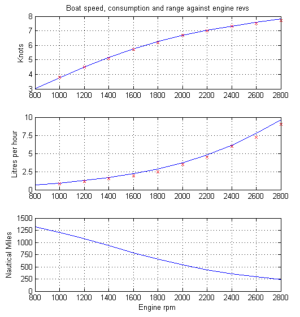
This is for my boat; blue graphs a mathematical model, red asterisks measured data. But that's with clean hull. With a fouled hull, and worse, a fouled prop, it's about 2 knots slower and much higher consumption for the same revs.
 

Attachments

  • Screenshot 2025-10-17 at 21.56.40.png
    Screenshot 2025-10-17 at 21.56.40.png
    281.5 KB · Views: 18
Ridgy, my old mgc27 is probably a good comparison. Volvo 9hp. About the same weight or slightly less.
With a clean bottom she will just get up to 5.5 knots. Wind against will slow her right down.
However, take her out of dock with summer growth on, ready to be jetwashed and she is lucky to do 2 knots.

9- 10 hp is just not much to push a yacht along really.
 
On a boat engine as old as the OP's, the mechanical fuel injection system is controlled by the throttle level. So if drag prevents the shaft and engine turning as fast as the throttle lever is set for , you get excess fuel going into the engine and coming out part burned as smoke.
 
Some interesting observations. Clearly I'm expecting too much of my little engine. Yeah there was a bit of slime on the hull which wouldn't have helped. I'll do some checks over the winter like the exhaust elbow and do a compression test but if they are clear I'll just put the old blades back on and accept my lot.
 
Some interesting observations. Clearly I'm expecting too much of my little engine. Yeah there was a bit of slime on the hull which wouldn't have helped. I'll do some checks over the winter like the exhaust elbow and do a compression test but if they are clear I'll just put the old blades back on and accept my lot.
I thought my volvo was knackered as well until i realised it was just under powered
 
Some interesting observations. Clearly I'm expecting too much of my little engine. Yeah there was a bit of slime on the hull which wouldn't have helped. I'll do some checks over the winter like the exhaust elbow and do a compression test but if they are clear I'll just put the old blades back on and accept my lot.
You have enough power to schive close to hull speed with clean bottom. If you can get 3300rpm under load with the correct blades there is little wrong with the engine itself.
 
How far do you want to motor? My old tub went well under sail but slowed down under motor. I changed prop because the smaller prop was like an eggwisk with 25hp behind it. The new larger prop actually didn't make that much difference apart from better power through rough water.. Over several hours you may notice a difference but in and out of harbour it doesn't matter.
 
A couple of times I’ve either made quicker progress than expected or left earlier than optimum to arrive at a useful hour and faced the full ebb out of Poole harbour.

The worst of it can be dodged by keeping to as shallow water as I dare but there isn’t much opportunity to do so along the fetch where the chain ferry runs.
 
Last edited:
If you are pushing a five knot tide then you have not been paying attention at the chart table! You should be going the other way.


If you berth in Chichester, and were coming from the west, how exactly do you avoid that? Really, there are numerous cases where it’s not possible to go all the way with the tide. And sometimes things don’t go to plan, too little wind perhaps. This is not a problem we have often, we have much more choice being faster. But I know it happens, very occasionally us too.
 
Top