How do I measure amps?

Rivers & creeks

Well-Known Member
Joined
23 Nov 2004
Messages
10,924
Location
Norfolk
Visit site
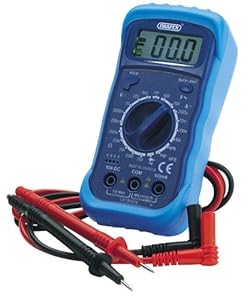
I have one of these
51J4TXAGE0L._SY300_.jpg


I want to measure the amperage current leaving the domestic battery bank and the amps coming from the solar panels to get a picture of typical consumption and replenishment. Obviously I'll cover the panels when measuring output from the batteries :)

I believe the unit I have can be used to measure amps but how do I do it?

Thanks.
 
My nmenonic is 'amps through, volts across' you need to break into the circuit and insert the meter in the gap, on the highest amps range using the extra 10A socket, at least to start with. A clip ammeter allows measurement without disturbing the circuit, but I have not used one.
 
Set the rotary switch to "10A". Connect the red probe to rightmost "10A DC" socket and the black one to the central "COM(mon)" one. Break whatever circuit you wish to measure and attach one probe to each side, so the current goes through the meter.

However ... you may well find it difficult to get a good enough contact to measure several amps reliably with those small pointy probes. Press hard and look for a stable reading as you move them very slightly about.
 
I've become more relaxed about monitoring as I now trust my system in a range of situations. (Sterling regulator, diode splitter, BEP meter, Aldi mains charger, 110Ah battery, new last year.)

This year I bought on impulse two of these. My BEP is only used as a voltmeter and is not very visible. These give an accurate (they agree with each other and the BEP) reading and can be used at any outlet. http://www.ebay.co.uk/itm/LED-12V-2...341?pt=LH_DefaultDomain_3&hash=item3a938b4215 BEP or NASA BM's £100 plus, these £1.30....
 
As JumbleQuack says with the proviso that everything that could take much juice is switched off. You don't want an Eber kicking in because the thermostat has decided that it's got cool and it's time for heat; nor do you want a water pump to start. These small ammeters are often unfused on their maximum range and 10A is easily exceeded. Solar panel (less than 120W, a few lights and electronics are ok.
 
My nmenonic is 'amps through, volts across' you need to break into the circuit and insert the meter in the gap, on the highest amps range using the extra 10A socket, at least to start with. A clip ammeter allows measurement without disturbing the circuit, but I have not used one.

The lower price-range clip ammeters usually read alternating current only via the clip, not DC.
 
The meter needs to be connected in series (i.e. in line) A meter like that will not handle much current and is IMHO not suitable for permanent insertion in the circuit, (if that was a thought). On my simple boat, (A few lights depth sounder and log, charging a maximum of 4A off the outboard and a 10W solar panel) and with a background in lighting and sound I quite happily use a similar one for occasional readings .

Be aware that they may or may not have internal fuses. On mine I don't think it has one in the 10A current reading circuit.
 
I'll say it again, go to Maplin or Screwfix or wherever and buy a clamp meter (make sure it has a DC range, some are AC only). For example ..

http://www.maplin.co.uk/p/uni-trend-203-dcac-current-clamp-multimeter-n41nc

(actually, don't go to Screwfix, they don't currently offer a DC clamp meter at any price)

Fannying about with a DVM as an ammeter is a right faff and no DVM will cope with checking the charge current from the alternator or a decent battery charger (for example)
 
http://www.ebay.co.uk/itm/100V-100A...Volt-Meter-12V-w-shunt-Dual-Car-/281285803565

This is just what you need at a tenth of the cost of a BM1. The shunt goes in the negative battery lead and you can then measure the current flowing into and out of the battery. To check the solar panel, just switch off all the loads so its output is all going into the battery.

It also shows the battery voltage, like a BM1.

How does one know if the reading is a discharge or a charge. Or does it show a +-ve sign in the display?
 
Thank you, really helpful collection of advice. I hadn't realised the 10amp issue, so my meter isn't any good for that as I'm trying to gauge the draw when sailing and the autopilot is fused at 40amps! The clamp on meter seems good but at £40 it's half the cost of a BM1. If I can work out how to wire in that £9 ebay one that does seem good.
 
Out of interest, how good is the NASA unit over a long period of time? Does it need resetting when you know you're at theoretical 100% charge say after a couple of days of shore power?
 
I'm no electrical expert, and so this may be a stupid question, but why do permanently installed ammeters/battery monitors need a load of wiring and a shunt, whereas a clamp ammeter just clamps over one wire?

I'd quite like to see how many amps are being used at any given time, and so is there anything that just has a clamp sensor and a remote display? I have a home energy monitor that just clamps over the incoming shorepower feed to show me my mains usage, and so was wondering if there's something similar I can get for dc usage. I don't need to see amps in, just out.
 
Last edited:
I'm no electrical expert, and so this may be a stupid question, but why do permanently installed ammeters/battery monitors need a load of wiring and a shunt, whereas a clamp ammeter just clamps over one wire?

I'd quite like to see how many amps are being used at any given time, and so is there anything that just has a clamp sensor and a remote display. I have a home enery monitor that just clamps over the incoming shorepower feed to show me my mains usage, and so was wondering if there's something similar I can get for dc usage. I don't need to see amps iin, just out.

That's a great question.
 
Top