Kukri
Well-Known Member
I’ve had four of these for ages. Brilliant. Can’t remember who made them but I think maybe @wilkinsonsails ?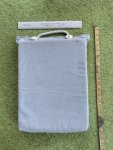



Agree with that, my argument is that rail space is better used by more effective equipment. We have a Lifesling which I suppose could be said to be a much improved horseshoe buoy. Currently wrestling with whether the danbuoy is usurped by crew PLBs….but that quickly leads to the PLB/AIS discussion……A horseshoe may be a poor solution in some ways but you are not going to be in a worse position for carrying one, and it might just save a life.

Have you ever tried using the Jonbuoy?I have two very faded and tatty ones. They came with the boat and I can’t really imagine using them in earnest, because I would use the Jonbuoy.
I suppose I ought to buy new ones.

My danbuoy was secured in a tube. You had to extend it as it was telescopic before deployment. By the time you had gone to the back of the boat, taken it out of the tube, extended it and thrown it over the side I suspect it would take over 10 seconds. At 7 kts the danbuoy will be over 100ft from the MOB.The danbuoy is good for practice. How good it would be in real life might depend on the strength of the wind, the sea state, the light and not least on the quality of the danbuoy… suspect the PLB is less useful for practice and the same might go for the AIS…?
Have you ever tried using the Jonbuoy?
I went on a sea survival course run by a very competent lady. During our group life raft sessions in the pool, her husband was attempting to enter the Jonbuoy. The pool session took around an hour. At the end of that hour, he had still not succeeded - and he was exhausted.
Love the folding rule. That would be worth a few bob on Bargain Hunt.I’ve had four of these for ages. Brilliant. Can’t remember who made them but I think maybe @wilkinsonsails ?View attachment 131731

Most of us carry one or two. Has anyone used theirs in anger. Is there something better such as a life saving torpedo float. I tried using one of mine as a practice a few years ago. It was so badly made the grab lines round the circumference just tore off.


Another good reason to use beanbags?On my first Atlantic crossing we squabbled over who's turn it was to sit on the lifebuoy. After a week or two those cockpit seats get damn hard!

Wouldn't it be simpler to just put them below when not on board, (or when not actually under way)?But they do get badly affected by UV damage if left uncovered when not in use. This happened to mine a couple of years ago so I replaced with new but made covers for them which are fitted when not on board. Made with velcro fastening so easy to remove and fit. Should last as long as I have the boat.
IMHO, the first action should be to immediately go about while dumping the main and leaving the jib sheeted, then steadily turning the tiller towards (wheel away from), the boom, thereby performing an Emergency Heave-To.My danbuoy was secured in a tube. You had to extend it as it was telescopic before deployment. By the time you had gone to the back of the boat, taken it out of the tube, extended it and thrown it over the side I suspect it would take over 10 seconds. At 7 kts the danbuoy will be over 100ft from the MOB.
At this point you haven't provided the MOB with a floatation device. So do you do that first? Assume you have a horse shoe ring and you deploy that first. Say 10 seconds so it 100 ft from the MOB. If it takes you another 10 seconds to deploy the danbuoy it will likely be 200ft from the MOB.
We sail predominantly as a couple so there is only likely to be one person left onboard in an MOB situation.
Our plan in such an event is hit MOB button on the plotter as first action followed by bean bags over the side. We have two of them. The next thing would be to get the sails down and motor on to return to where the MOB went in the water. Trying to sail to the MOB then use a lifesling single handed isn't going to happen. We have practised that in calm conditions under sail and picked up my volunteer wife. It wasn't easy at all. Based on that experience we decided sails down gave far better certainty of a successful rescue in a bumpy sea.
Not when you are tradewind sailing. Twin headsails or worse spinnaker and main. An East to West Atlantic crossing was our last trip. It needs different tacticsIMHO, the first action should be to immediately go about while dumping the main and leaving the jib sheeted, then steadily turning the tiller towards (wheel away from), the boom, thereby performing an Emergency Heave-To.
This quickly stops the boat in the vicinity of the casualty, then all the other actions can follow. Try it out while passing close to a convenient mooring buoy at a decent speen on any point of sail, and see how close to the target you can stop. I used to do this while teaching on keelboats.