
Honda 2.3 problem

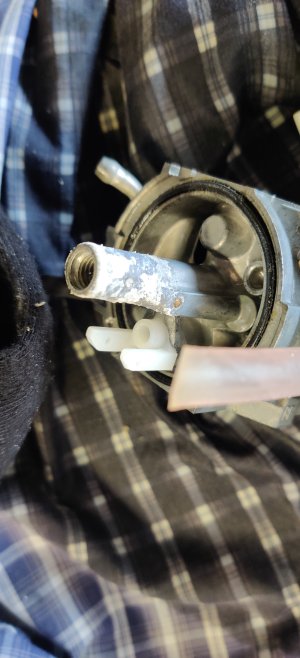
2 year old Honda 2.3 BF issues. OB not starting, stripped carb and found main jet base blocked with debris, cleaned out. Slow running jet also blocked and cleaned with carb cleaner. Tank cleaned. Reassembled and ran correctly on aspen. One week later engine no starting. Stripped carb and found cave casting highly corroded and main jet housing two large holes blocked. Cleaned main and slow running jets. Fitted new inline filter near tank. Engine ran correctly for one week during daily trips ashore.
Corrosion of aluminium within float chamber unexpected, but since no evidence of water, it could be poor quality casting.
I agree with routine of draining float chamber if not during OB for several weeks and prior to winter layup.
In contrast, my 40 year old 2hp Mariner starts every time.....
Pic of float chamber corrosion attached.
 

Attachments

  • IMG_20250425_150407.jpg
    IMG_20250425_150407.jpg
    1 MB · Views: 10
I prep my BF2D for a six month lay up by running the last bit of petrol with Sta-Bil then drain the carb. After all this I still find the main jet clogged with some kind of guck. Any ideas?
 
I see the parts for a BF2D indicate four different carburetor jet sizes: 58, 60, 62, and 65. Why? Perhaps operating altitude? Which one should be used at sea level?
 
It might mean that a jet size in that 'area' is probably close enough, given that the sizes are so tiny, that a #62 is (about) the same as a #58, and it'll be OK, given the general climate and general fuel quality etc....
"The standard main jet size for the Honda BF2D carburetor is typically a #62 jet (0.62 mm), but the exact size can vary depending on the specific model year and operating elevation.
Jet Details
Standard Main Jet: The typical standard size is a #62 jet.
Slow/Pilot Jet: The slow or pilot jet has a very small, specific orifice that is a common point for blockages due to ethanol in fuel and is often recommended for replacement if cleaning doesn't work.
High Elevation Operation: Honda specifies optional, smaller main jets for use at high elevations (above 2,000 feet) to maintain the correct air-fuel mixture and prevent engine damage.
Important Considerations
Model Specificity: The precise jet size is linked to specific engine models and serial numbers, so it is crucial to verify the correct part number using the official Honda parts catalog or a local dealer.
Cleaning vs. Replacement: The jets are very delicate and have extremely fine holes that can be easily damaged or blocked. While cleaning with carburetor cleaner and compressed air is a common maintenance task, some advise caution or replacement, especially for the small pilot jet.
Service Manual: For accurate specifications and detailed maintenance instructions, it is recommended to consult the official Honda Shop Manual for the specific BF2D model.
When purchasing replacement parts, refer to the carburetor assembly number (e.g., 16100-ZW6-716) for compatibility."
 
It might mean that a jet size in that 'area' is probably close enough, given that the sizes are so tiny, that a #62 is (about) the same as a #58, and it'll be OK, given the general climate and general fuel quality etc....
"The standard main jet size for the Honda BF2D carburetor is typically a #62 jet (0.62 mm), but the exact size can vary depending on the specific model year and operating elevation.
Jet Details
Standard Main Jet: The typical standard size is a #62 jet.
Slow/Pilot Jet: The slow or pilot jet has a very small, specific orifice that is a common point for blockages due to ethanol in fuel and is often recommended for replacement if cleaning doesn't work.
High Elevation Operation: Honda specifies optional, smaller main jets for use at high elevations (above 2,000 feet) to maintain the correct air-fuel mixture and prevent engine damage.
Important Considerations
Model Specificity: The precise jet size is linked to specific engine models and serial numbers, so it is crucial to verify the correct part number using the official Honda parts catalog or a local dealer.
Cleaning vs. Replacement: The jets are very delicate and have extremely fine holes that can be easily damaged or blocked. While cleaning with carburetor cleaner and compressed air is a common maintenance task, some advise caution or replacement, especially for the small pilot jet.
Service Manual: For accurate specifications and detailed maintenance instructions, it is recommended to consult the official Honda Shop Manual for the specific BF2D model.
When purchasing replacement parts, refer to the carburetor assembly number (e.g., 16100-ZW6-716) for compatibility."
Great reply! Thanks for taking the time. Wish Honda put the engine serial number in a place where you can read it.
 
Top