High 'anti-siphon' loop required with a 'piddle tube'?

dankilb

Well-Known Member
Joined
23 Jan 2008
Messages
1,538
Visit site
Thankfully an awkward visit to the doctor isn't required for this particular plumbing issue...!

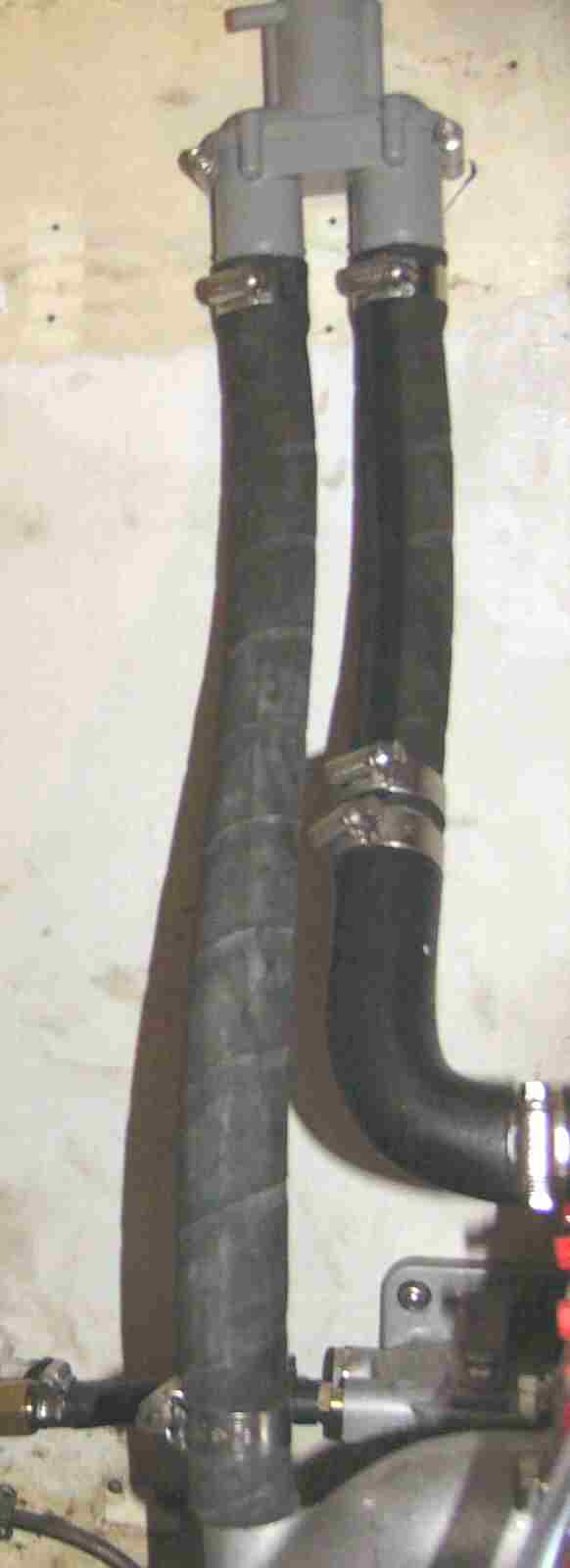
Having been collecting nice DZR fittings ready to replace our big ol' 1inch anti-siphon loop, which terminates at the forward/top of our engine compartment where it tees to connect to an 8mm ID 'piddle tube' (venting overboard in the factory location high on the topside), I suddenly thought - why do I need a (so-called anti-siphon) loop at all?

Won't the piddle tube, alone and wherever it connects to between the h/e and mixer, act as my anti-siphon break?

OTOH, I cannot see why not. It provides a natural siphon breaking vent to about as high up on the boat as you can reasonably go from there. It's definitely clear and easy to check. On the other, perhaps it helps to have a bit of extra distance, head and volume between the piddle tube and the mixer designed into the system? (If so, I was ready to replace it anyway!)

The loop is as cumbersome as they typically are in more confined (41') AWB installations, involving a long run of pipe, with tight radius bends to make the hose tails on both ends, and elbows to enable the tee to occupy its lofty position at the very highest (confined) space under the bridgedeck! It would simplify things considerably to reduce it (to go position closer to the h/e and exhaust) or even remove it altogether.

Instead, I could have a short loop between the (Beta) heat exchanger and the exhaust elbow, with a tee at the highest point (I could manage say 200mm above the mixer in situ).

Sorry I don't have photos as the engine is sitting disconnected from everything, mid-refit! But any advice on the theory, at least, would be great.
TIA!
 
The piddle tube is an anti syphon loop - just not a valve. The purpose is to provide a syphon break well above the waterline. The piddle tube does it when the engine stops and breaks the syphon. The valve does it by opening when the engine stops. Possible problem with valve is sticking, but on many boats a piddle tube is not practical and not everybody wants a stream of water running through the cockpit every time the engine is run. Hence the attraction of valves.
 
The piddle tube is an anti syphon loop - just not a valve. The purpose is to provide a syphon break well above the waterline. The piddle tube does it when the engine stops and breaks the syphon. The valve does it by opening when the engine stops. Possible problem with valve is sticking, but on many boats a piddle tube is not practical and not everybody wants a stream of water running through the cockpit every time the engine is run. Hence the attraction of valves.

It doesn't have to run through the cockpit, mine exits externally, just under the rubbing strake, don't even notice it 99% of the time.
 
I had an valve at the top of the antisyphon loop, but removed it and fitted a piddle hose at the transom. No water from the valve in the bilge.
 
It doesn't have to run through the cockpit, mine exits externally, just under the rubbing strake, don't even notice it 99% of the time.
I know. Exactly why I said it is not practical on many boats. Would not work on mine as there is no clear route from the engine compartment to hull side. Pretty common with most AWBs.
 
Interestingly, the De Havilland Mosquito had an arrangement called the Pilot's Relief Tube......
I did some flying training with a company that operated King Airs (twin turboprops for biz/medivac) with relief tubes. I recall tales of some rather cruel practical jokes on the newbies/trainees, although thankfully can't remember the details!

there is no clear route from the engine compartment to hull side
Indeed! Jeanneau fitted our piddle tube from the factory, but it's one of the only remaining runs of plumbing/wiring that I still don't know exactly where it goes! It disappears up between the bridgedeck moulding and the joinery above the aft cabin 'vanity' and reappears some 10 feet aft under the gas locker on the port side.
 
Have had both Vetus and Volvo valve types and never problems with weeping nor sticking. Just open them up from time to time.
 
This is mine (on a small Beta), piddle tube (not attached in photo) exits via transom next to exhaust outlet. Height is sufficiently above waterline.

syphon.jpg
 
This is mine (on a small Beta), piddle tube (not attached in photo) exits via transom next to exhaust outlet. Height is sufficiently above waterline.

syphon.jpg
Neat! Thanks for sharing.

I was also planning to give it a bit of head/height, just because it makes sense to get the piddle tube tee out of the way of the donk. Although the conclusion seems to be it could just tee off anywhere?

Also like the 90-degree elbow. Our previous installation had a tight radius forced into the hose, which eventually caused a leak that totalled the engine mount below!
 
...

Also like the 90-degree elbow. Our previous installation had a tight radius forced into the hose, which eventually caused a leak that totalled the engine mount below!

The 90 deg elbow was what came with the engine to link heat exchanger output to exhaust pipe mixing elbow. I turned it through 180 deg.

I must have got the Vetus syphon break very cheaply, there's no conceivable way I would have paid £90.
 
I got the various Maestrini bits needed to fashion an alternative 'vented loop' fitting - 3/4 BSP female tee and the various hose tails - for less than their own valveless loop. Sealed with crush washers and thread sealant, I'm hoping it'll be reliable and I won't regret introducing lot of extra joins just to be a cheapskate!

I like that you can swap and re-purpose the bits. It'll help now I know mine doesn't need to be such a lofty and acrobatic loop as originally intended (replacement straight instead of elbow hose tails already ordered!).

As an aside, at one point I also intended to tee off this again to vent our Volvo/Radice-style lip seal (we've got the type with a hose barb) to the same piddle/breather arrangement... But I decided it was introducing one too many complexity.

Now with my planned new setup, I could tee off the raw water to piddle tube connection to feed the shaft seal. I was under the impression that this was unnecessary for 'slow' boats, though (and therefore not worth my doing)?

All in favour of a simple vent pipe for the (new) shaft seal? It could even occupy the lofty heights under the bridgedeck previously reserved for the loop arrangement!
 
As an aside, at one point I also intended to tee off this again to vent our Volvo/Radice-style lip seal (we've got the type with a hose barb) to the same piddle/breather arrangement... But I decided it was introducing one too many complexity.

Now with my planned new setup, I could tee off the raw water to piddle tube connection to feed the shaft seal. I was under the impression that this was unnecessary for 'slow' boats, though (and therefore not worth my doing)?

All in favour of a simple vent pipe for the (new) shaft seal? It could even occupy the lofty heights under the bridgedeck previously reserved for the loop arrangement!

If you have a Radice-style seal, all you need is a vent pipe going up a little way above sea level.
 
If you have a Radice-style seal, all you need is a vent pipe going up a little way above sea level.
Yup. Thanks, that’s what I had also concluded. ‘KISS’ etc…

I also recall that, reading between the lines in the Beta manual, they don’t want you diverting too much of the coolant water (better off in the exhaust mixer?!).
 
It doesn't have to run through the cockpit, mine exits externally, just under the rubbing strake, don't even notice it 99% of the time.
Some engines do not need an anti Syphon loop but still have the piddle tube to indicated that cooling water is being delivered to the engine. The OP. H A S. an anti Syphon loop and so the piddle tube is there for a reason. I wonder how much damage it will take to realise his mistake in removing the antisyphon loop so possibly having water find its way into the engine after a run.
 
Some engines do not need an anti Syphon loop but still have the piddle tube to indicated that cooling water is being delivered to the engine. The OP. H A S. an anti Syphon loop and so the piddle tube is there for a reason. I wonder how much damage it will take to realise his mistake in removing the antisyphon loop so possibly having water find its way into the engine after a run.
I wouldn’t assume that anything on this boat is there for a reason! Some of the original gear, assumed sound by the PO, could’ve sunk her if launched ‘as is’. It’s a mess of previous bodges…

But are we saying there’s a risk of reducing (not entirely removing) the vertical ‘loop’ section? Remember that there’s an effective ‘siphon break’ vent to atmosphere, via a 10mm ID ‘piddle tube’ to a purpose made s/s breather ‘manifold’ that vents on the topside. It is easy to check visually and can’t see how it would fail without soon being noticed. And if it did block, surely a loop wouldn’t help anyway?

Bear in mind also have a high rise exhaust mixer with sufficient fall to the waterlock. The system is designed and specified not to hydro lock!
 
Some engines do not need an anti Syphon loop but still have the piddle tube to indicated that cooling water is being delivered to the engine. The OP. H A S. an anti Syphon loop and so the piddle tube is there for a reason. I wonder how much damage it will take to realise his mistake in removing the antisyphon loop so possibly having water find its way into the engine after a run.

The piddle tube IS an anti syphon break, there is no need for two anti syphon breaks.
 
Top