Hempel Silic One for propellers - anyone tried it?

  • Thread starter Thread starter KAL
  • Start date Start date

KAL

Well-Known Member
Joined
9 Feb 2006
Messages
1,547
Location
River Dart
Visit site
After another haul out which proved that our prop is, quite probably, the most des res that a barnacle or two thousand can imagine themselves inhabiting, I came across Hempel's Silic One propeller kit, which promises a 100% foul-free prop without biocides and yucky chems.

Anyone used it? Would be interested in any user feedback.

Let's face it. Over the years I've tried just about every other product claiming to protect the prop, to no effect whatsoever. Yes, that even includes udder cream, before you ask.

Any use?
 
Not used Silic One, but used silicone based Prop Speed a few years back (there's a clue!). It was applied by the importer to the brand new Autoprop, in the hope it would last the two years promised. It dropped off the prop like nothing on earth, and I was given a free reapplication (again by the importer) the following spring with the same result...

Obviously, I was not impressed. If you have success I'd be very interested to know.
 
Last edited:
Give it a try and let us know the result. I used to apply lanolin with a blowlamp, but don't recall the results being conclusively positive.
 
Tried Velox plus? a revelation for me last year - a real improvement on anything else I had tried (there are some pictures on an old forum post) The important tweak was not to use Velox's primer but instead use Hammerite special metals primer - far better for my stainless and bronze prop.
 
I've used Velox for the last 2 yrs and this year will be the 3rd. Reasonably impressed, fewer barnacles but not perfect by any means. Certainly MUCH better than lanolin, udder cream and other unusual remedies. I did use the Velox primer not Hammerite. I'll know better when I come out this autumn.
 
Isn't there a "gotcha" when it comes to silicone treatments for antifouling? They depend on larval fouling organisms being unable to attach to the slippery surface. Fine in principle - but if the surface isn't moving a lot of the time, there is no force to remove the larvae before they become attached. and once attached, they remain attached. So, unless your propeller is in use pretty much every day, fouling organisms WILL attach, and the antifouling will be ineffective. This seems to tally with people's experience as reported on here. I think I'd be looking at using an antifouling with biocides - I may need it, as I suspect my propeller is being colonized, judging by the loss of speed I've noticed!
 
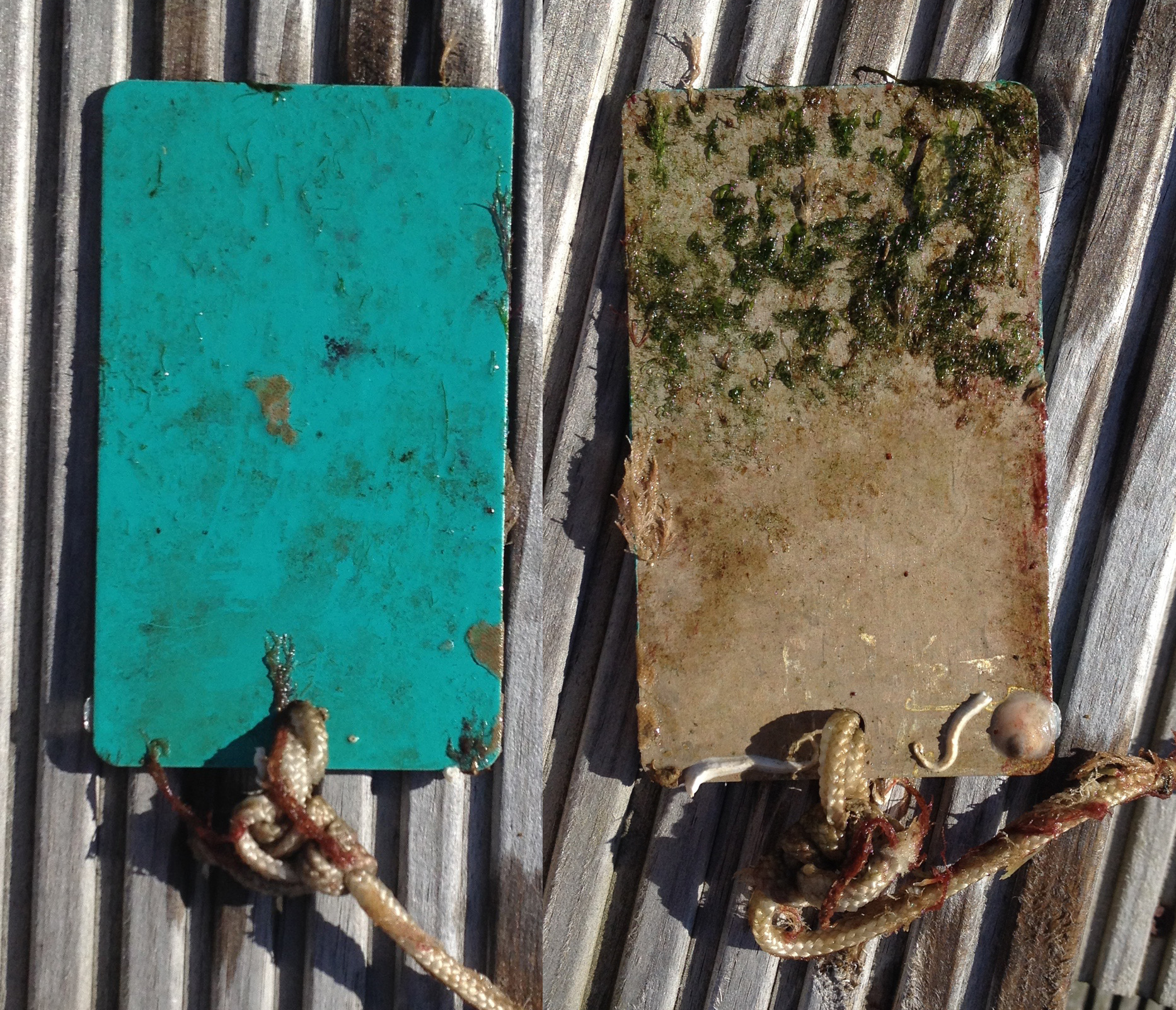
At the 2016 SIBS I chatted to a company rep selling silicone based antifouling. It wasn't Hempel, but I don't think there's big differences between brands with this stuff - the whole concept is just about making a smooth surface so creepy crawlies can't stick to it. He gave me a sample, which was a small piece of aluminium sheet treated on one side with their stuff (by them - so nobody can blame wrongful application) and untreated on the other, with a hole punched through one end.

I hung this on the end of the pontoon next to the boat when I got back and fished it out in June 2017, about 9 months later. Both sides were thick with fouling, but after running the hose over it with gentle pressure (very unscientific, I know), the sides looked like this:

siliantifoul.jpg


Much like Coppercoat, hard fouling doesn't seem to settle on it (unless submerged in mud, grumble - see Mr. Barnacle and his tubeworm friend on the untreated side) and it's easy to scrub off in the water or out. Unlike Coppercoat, it's suitable for application on metal. So I'm very interested in giving it a try for the prop and saildrive next haulout. The Velox Plus currently there held up okay for two years, but is now starting to fail, either due to us entering warmer waters or because it's coming to an end of its effective lifespan. I can see the smooth silicone stuff working very well on a propeller due to the fast movement, and don't mind scrubbing the saildrive leg now and then in the water.
 
The green color looks like a copper salt so it's not neat silicone, has anyone used silic one for propellers, does it work and adhere or is it just a fluke?
 
The green color looks like a copper salt so it's not neat silicone, has anyone used silic one for propellers, does it work and adhere or is it just a fluke?

The green colour is probably just a dye added to the silicone. I saw a very similar colour in the silicone hull coating of a Mobo last year. The coating was developed by Fujifilm for large shipping vessels, but discontinued. It was working brilliantly on the hull of the mobo, which was owned by the gentleman who had the license for the UK.

I hope to be able to let you know how successful the Silic One has been in a few days. Am waiting for date for a lift out, but so far the evidence is very promising. I was able to get 7kn SOG (33’ sloop) a couple of weeks ago under engine alone in slack water and no wind, so the prop can’t be too fouled. Have been in the water about a year since the Silic One was applied and we were re-coppercoated.
 
Last edited:
Those samples look like Aquacote as I hung one over the side of my boat last year. It seemed effective in that the slime wiped off easily. However I’ve been told that after a few years it ages and loses its slipperyness and it cant be recoated without a lot of preparation. Was tempted to try it on a part of the hull tho.
 
I'm interested in the preparation required for the application of silic one on propellers , they use an epoxy primer instead of an etching primer like other silicone coatings for propellers, they say that brass need an etching primer. Anyway, with most silicone coatings you can just overcoat with the same kind of silicone without any problems, you just need to clean the sludge from the surface. There are two types of silicone chemistries condensation and addition cure, just make sure you don't mix the two.

There are some antifoulings from the large companies that are actually silicones with biocides, if the MSDS has the word siloxane, silicate, alkoxysilane, oximosilane, aminosilane and the like it's either silicone or a silicone hybrid.

The fouling release coatings are similar to potting silicones just like propspeed. Why did aquamarine go bust? Everyone just buys the cheap stuff I guess.

Another question is how do so many companies sell the exact same formulation like propspeed under different names? There should be an OEM manufacturer or very lazy formulators.,
 
Last edited:
Update: dived on the prop and found that the silicone has come off the outer 2/3 of the prop blades. The centre and the shaft were perfectly clean where the coating remained intact.
 
Update: dived on the prop and found that the silicone has come off the outer 2/3 of the prop blades. The centre and the shaft were perfectly clean where the coating remained intact.

Did you apply epoxy primer then the tie coat and then the silic one top coat on the props?
 
Last edited:
I expected more from Hempel but propspeed comes off in about a year as well. Aminated fatty acids don't work very well as an adhesion promoter after all huh? :nonchalance:
Anyway thanks for letting us know about the silic one coating.
 
Last edited:
Top