
Hairsy25
New Member
I would appreciate some advice.
In the next few weeks I will start using a trot mooring that is set up with pylons. I’ve never used this type of mooring before and would appreciate some advice on how best to set it up and technique for mooring. I’ve struggled to get anything useful with my google skills.
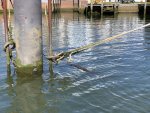
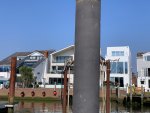
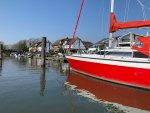
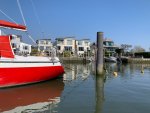
I've attached pictures of how the pylons are set up and how another yacht is currently moored to a similar mooring.
A few points about the moorings and environment:
a) The wooden pylons at the bow and stern each have a very solid bar with a strong ring that can move up and down the bar to allow for tidal movement.
b) People generally appear to attach mooring lines to this ring using a large shackle. The pylon ends of the mooring lines have a metal thimble spliced in to the end for attaching to the shackle. There appear to be various options for thimble material (galvanised / stainless / heavy duty stainless)
c) There are large hooks at the top of each pylon, presumably where people leave the mooring lines when the mooring isn’t in use
d) I presumably need to be careful about line lengths in case one falls in the water and then gets caught in the prop
e) There are a number of unused moorings that I’ve been able to look at. Some of these have heavy duty mooring lines but also some lighter lines - perhaps to initially secure the boat before attaching the main mooring lines?
f) The mooring I will be using is in a fairly narrow part of the river, and around 40’ downstream of a low bridge. The river is slightly tidal but the flow is generally downstream from the bridge. The tide won’t normally be taking me towards the bridge but manoeuvring space is tight. I need a setup that allows a reliable method of mooring.
So my main questions are:
1) What line setup would be recommended?
2) Assuming a spliced in thimble is part of the setup, what material do I need for the thimble?
3) What technique would be recommended for leaving the lines when departing and then picking them up again upon return?
4) Are there questions I haven’t asked but should have?
5) Does anyone have experience-based tips that can be provided to make the whole process easier?
All advice appreciated.
Thank you.
In the next few weeks I will start using a trot mooring that is set up with pylons. I’ve never used this type of mooring before and would appreciate some advice on how best to set it up and technique for mooring. I’ve struggled to get anything useful with my google skills.
I've attached pictures of how the pylons are set up and how another yacht is currently moored to a similar mooring.
A few points about the moorings and environment:
a) The wooden pylons at the bow and stern each have a very solid bar with a strong ring that can move up and down the bar to allow for tidal movement.
b) People generally appear to attach mooring lines to this ring using a large shackle. The pylon ends of the mooring lines have a metal thimble spliced in to the end for attaching to the shackle. There appear to be various options for thimble material (galvanised / stainless / heavy duty stainless)
c) There are large hooks at the top of each pylon, presumably where people leave the mooring lines when the mooring isn’t in use
d) I presumably need to be careful about line lengths in case one falls in the water and then gets caught in the prop
e) There are a number of unused moorings that I’ve been able to look at. Some of these have heavy duty mooring lines but also some lighter lines - perhaps to initially secure the boat before attaching the main mooring lines?
f) The mooring I will be using is in a fairly narrow part of the river, and around 40’ downstream of a low bridge. The river is slightly tidal but the flow is generally downstream from the bridge. The tide won’t normally be taking me towards the bridge but manoeuvring space is tight. I need a setup that allows a reliable method of mooring.
So my main questions are:
1) What line setup would be recommended?
2) Assuming a spliced in thimble is part of the setup, what material do I need for the thimble?
3) What technique would be recommended for leaving the lines when departing and then picking them up again upon return?
4) Are there questions I haven’t asked but should have?
5) Does anyone have experience-based tips that can be provided to make the whole process easier?
All advice appreciated.
Thank you.


