Help with my deviation card please.

scrambledegg

Well-Known Member
Joined
2 Nov 2015
Messages
264
Location
Portsmouth
Visit site
Friends,

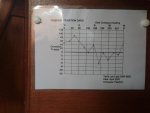
The deviation card below came with my boat.
deviation card.jpg

The question I have is for the positive corrections above the halfway line (eg +6 for East), which way would I apply that correction ie would I add it to the compass reading to get magnetic, or would I subtract it to get magnetic?
I am hoping that there is some convention for this that I am unaware of.
Or, you can tell me to put the boat on a known course, note how the compass differs, apply variation and work it out.
I hope the former.
It's a bit sad that I haven't yet taken the boat out far enough for this to matter......
 
I think you need to make a new deviation card. They are only good for a few years. It's pretty straightforward to swing your compass. Lots on YouTube too help.
 
Last edited:
see if you can work through this: http://splashmaritime.com.au/Marops/data/text/Navtex/Naverror.htm
now.. converting from compass to magnetic they say add east. Your chart is always increasing east, even when west of south. So, what you have there are values to add to what the compass reads in order to determine your magnetic heading.
Once you have your magnetic heading, you can then add the current variation to find your true heading.
When you want to do the reverse calculation (when the navigator yells to the helm which way to point the boat) you subtract instead of add.
I remember hearing "add above, subtract below.
 
I read it that you are just looking to how to use the deviation card.

You treat variation and deviation separately. So say your true course (i.e. on chart) is 90 degrees (degrees True). Lets assume Variation is 4 degrees W (you'll get it from the local chart) then the magnetic course is 94 degrees Magnetic. For Variation you add West and subtract E.

Your deviation card then says add 6 degrees when the magnetic is 94 (treat it as approx 90), so that gives you a compass course of 100 degrees (degrees C as compass course).

Apologies if this is teaching you to suck eggs, you can ignore it.

And Richard S has a bit of a point, so you may want to produce a new deviation card when you get the chance.

Edit: Reading the small print on the card again I think Lon nan Grugagh has it right. It is the correction to apply to the compass course to get magnetic, so you would subtract from magnetic to get compass -> 88 deg C.
 
Last edited:
Unless the boat itself, or the compass, or its stores have changed, why would the deviation card change? IIRC this tells you the difference between the reading on the ship's fixed compass and actual magnetic. The difference would remain constant regardless of changes to variation.

Or is that badly remembered boll**ks?
 
Unless the boat itself, or the compass, or its stores have changed, why would the deviation card change? IIRC this tells you the difference between the reading on the ship's fixed compass and actual magnetic. The difference would remain constant regardless of changes to variation.

Or is that badly remembered boll**ks?

I'm no expert on this, but doesn't magnetic North move about?
 
Last edited:
Unless the boat itself, or the compass, or its stores have changed, why would the deviation card change? IIRC this tells you the difference between the reading on the ship's fixed compass and actual magnetic. The difference would remain constant regardless of changes to variation.

Or is that badly remembered boll**ks?

The residual magnetic properties of items in the boat that give cause to the deviation change over time. It’s worth checking the deviation curve periodically.

I'm no expert on this, but doesn't magnetic North move about?

Variation does change as you say. But the OP is asking about Deviation (the local influence of the boat on his compass). One needs to add or subtract both errors in the correct sequence to arrive at ‘Compass’ from ‘True’ or vice versa...
 
Variation does change as you say. But the OP is asking about Deviation (the local influence of the boat on his compass). One needs to add or subtract both errors in the correct sequence to arrive at ‘Compass’ from ‘True’ or vice versa...

I've seen this a lot, in fact all the time...
But its all addition (or subtraction, same thing really).
A + B + C === A + C + B
A - B - C === A - C - B unless you do it wrong (mathematically that is ) and contrive A - (B - C)
 
The residual magnetic properties of items in the boat that give cause to the deviation change over time. It’s worth checking the deviation curve periodically.


Variation does change as you say. But the OP is asking about Deviation (the local influence of the boat on his compass). One needs to add or subtract both errors in the correct sequence to arrive at ‘Compass’ from ‘True’ or vice versa...

Thanks for clearing that up.
 
I've had a further thought. My deviation card has plus and minus numbers of degrees of correction, which makes it unclear whether the correction should be added or subtracted. It would seem to make more sense if the deviation is described as number of degrees east or west, just like variation is described on a chart. I think most of us remember a phrase like "error west compass best, error east compass least", which essentially tells us whether to add or subtract a correction.
Do any of you have a deviation card with correction east and west?
 
I've had a further thought. My deviation card has plus and minus numbers of degrees of correction, which makes it unclear whether the correction should be added or subtracted. It would seem to make more sense if the deviation is described as number of degrees east or west, just like variation is described on a chart. I think most of us remember a phrase like "error west compass best, error east compass least", which essentially tells us whether to add or subtract a correction.
Do any of you have a deviation card with correction east and west?

Yes and it’s the normal way as far as I know. Otherwise we get the ambiguity you refer to...
 
Do you have a GPS on-board? I use it to do a rough deviation card. I am not a brilliant helm so always calculate that I steer +/- 10 degrees without any visual reference; I am so looking forward to the Hydrovane being fitted.
 
see if you can work through this: http://splashmaritime.com.au/Marops/data/text/Navtex/Naverror.htm
now.. converting from compass to magnetic they say add east. Your chart is always increasing east, even when west of south. So, what you have there are values to add to what the compass reads in order to determine your magnetic heading.
Once you have your magnetic heading, you can then add the current variation to find your true heading.
When you want to do the reverse calculation (when the navigator yells to the helm which way to point the boat) you subtract instead of add.
I remember hearing "add above, subtract below.

I remember being told a memory aid for this was to consider what you did with your jacket in either location - put it on above, take it off below.
 
see if you can work through this: http://splashmaritime.com.au/Marops/data/text/Navtex/Naverror.htm
now.. converting from compass to magnetic they say add east. Your chart is always increasing east, even when west of south. So, what you have there are values to add to what the compass reads in order to determine your magnetic heading.
Once you have your magnetic heading, you can then add the current variation to find your true heading.
When you want to do the reverse calculation (when the navigator yells to the helm which way to point the boat) you subtract instead of add.
I remember hearing "add above, subtract below.

Yes I think you must be right, because in the top right corner of the card it states "Boat Compass Heading", implying that you look at the boat's heading on the compass, then use the card to convert to magnetic.
This is probably pretty useless, since you mostly want to go from a true heading on a chart, use variation to convert to magnetic and then deviation to convert to compass. I can hardly think of any situation one would want to do the reverse operation.
I sense I might be about to be corrected.....
 
Yes I think you must be right, because in the top right corner of the card it states "Boat Compass Heading", implying that you look at the boat's heading on the compass, then use the card to convert to magnetic.
This is probably pretty useless, since you mostly want to go from a true heading on a chart, use variation to convert to magnetic and then deviation to convert to compass. I can hardly think of any situation one would want to do the reverse operation.
I sense I might be about to be corrected.....

Your wish is my command....
Lets say to want to know your bearing from a landmark and have no hand held compass.... You point the boat at the mark and read the compass....
 
Top