Help with install of Victron Energy Battery Monitor BMV-712 Smart

JUSTINHALEWOOD

Active Member
Joined
10 Dec 2019
Messages
55
Visit site
Hi All,
Having bought our boat a year or so ago, I'm now trying to get to grips with the electrics. As part of this we are planning to install solar panels and an improved battery monitoring system. We have an Ampair wind generator and 2x Varta 12v 180 Amphour house batteries currently and will be assessing their health also.
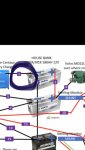
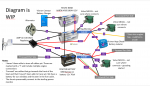
We're trying to start with the installation of a Victron Energy Battery Monitor (BMV-712 Smart). However, I've already hit the limit of my current understanding and was hoping for advice from the forum. Please find a summary of the current set-up and wiring diagram (work in progress) below - thank you for your help!
- The Varta house batteries are wired in parallel. I have also included the connection to the start battery also (Numax 12v 70ah).
- There are two separate shunts fitted to one of the Vartas batteries and one to the Numax. I believe these are connected to the Sterling Battery Monitor currently installed (I want to replace to the BMV to access the smart functionality like 'remaining time').
- Please see other connections below. I have yet to trace all wires as they go into the interior of the boat - I'm planning to do this in the next few weeks.
Where should I put the BMV? Is it just a case of replacing the existing shunt?
Thank you for any help!
Justin
1608842316287.png
 
Sorry, but your diagram makes no sense, it's impossible that it's correct. You show all charging sources going to battery negatives, but the Victron Argo is connected to the battery positives, with no incoming charge connection. You cannot have a positive battery connection going to an anode. You don't show any isolator switches. I'm afraid you'll need to go back to the drawing board with your diagram. May i also respectfully say that it's very difficult to read and not at all clear.

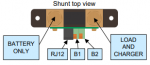
Some (maybe all) of the Sterling shunts could be fitted to the positive or negative circuits, but your Victron shunt must be connected to the negative circuit. The schematic below shows how the Victron shunt and Argo should be connected, you can ignore the isolator switches, as yours may differ.

Charging-2-Batteries-One-Engine-with-ArgoFET.jpg
 
Sorry, but your diagram makes no sense, it's impossible that it's correct. You show all charging sources going to battery negatives, but the Victron Argo is connected to the battery positives, with no incoming charge connection. You cannot have a positive battery connection going to an anode. You don't show any isolator switches. I'm afraid you'll need to go back to the drawing board with your diagram. May i also respectfully say that it's very difficult to read and not at all clear.

Some (maybe all) of the Sterling shunts could be fitted to the positive or negative circuits, but your Victron shunt must be connected to the negative circuit. The schematic below shows how the Victron shunt and Argo should be connected, you can ignore the isolator switches, as yours may differ.

Charging-2-Batteries-One-Engine-with-ArgoFET.jpg
Thank you. And I take the point on the diagram - it’s very much a work in progress.
 
The shunt should be the only thing connected to the negative terminal of the domestic battery bank. The negative ends of Everything else supplied by the domestic bank should be connected to the other end of the shunt. (Hope that makes sense :) ).

If the Sterling shunt is fitted correctly, just replacing it should be fine.

On remaining time it’s actually a moveable feast, so not accurate. It uses instantaneous AMPs flowing, and divides AmpHours remaining to find the time. I often find I have infinite time remaining one minute, then a day or so the next.

Good monitor though!
 
The shunt should be the only thing connected to the negative terminal of the domestic battery bank. The negative ends of Everything else supplied by the domestic bank should be connected to the other end of the shunt. (Hope that makes sense :) ).

If the Sterling shunt is fitted correctly, just replacing it should be fine.

On remaining time it’s actually a moveable feast, so not accurate. It uses instantaneous AMPs flowing, and divides AmpHours remaining to find the time. I often find I have infinite time remaining one minute, then a day or so the next.

Good monitor though!

Does no-one read anything that gets posted here ?

I posted a schematic that clearly shows how the shunt should be connected, can't get any clearer than that.

I also pointed out that the Sterling shunt could be fitted to the positive or negative circuit. The OPs diagram shows them fitted to the positives, so suggesting that the OP just replaces them is incorrect and likely to cause confusion.
 
Thank you both - very helpful. I plan to install the shunt on the position marked below, subject to confirming some of the corrections identified by Paul. happy Christmas!
 

Attachments

  • D654200B-8F69-459C-96B8-283F231E4731.jpeg
    D654200B-8F69-459C-96B8-283F231E4731.jpeg
    417.8 KB · Views: 29
Thank you both - very helpful. I plan to install the shunt on the position marked below, subject to confirming some of the corrections identified by Paul. happy Christmas!
In that position the only current it will see is the current from the battery charger !

There must be just one negative connection to the battery bank, and that must be the shunt. All other negative connections, both load and from charging sources and the connection to the engine start battery negative but be made to the other end of the shunt. You will find it convenient to simply run one connection from the "non battery end" of the shunt to a bus bar and connect all the negatives to that .

The Victron's instruction are pretty clear The shunt's battery connection is clearly identified in the installation instructional also the connection for all loads and charging

1608933779388.png

Sorry but the "diagram" you posted at the top of the thread is useless as a wiring diagram. Work in progress or not it is just a collection of pictures of components , including three engines,, linked together by lines.
 
Last edited:
Does no-one read anything that gets posted here ?

I posted a schematic that clearly shows how the shunt should be connected, can't get any clearer than that.

I also pointed out that the Sterling shunt could be fitted to the positive or negative circuit. The OPs diagram shows them fitted to the positives, so suggesting that the OP just replaces them is incorrect and likely to cause confusion.

I did say that it should be connected in the negative circuit.

I didn’t know that the Sterling can be connected in either positive or negative and, whilst I read your post, it was very quick, so I missed your point.

so it’s a good job you are here to keep an eye us laymen and put us straight from time to time :)
 
There must be just one negative connection to the battery bank, and that must be the shunt. All other negative connections, both load and from charging sources and the connection to the engine start battery negative but be made to the other end of the shunt. You will find it convenient to simply run one connection from the "non battery end" of the shunt to a bus bar and connect all the negatives to that .

Here we go again.

Isn't that how my schematic shows it ?
 
Thank you both - very helpful. I plan to install the shunt on the position marked below, subject to confirming some of the corrections identified by Paul. happy Christmas!

That's incorrect. Just follow the schematic in post #2

Any additional equipment not shown in the schematic, such as you mains charger, must have the negative connected to the busbar, you must not connect any other negatives to anywhere else.
 
Hi All,
Having bought our boat a year or so ago, I'm now trying to get to grips with the electrics. As part of this we are planning to install solar panels and an improved battery monitoring system. We have an Ampair wind generator and 2x Varta 12v 180 Amphour house batteries currently and will be assessing their health also.
We're trying to start with the installation of a Victron Energy Battery Monitor (BMV-712 Smart). However, I've already hit the limit of my current understanding and was hoping for advice from the forum. Please find a summary of the current set-up and wiring diagram (work in progress) below - thank you for your help!
- The Varta house batteries are wired in parallel. I have also included the connection to the start battery also (Numax 12v 70ah).
- There are two separate shunts fitted to one of the Vartas batteries and one to the Numax. I believe these are connected to the Sterling Battery Monitor currently installed (I want to replace to the BMV to access the smart functionality like 'remaining time').
- Please see other connections below. I have yet to trace all wires as they go into the interior of the boat - I'm planning to do this in the next few weeks.
Where should I put the BMV? Is it just a case of replacing the existing shunt?
Thank you for any help!
Justin
View attachment 105604

First, what is the boat? make, model and year.

Brian
 
Thanks all. I’ll plan to use a bus bar.
First, what is the boat? make, model and year.

Brian
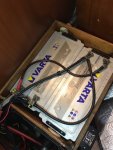
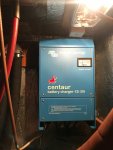
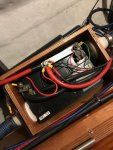
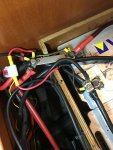
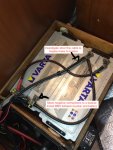
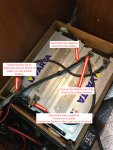
Hallberg Rassy 36, 1994. Please find photos of electrical connections etc attached. I've also marked up a photo of where I think the BMV should be installed. I understand there should only be one connection to the battery from the battery end of the shunt and all other loads should probably go a busbar and then connected onto the load end of the shunt - I've marked up a photo to show this. I think I also need to investigate what is actually connected to the negative of the second battery connected in parallel - I thought the Victron battery charger but difficult to tell with the way the cables run through bulkheads etc. I assume I may need to move this cable to the busbar.
Thanks for any help!
 

Attachments

  • IMG_9046 (1).jpg
    IMG_9046 (1).jpg
    60.7 KB · Views: 27
  • IMG_3626.jpg
    IMG_3626.jpg
    490.3 KB · Views: 29
  • IMG_3624.jpg
    IMG_3624.jpg
    588.2 KB · Views: 34
  • IMG_3622.jpg
    IMG_3622.jpg
    541 KB · Views: 32
  • IMG_9049.jpg
    IMG_9049.jpg
    477.6 KB · Views: 32
  • IMG_9044.jpg
    IMG_9044.jpg
    509.4 KB · Views: 32
  • IMG_9046 (1).jpg
    IMG_9046 (1).jpg
    119.3 KB · Views: 33
The pictures help. The Sterling shunts are fitted to the positive circuits, so just remove them and connect all of the cables that are fitted to them directly to the batteries. You could, if you wanted, leave the engine battery shunt and continue to use the Sterling monitor for the engine battery alone, it may save having to find a way to hide the hole that would be left by removing the Sterling display. Using the Sterling monitor in this way will not affect the Victron one.

In the last picture, the cable marked for investigation needs to go to the busbar, you then need a cable from the busbar to the shunt "load" terminal and another cable from the shunt "battery" terminal to the terminal of the battery, where this cable came from. You then need to move the cable from the other negative terminal of the domestic bank to the shunt, as you have noted in the picture.

The engine battery and engine negatives connect to the busbar, as per my schematic in post #2. The negative connection from the charger also goes to the busbar, as will any other negatives.
 
Thanks Paul. Please find a marked-up photo attached - I hope I've understood correctly?
Please can I ask a few more questions:
1. Do you think I could keep the sterling shunt on the positives and run both this and the BMV for the house battery bank (and engine battery)
2. Do I definitely need to connect the negative busbar to the battery on the righthand side? It may help with wiring if I can connect to the battery on the left, where the bulk of the negative connections are connected currently.
3. Do you have an inclination of what the negative cable marked for investigation is likely to be connected to? I'm heading to the boat this afternoon and will try to confirm again but interested to hear your assumption.
4. Does it make sense that the engine battery is connected in parallel with the main bank? I thought typically they would be on separate circuits.
Sorry to ask lots more questions - I am learning a lot - thank you again.
 

Attachments

  • IMG_9046.jpg
    IMG_9046.jpg
    838.3 KB · Views: 22
Thanks Paul. Please find a marked-up photo attached - I hope I've understood correctly?
Please can I ask a few more questions:
1. Do you think I could keep the sterling shunt on the positives and run both this and the BMV for the house battery bank (and engine battery)
2. Do I definitely need to connect the negative busbar to the battery on the righthand side? It may help with wiring if I can connect to the battery on the left, where the bulk of the negative connections are connected currently.
3. Do you have an inclination of what the negative cable marked for investigation is likely to be connected to? I'm heading to the boat this afternoon and will try to confirm again but interested to hear your assumption.
4. Does it make sense that the engine battery is connected in parallel with the main bank? I thought typically they would be on separate circuits.
Sorry to ask lots more questions - I am learning a lot - thank you again.

The notes on your picture are correct, not that there is only a single negative busbar.

Other questions:
  1. Yes.
  2. Best practice would be to mount the busbar where convenient, a cable must go between the busbar and the shunt, you must connect the battery end of the shunt to the battery bank, this should be the negative on the right hand battery. All negatives on the left hand battery must go to the busbar. If it suits you, you can connect all of those connections on the left battery negative to a terminal post and run a single cable from the terminal post to the busbar, if you choose to do this, i'd make the link cable from the same cable as used on the batteries. You can buy a terminal post (12v planet keep them) or you can simply use a stainless nut and bolt, suitably secured in place.
  3. It should go to your domestic loads, but given the wiring is a bit of a rats nest, it might go elsewhere, possibly the engine battery.
  4. It's common for the negative to link across all batteries, the positive should not., are you sure the positive from the domestic bank is linked to the engine battery positive ? What battery isolator switches do you have ?
As far as connecting the Victron shunt goes, you current negative wiring is somewhat irrelevant. It is simply a matter of:
  1. Connect a cable from the right hand batter to the shunt and a cable from the shunt to the busbar. All other negative cables go to the busbar, that's it. All domestic load cables, all charging cables (mains, solar), engine negative, engine battery etc, everything.
 
Thanks Paul, really helpful and i think we'll take this approach.
I'm not sure there is a positive from the house bank to the engine battery. I think just a negative. Where I have used an engine icon after a positive wire from the house battery it means it goes into the engine bay, but not sure where it connects to. Again, sorry my diagram is so bad - I have learnt a lot in the last 48 hours.
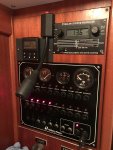
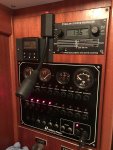
There are battery isolator switches beneath the control panel - please see very bottom of the photo attached (at the edge of the photo). If helpful please find the link to the HR36 wiring diagram here, although I think our system has been substantially modified since this was taken:
https://www.hallberg-rassy.com/fileadmin/user_upload/HR36elschema.pdf
 

Attachments

  • IMG_3622.jpg
    IMG_3622.jpg
    541 KB · Views: 11
Thanks Paul, really helpful and i think we'll take this approach.
I'm not sure there is a positive from the house bank to the engine battery. I think just a negative. Where I have used an engine icon after a positive wire from the house battery it means it goes into the engine bay, but not sure where it connects to. Again, sorry my diagram is so bad - I have learnt a lot in the last 48 hours.
There are battery isolator switches beneath the control panel - please see very bottom of the photo attached (at the edge of the photo). If helpful please find the link to the HR36 wiring diagram here, although I think our system has been substantially modified since this was taken:
https://www.hallberg-rassy.com/fileadmin/user_upload/HR36elschema.pdf

The HR schematic shows what i'd expect, separate circuits and switches for the engine and domestics. Easy to cheap if someone has molested it, turn one switch on at a time, in isolation from the other, and make sure that only the expected stuff powers up.
 
Thanks all. I’ll plan to use a bus bar.

Hallberg Rassy 36, 1994. Please find photos of electrical connections etc attached.
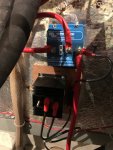
What's the black finned item in the same picture as the Argo Diode battery isolator?
It looks like an old Sterling diode splitter . If so why is it still there with the Argo Diode isolator fitted and what's it doing with only two wires connected to it ?
 
What's the black finned item in the same picture as the Argo Diode battery isolator?
It looks like an old Sterling diode splitter . If so why is it still there with the Argo Diode isolator fitted and what's it doing with only two wires connected to it ?

It's a split charge diode, the input is connected to the input terminal of the Argo. it's possibly there to charge a battery at the bow for the windlass or bow thruster ?

If it is and i was the OP, i'd replace it, and the Argo, with a 3 output Argofet, neater, tidier and less voltage drop.
 
Top