
Robert Wilson
Well-Known Member
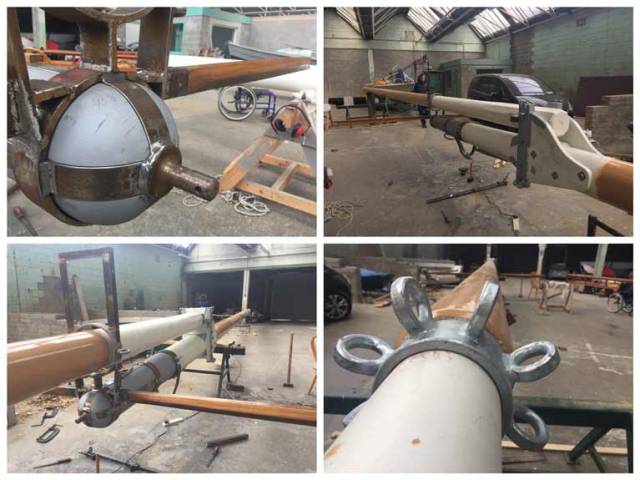
My grey matter has "frozen". I've been trying to remember the name of the two clamps/brackets/fittings which join the two masts.
Doin' me 'ead in, it is.
TIA
Doin' me 'ead in, it is.
TIA


My grey matter has "frozen". I've been trying to remember the name of the two clamps/brackets/fittings which join the two masts.
Doin' me 'ead in, it is.
TIA
I hope i dont get an infarction
Futtocks
That sounds logical, but I thought there was a specific name for the pair of fittings. Something like a tabernacle - but that's something else. Or perhaps it's the same?Assuming we’re talking a fore-and-aft rig on a pilot cutter or something, rather than a square-rigger, I’d call the top one a spectacle iron. Not aware of a specific name for a lower fitting, it’s more just a case of the topmast heel fitting in between the crosstrees and the lower mast. A fid passes through to bear the weight.
Pete

That sounds logical, but I thought there was a specific name for the pair of fittings. Something like a tabernacle - but that's something else. Or perhaps it's the same?
Trestle trees
Doubling?
Almost.
But if you look at a diagram of the masts it shows a lower and upper fitting which encompasses both masts, rather than on both sides to hold the crosstrees.

.jpg.ee5bc94881bb297ddaeb8fbf7ab16d7f.jpg)
I hope this shows the two bits I'm talking about.

This (page 26!) shows the traditional usage: https://books.google.co.uk/books?id...24&source=gbs_toc_r&cad=4#v=onepage&q&f=false
Darcy Lever's "Young Sea Officer's Sheet Anchor" was the standard text on rigging and seamanship for most of the Victorian era.

I happen to have it on my bookshelf; Amazon sell a facsimile version of it. I was fortunate enough to see an original copy when I was a student; a friend of our family had a copy which I arranged to be rebound. It is referenced frequently in Ashley's Book of Knots.Well done. Fig. 185 clearly identifies them. Thank you.
So it appears that the two fittings are called "caps". Apparently nothing to do with "cap-shrouds" - or perhaps originally the cap-shrouds attached to these "caps".
I always thought there was a much more interesting name for them.
Thank you.
It also appears I could have answered my own question on my #14 post above