Help needed with understanding electricity usage

Bathdave

Well-Known Member
Joined
4 Apr 2012
Messages
1,353
Location
jersey, CI
Visit site
sorry if this seems some stupid questions to you seasoned veterans


i Am concerned that something doesn’t quite add up in my electricity usage ..I have 2 105 Ah sealed lead acid house batteries which historically seemed to give us enough Ah to meet our needs but over last few months have seemed to discharge too quickly when sailing . We tend to use the autopilot most of the time.

I have checked and rechecked teh batteries (new last year) and they are coming up as fine on battery testers

1. I want to get an understanding of how much my raymarine auto pilot is likely to draw, assuming average conditions and a reasonably well balanced sail plan

2.. I also am trying to understand how many ‘useful‘ Ah I have and what the alarm level for my battery voltage should be …my online research is suggesting that 12.1 v represents 50% discharge and it would be beneficial for battery life to not discharge below this, although I could go down every once in a while to 70% discharge and expect 11.8 v

3. using the 50% figure, am I right in believing I should have around 100Ah to play with ?

4. running 2 plotters, a ‘’smart’ cool box type fridge that goes into efficient mode when not detecting shore power or alternator running, my AIS transmissions, and auto pilot on standby rather than active, would I be right in believing my current draw should be around 3 A,? Would my auto pilot being active add another couple of A ?

if my understanding is correct, I am thinking that I should expect 20 hours of 5Ah usage to get to 50% discharge …

I don’t seem to be getting anything like that and I am trying to piece together my understanding of what all these figures actually mean and the maths, and whether I have a ‘current leak‘ going on somewhere.

any help or advice gratefully received
 
I think your mistake is the way in which you are interpreting a voltage of 12.1 as being a 50% depth of discharge.

12.1 [I'd have said 12.2) would be 50% for a rested battery , ie one which has not been charged or loaded for 24 hours. The voltage you observe for a battery under load will be somewhat lower. The actual reading will depend on the battery capacity and the current you are taking at the time .
 
It also depends on temperature. If the water is cold and it is cool in the bilge, subtract a few tenths. Voltage without draw and temperature does not tell you much. And the batteries are not new. I'm guessing they lost a step.

battery%2Bcharge.jpg
 
You have the principles correct. However your theoretical 100ah is an overestimate for 2 reasons. First it is very difficult to get such batteries fully charged to start with and second you have probably been discharging them far more than 50% based on what you say you run from them, so the batteries will have lost theoretical capacity.

Rather than guessing your consumption you heed accurate data which a battery monitor will give you. I assume the house bank is just that so a monitor will measure everything in and out to give you a picture of what you are actually using and by selectively switching devices on and off what each consumes. you can then compare this with what you are actually putting in to see the deficit. I expect you will be surprised by the size of the deficit over a day or 2. If you do not make up this deficit for example by mains charging you will stert your next usage cycle with a less than fully charged battery.

See my reply to Yeoman24 for a fuller explanation.
 
The problem is that your consumption is just guess work. I really think the best thing to do is fit a Smart Shunt and establish exactly how much each component of your system is drawing. (Beaten to the punch by @Tranona)

A Pelagic style tiller drive can use as much as 3A or 4A on its own - the spec sheet says 1.2A with no load. Below decks pilots probably have beefier motors (which could draw more) but, most of the time and with balanced sails, I'd guess you're probably using about half power.

Of the things that you mention, the fridge probably draws the most - doesn't matter how "smart" it is, it needs to draw power to cool your milk, so the important factor is whether it's compressor or peltier based.
 
I think your mistake is the way in which you are interpreting a voltage of 12.1 as being a 50% depth of discharge.
12.1 [I'd have said 12.2) would be 50% for a rested battery , ie one which has not been charged or loaded for 24 hours. The voltage you observe for a battery under load will be somewhat lower. The actual reading will depend on the battery capacity and the current you are taking at the time .

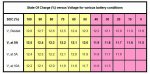
When the battery is under load (which it normally is) I tend to use this table...

BatterySOC.jpg
 
Thanks for responses so far

I am planning to fit a battery monitor, following suggestions on here

I have also twigged, following conversations with a friend here, that my steering has been slightly stiffer than it used to be, and that will be requiring more Ah to overcome the extra resistance …a service and greasing called for

does anyone know at what voltage level a Raymarine AP drops off and goes from auto to standby ..I know it happens, I have experienced it drop off, and I read a Raymarine engineer comment on another forum
 
When the battery is under load (which it normally is) I tend to use this table...

View attachment 135905

The voltages quoted (except the resting voltage) will depend on the size of the battery bank. Rather than a specific current (such as 10A) the table would be much more useful if it was expressed in terms of the C rate (the discharge current in relation to battery size).

Even if this the table was corrected for this omission other factors such as temperature, battery chemistry and discharge history needs to be taken into account. A good, and well calibrated battery monitor is much better guide.
 
Last edited:
does anyone know at what voltage level a Raymarine AP drops off and goes from auto to standby ..I know it happens, I have experienced it drop off, and I read a Raymarine engineer comment on another forum
Sorry if you already know this, but this could be affected by the length / diameter of the wire and voltage drop.

Assuming the drop off voltage was, say, 12v - the AP could be seeing that while the voltage was 12.1v or 12.2v (I don't know) at the battery.
 
Victron bluetooth shunt will tell you what is going in / out of your battery

We have BM1 which accurately shows voltage and current in/out but very hard to see what the linear drive is drawing. With well balanced sails and reasonable sea state, the wheel just twitches rather than being wound round so current draw is for very short periods and pretty low. Other boats may not be as directionally stable so it may have to work harder. In our case, the fridge draws far more than the pilot.
 
the victron graph in real time is very detailed and visible on phone ipad etc, may be drowned out by other minor fluctuations
easy to see what you use in real time and get a prediction from the last x mins usage, progamable, as to how much is left in the battery

It is very good, but it does my head in how it looses the connection if you switch out to another app, meaining you have to reconnect loosing all your collected data.
 
I wholeheartedly endorse the SmartShunt, but I wish the bluetooth range extended just a couple of meters further.

I guess it'll work in the cockpit just fine, but it doesn't from the sofa in the salon.
 

Other threads that may be of interest

Top