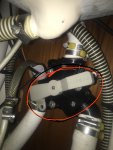
Help needed to decipher what these do on a MF805

wheatleye

New Member
Joined
22 Jun 2021
Messages
15
Visit site
E7AEF8D8-CBD3-4561-9361-4136F100C969.jpegAB5FC16F-F1FD-4727-91B2-698FD888BE97.jpeg
Can anyone help me with these, please. We are mostly in a marina so do not use the toilet but unsure which way they should go and what they do. These are under the sink in the bathroom. We also seem to have a metal tank under the bed in the forward cabin which I presume is a holding tank. Any help is very much appreciated.
 
Looks like the lever valves on the white piping are raw water in and toilet out for the flush. Both should be inline with the pipe when being used and then at 90 deg when you’re under way . Not sure about the valve on the dirtier looking pipe as I can’t see where it comes from, but looks like another raw water pipe of some sort.
The second photo looks like a directional valve for the toilet to either pump straight out or pump into the holding tank.
 
In the first picture those are sea clocks to open and close the pipe to the sea. If the handle is in line with the pipe they are open and if at 90 degrees to the pipe they are closed. When you leave you boat they should be closed but many people never move them. If you close them remember to open them when you come back to use your boat. I the second picture that is the Y valve for your toilet. In one position it will allow the waste from the toilet to pump into the sea with the sea clock open. In the other position it will allow the toilet waste to go into the holding tank

re these valves very often they are very stiff to operate as many people never move them If they are stiff be careful operating them as these sea clocks are below the waterline and a potential weak or leak point on older boats. They worry the heck out of me

hope this helps
 
In the first picture those are sea clocks to open and close the pipe to the sea. If the handle is in line with the pipe they are open and if at 90 degrees to the pipe they are closed. When you leave you boat they should be closed but many people never move them. If you close them remember to open them when you come back to use your boat. I the second picture that is the Y valve for your toilet. In one position it will allow the waste from the toilet to pump into the sea with the sea clock open. In the other position it will allow the toilet waste to go into the holding tank

re these valves very often they are very stiff to operate as many people never move them If they are stiff be careful operating them as these sea clocks are below the waterline and a potential weak or leak point on older boats. They worry the heck out of me

hope this helps
Didn’t I just say this in #2?
 
Didn’t I just say this in #2?
Not quite .
A6AF6BFF-65EF-4619-B3AD-2973488FFDA9.jpeg
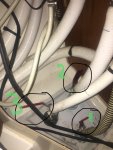
1 is sink drain as the other end seen in diverter valve pic , it’s open hence the sink drains .
3+2 are either the raw toilet sewage direct out , prob 2 as op says he’s never used the tank and the toilet works and it’s open .
3 is the tank out , it’s closed .There will be the tank macerator pump , near the tank under the bed somewhere connected to this .

Of course 2+3 could be the other way round from the info supplied thus far . They are both exits , one for toilet direct , other tank .Close one and flush the bowl if it does not empty then that’s the direct out .

To switch the ops needs to open one and close the other and swing the diverter valve across.
As big lumps says ideally close ALL seacocks when left unattended, ie when you go home .The handle in 3 , kinda 90 degrees is closed .
Regularly exercise them as well .

I leave a check list on the saloon table for myself with the whole boats written on ..
Also a additional engine room list under the helm station cover , with engine seacocks and diesel fuel cocks on in case an engineer or my guardian need to start the boat - ship yard visit etc , service work .They need to know they have been left closed , as Biglimps infers a lot of folks simply waltz off without a care in the world when they leave the boat .
I email images of the ER ones as well to 3 rd parties as a belt n braces approach .

The only ones to leave open are the bilge pump manifolds , Exercise them but obviously leave them open so if the pumps run water can escape as desired.You should also leave them on , it separate switched .Some although are permanently wired up to a battery ? Work out how yours works and make sure they can run properly when you are absent .

I check all the float switches two at sometime during a boat visit , Fortunately on the saloon panal I have LEDs that can tell me if a bilge circuit is duff = switch or pump gone .Nether the less nothing more satisfying than hearing the thing work .Mk 1 eyeball + ear :)
Finally shower sumps , the opposite they have have a tendency to jam on , the float switch is basically submerged when the box fills up and water knackers them with time or they get stuck in the on position .Carry spares .Clean the hairs out as well they sometimes just need freeing up of detritus that ends up in the shower box .

In marinas and certain inland places bays and anchorages you should be on the holding tank .
Discharge it ( check locally the rules ) waaay out at sea .

Hope this helps ?
 
Not quite .
View attachment 120463
1 is sink drain as the other end seen in diverter valve pic , it’s open hence the sink drains .
3+2 are either the raw toilet sewage direct out , prob 2 as op says he’s never used the tank and the toilet works and it’s open .
3 is the tank out , it’s closed .There will be the tank macerator pump , near the tank under the bed somewhere connected to this .

Of course 2+3 could be the other way round from the info supplied thus far . They are both exits , one for toilet direct , other tank .Close one and flush the bowl if it does not empty then that’s the direct out .

To switch the ops needs to open one and close the other and swing the diverter valve across.
As big lumps says ideally close ALL seacocks when left unattended, ie when you go home .The handle in 3 , kinda 90 degrees is closed .
Regularly exercise them as well .

I leave a check list on the saloon table for myself with the whole boats written on ..
Also a additional engine room list under the helm station cover , with engine seacocks and diesel fuel cocks on in case an engineer or my guardian need to start the boat - ship yard visit etc , service work .They need to know they have been left closed , as Biglimps infers a lot of folks simply waltz off without a care in the world when they leave the boat .
I email images of the ER ones as well to 3 rd parties as a belt n braces approach .

The only ones to leave open are the bilge pump manifolds , Exercise them but obviously leave them open so if the pumps run water can escape as desired.You should also leave them on , it separate switched .Some although are permanently wired up to a battery ? Work out how yours works and make sure they can run properly when you are absent .

I check all the float switches two at sometime during a boat visit , Fortunately on the saloon panal I have LEDs that can tell me if a bilge circuit is duff = switch or pump gone .Nether the less nothing more satisfying than hearing the thing work .Mk 1 eyeball + ear :)
Finally shower sumps , the opposite they have have a tendency to jam on , the float switch is basically submerged when the box fills up and water knackers them with time or they get stuck in the on position .Carry spares .Clean the hairs out as well they sometimes just need freeing up of detritus that ends up in the shower box .

In marinas and certain inland places bays and anchorages you should be on the holding tank .
Discharge it ( check locally the rules ) waaay out at sea .

Hope this helps ?
Yeah, like I said! I just used fewer words. ??
 
Yeah, like I said! I just used fewer words. ??
Nope you said this in post #2 “ lever valves on the white piping are raw water in and toilet out for the flush.”

I am saying the pipes marked 3+2 in my marked up pic are both sewage out , one direct the other from the tank .They are std 32 mm white sewage pipes .

There s the distinction.
 
Nope you said this in post #2 “ lever valves on the white piping are raw water in and toilet out for the flush.”

I am saying the pipes marked 3+2 in my marked up pic are both sewage out , one direct the other from the tank .They are std 32 mm white sewage pipes .

There s the distinction.
Yeah well it was close enough.
 
The one that's become numbered 3 looks like it's started to form quite a sharp bend as it comes off the top of the seacock/ valve. I know the valve is closed in the photo but I would check that hose carefully before leaving that one open. Perhaps the hose needs a bit more support to line it up with the fitting.

At least they all have two clips in opposing directions :)
 
Not quite .
View attachment 120463
1 is sink drain as the other end seen in diverter valve pic , it’s open hence the sink drains .
3+2 are either the raw toilet sewage direct out , prob 2 as op says he’s never used the tank and the toilet works and it’s open .
3 is the tank out , it’s closed .There will be the tank macerator pump , near the tank under the bed somewhere connected to this .

Of course 2+3 could be the other way round from the info supplied thus far . They are both exits , one for toilet direct , other tank .Close one and flush the bowl if it does not empty then that’s the direct out .

To switch the ops needs to open one and close the other and swing the diverter valve across.
As big lumps says ideally close ALL seacocks when left unattended, ie when you go home .The handle in 3 , kinda 90 degrees is closed .
Regularly exercise them as well .

I leave a check list on the saloon table for myself with the whole boats written on ..
Also a additional engine room list under the helm station cover , with engine seacocks and diesel fuel cocks on in case an engineer or my guardian need to start the boat - ship yard visit etc , service work .They need to know they have been left closed , as Biglimps infers a lot of folks simply waltz off without a care in the world when they leave the boat .
I email images of the ER ones as well to 3 rd parties as a belt n braces approach .

The only ones to leave open are the bilge pump manifolds , Exercise them but obviously leave them open so if the pumps run water can escape as desired.You should also leave them on , it separate switched .Some although are permanently wired up to a battery ? Work out how yours works and make sure they can run properly when you are absent .

I check all the float switches two at sometime during a boat visit , Fortunately on the saloon panal I have LEDs that can tell me if a bilge circuit is duff = switch or pump gone .Nether the less nothing more satisfying than hearing the thing work .Mk 1 eyeball + ear :)
Finally shower sumps , the opposite they have have a tendency to jam on , the float switch is basically submerged when the box fills up and water knackers them with time or they get stuck in the on position .Carry spares .Clean the hairs out as well they sometimes just need freeing up of detritus that ends up in the shower box .

In marinas and certain inland places bays and anchorages you should be on the holding tank .
Discharge it ( check locally the rules ) waaay out at sea .

Hope this helps ?

Actually #1 is most likely water supply to the toilet (sink out is likely at the hull side above the waterline) #2 is toilet direct out and #3 is tank out and there is an easy tell in that #3 should be connected to the pump which likely is in the same area.
 
My MF805 does not have a holding tank so 1 and 3 are standard being sea water in and waste out. To avoid smells from stagnant seawater use the basin hose to run fresh water into the bowl if you need to use it. If you are a smaller lady you can probably get into the locker to work the valves but it is almost impossible to get your shoulders through the door to get into the cupboard with 2 hands I find! My main seacock was jammed so had to be serviced out of the water. As said above move valves regularly.
 
Thanks. I’m unsure whether the tank has anything in it so next time we take her out to sea…..very far out, we’ll see if we can empty it. There is a gauge on the wall in the bathroom but it doesn’t seem to work.
 
The sender units for the gauges often get stuck in the boats not used .
Its a float on a shaft and the shaft gets gummed up .
Some times if it’s stuck down at the low point a fill up the tank and the buoyancy starts it moving .
Or as well as take the boat out and bounce it about in wave = shock treatment .
Or they are usually accessible on the top of the tank via 6 screws ……You know what’s coming next a 5hitty job .
If you do that slide the thing up/ down to check the gauge , check the wires and get the serial number size L etc .
Like car tyres they come in a multitude of different sizes .

You really need it working .
Have you found the pump out switch and the pump yet ?
That’s another thing ( there was a recent thread on here ) thoses pumps pack up .Another 5hitty job , they can be serviced not necessary replaced .A quality one has a external manual way of rotating it , if it’s stuck from inactivity.
 
Top