Helm to Flybridge wire connection colour

In post #88 i said "If you have the usual TAMD41x engines and standard panels on the flybridge you would not have had oil pressure gauges." The Mercruiser option is rare and without any info about engine from the OP, i based post #88 on the more "normal" Volvo engines.

The statement in post #90 that "They are current measuring devices ( milliammeters )" is incorrect. The TAMD41 series (along with most/all) Volvos of the era use VDO resistive senders.

These senders are available in single or dual station. The standard engine panel for the TAMD41 does not have oil pressure gauges on the flybridge, so the sender would be single station. The panel does have a key switch, the same as the lower helm.

Changing the sender to a dual station one would be a pointless waste of money, and pretty stupid, as it would mean that both helm stations would need to be powered up all of the time. You cannot operate the boat from both stations at the same time, if one wants to change from one helm to the other there is a procedure to hand control to the other station, this varies from boat to boat. With my boat, for instance, the engines need to be taken out of gear at the helm in use, or the control levers cannot be operated at the other helm.

So, with the flybridge gauges wired in parallel one simply turns the key switch on at the helm one wishes to use and everything just works. If one wants to move to the other helm, ones takes the engines out of gear and turns the key switch off, turning the key switch on at the other helm and engaging the gearbox.

It's that simple.

The OP has subsequently revealed that he has Mercruiser engines, this doesn't necessarily change the above, but it would be helpful to see a picture of the flybridge helm at to know how/if the engine can be stopped/started from the flybridge.

Both gauges should still be wired in parallel. If the flybridge originally had oil pressure gauges, they should work correctly. If not, one would normally only power up the helm in use, as above. The OP states there is no key switch on the flybridge, having no way to start/stop the engines from the flybridge would be unusual, but if that's the case, there is still no need for a changeover switch at the flybridge. Fitting one would mean running a wire from the engine harness to the flybridge and back again, pointless. It would make more sense to fit a changeover switch at the lower helm. Or, fit a simple on/off switch at both helms, only turning on the one that is needed.

EDIT : A more elegant solution to changing helm power to the instruments (in the absence of key switches on the flybridge) would be to fit a latching relay at the lower helm. Cut the positive wire that goes to all of the instruments and connect it to the relay, connect another wire that goes to the flybridge helm and powers all gauges there. Connect a negative to the relay. Fit momentary on switches/buttons at both helms to supply power to the relay coil. Pressing either button will change the sate of the relay, turning one helm off and the other on.
 
Last edited:
In post #88 i said "If you have the usual TAMD41x engines and standard panels on the flybridge you would not have had oil pressure gauges." The Mercruiser option is rare and without any info about engine from the OP, i based post #88 on the more "normal" Volvo engines.

The statement in post #90 that "They are current measuring devices ( milliammeters )" is incorrect. The TAMD41 series (along with most/all) Volvos of the era use VDO resistive senders.

These senders are available in single or dual station. The standard engine panel for the TAMD41 does not have oil pressure gauges on the flybridge, so the sender would be single station. The panel does have a key switch, the same as the lower helm.

Changing the sender to a dual station one would be a pointless waste of money, and pretty stupid, as it would mean that both helm stations would need to be powered up all of the time. You cannot operate the boat from both stations at the same time, if one wants to change from one helm to the other there is a procedure to hand control to the other station, this varies from boat to boat. With my boat, for instance, the engines need to be taken out of gear at the helm in use, or the control levers cannot be operated at the other helm.

So, with the flybridge gauges wired in parallel one simply turns the key switch on at the helm one wishes to use and everything just works. If one wants to move to the other helm, ones takes the engines out of gear and turns the key switch off, turning the key switch on at the other helm and engaging the gearbox.

It's that simple.

The OP has subsequently revealed that he has Mercruiser engines, this doesn't necessarily change the above, but it would be helpful to see a picture of the flybridge helm at to know how/if the engine can be stopped/started from the flybridge.

Both gauges should still be wired in parallel. If the flybridge originally had oil pressure gauges, they should work correctly. If not, one would normally only power up the helm in use, as above. The OP states there is no key switch on the flybridge, having no way to start/stop the engines from the flybridge would be unusual, but if that's the case, there is still no need for a changeover switch at the flybridge. Fitting one would mean running a wire from the engine harness to the flybridge and back again, pointless. It would make more sense to fit a changeover switch at the lower helm. Or, fit a simple on/off switch at both helms, only turning on the one that is needed.

EDIT : A more elegant solution to changing helm power to the instruments (in the absence of key switches on the flybridge) would be to fit a latching relay at the lower helm. Cut the positive wire that goes to all of the instruments and connect it to the relay, connect another wire that goes to the flybridge helm and powers all gauges there. Connect a negative to the relay. Fit momentary on switches/buttons at both helms to supply power to the relay coil. Pressing either button will change the sate of the relay, turning one helm off and the other on.
Hi I have been really busy at work and just catching up on what people are saying. I will take some pic of the flybridge layout. The wiring setup looks a bodge job as I have previously mentioned. I appreciate what people are saying but I trust what PR is saying and didn't want to start people arguing over this topic. I will get this sorted and it will all be fine.
 
Hi I have been really busy at work and just catching up on what people are saying. I will take some pic of the flybridge layout. The wiring setup looks a bodge job as I have previously mentioned. I appreciate what people are saying but I trust what PR is saying and didn't want to start people arguing over this topic. I will get this sorted and it will all be fine.
Work tends to get in the way.....

Pictures of the flybridge helm and the lower one would be helpful, but post #101 basically covers it all.

I've tried to find some pictures of the helm panels for Mercruiser engines, but cannot find a single Corniche with a Mercruiser option. Are they petrol or diesel ? Do you know the engine model ?
 
Work tends to get in the way.....

Pictures of the flybridge helm and the lower one would be helpful, but post #101 basically covers it all.

I've tried to find some pictures of the helm panels for Mercruiser engines, but cannot find a single Corniche with a Mercruiser option. Are they petrol or diesel ? Do you know the engine model ?
Hi Paul, engine are D254ac. and are diesel. They are based on the 4.2 engine.
 
Hi Paul, engine are D254ac. and are diesel. They are based on the 4.2 engine.
I'm not familiar with the engines as an option to the Corniche, almost every Corniche i've seen has been fitted with TAMD41x engines. That won't particularly effect the solutions to your issue though. Post pics of lower helm and flybridge instrument panels/dashes and we'll go from there.
 
>

The statement in post #90 that "They are current measuring devices ( milliammeters )" is incorrect. The TAMD41 series (along with most/all) Volvos of the era use VDO resistive senders.


The statement in #90 is not incorrect. It refers to the gauges, which are current measuring devices
I said:

"You cannot run a second gauge in parallel with the original​
They are current measuring devices ( milliammeters ) if two are wired in parallel each will only see half the current and therefore only give about half the correct reading."​

Please learn to read posts correctly.

.
 
The statement in #90 is not incorrect. It refers to the gauges, which are current measuring devices
I said:

"You cannot run a second gauge in parallel with the original​
They are current measuring devices ( milliammeters ) if two are wired in parallel each will only see half the current and therefore only give about half the correct reading."​

Please learn to read posts correctly.

.
Post #90 is an effort by you to find an error in my advice, something you like to do as often as possible. My advice is sound, post #101 details how things are done in the real World, rather than in your World of Googled information, based on the zero experience of such matters that you possess.

Stick to what you know, rather than trying to learn from Google.
 
Last edited:
Hi all, so I have been unwell and haven't had chance to go to the boat and take more pic. Anyway with the wiring on the boat it has been a bit of an rubbish job so I thought start again. This is what I have in mind but please let me know thoughts.

So I am now going to remove wires from the start button and the oil pressure gauge.

With the start button I'm going to connect 10awg from button to solenoid, then a + and - wire from button to isolator switch but not sure what awg size.

With the oil pressure gauge, a wire 1mm Blue from gauge to sender. This would be repeated on flybridge. Then a + and - wire to isolator switch which would be 1mm wire.

This way I don't need to worry about the switches and trying to link them,

If this setup is wrong would people recommend.

 
Hi all, so I have been unwell and haven't had chance to go to the boat and take more pic. Anyway with the wiring on the boat it has been a bit of an rubbish job so I thought start again. This is what I have in mind but please let me know thoughts.

So I am now going to remove wires from the start button and the oil pressure gauge.

With the start button I'm going to connect 10awg from button to solenoid, then a + and - wire from button to isolator switch but not sure what awg size.

With the oil pressure gauge, a wire 1mm Blue from gauge to sender. This would be repeated on flybridge. Then a + and - wire to isolator switch which would be 1mm wire.

This way I don't need to worry about the switches and trying to link them,

If this setup is wrong would people recommend.

I'd like to see some pictures of both helm instrument panels, appreciate you've not been able to do so yet.

AWG is an American thing, we use mm sq here. 10 awg is 6mmsq, which is going to be way over the top for the starter button. In all likelihood (but not guaranteed) the key switches are wired to relays, which in turn operate the starter solenoids.

There is no need to run wires from the FB to the engines, you can run parallel wiring from the lower helm. In fact, there should have already been such wiring, look at the lower helm and see if you can see a set of connections from the engine harnesses. It's common practice to have an engine harness which goes to the instrument panel of a single helm setup, or to some form of Y connector, which has secondary harnesses going to each helm.

The FB helm should have key switches for the engines, the same as the lower helm. You need to be able to stop/start the engines from the FB. If these switches are missing, you can fit rocker switches to do the same job, a pair of Carling Contura switches for each engine would do the job and not cost much, they would also be in keeping with the boat.

With "ignition" switches on the FB there is no need for changeover switches or any other such nonsense. You turn the "ignition" on at the helm you are using and the gauges work without the need for dual station senders or additional wiring.

So, to start with, get some pics of both helms and have a good look behind the lower instrument panel, see if you can spot a Y connector or some other form of "splitter" for the engine harness. Also, take a pic of the back of the lower helm key switches, see if you can measure some of the wires. Would also be useful to see if there are relays in the starter wiring (probably something like a 25mm cube), may also be relays for the pre-heat (if fitted) and the stop solenoids.
 
Hi, I will take some pic when im down there next not a problem.

All I can say with the setup is that the start button is not wired to the key switch it was inserted on a individual system and you can only start the engines on the helm controls. With the FB instruments they are wired with a harness but the oil switch is on those switches and you have joint wires and that's what I don't understand why they would do that rather than one wire. Im sure we will get there.
 
Hi, I will take some pic when im down there next not a problem.

All I can say with the setup is that the start button is not wired to the key switch it was inserted on a individual system and you can only start the engines on the helm controls.
Confused....

You said no key switches on the FB ? Can you clarify what is at each helm, in terms of engine starting, stopping etc.
With the FB instruments they are wired with a harness but the oil switch is on those switches and you have joint wires and that's what I don't understand why they would do that rather than one wire. Im sure we will get there.
I'd forget about all of that, it goes in the skip and you start again.
 
Confused....

You said no key switches on the FB ? Can you clarify what is at each helm, in terms of engine starting, stopping etc.

I'd forget about all of that, it goes in the skip and you start again.
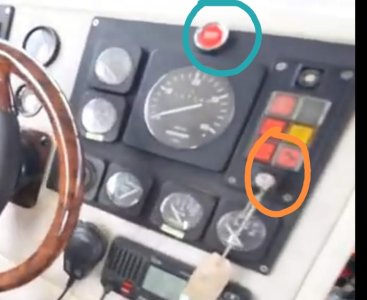
Hi, so there is no key on FB. I have found an image of the helm. You will see the start button top centre of the pic circle in blue and the key circle in orange. I will take a pic of the FB once I'm down there but there is no key on the FB.
 

Attachments

  • IMG-20240129-WA0005_edit_1051328576564579.jpg
    IMG-20240129-WA0005_edit_1051328576564579.jpg
    90.6 KB · Views: 10
Ok it looks like to me the key is used to switch the "ignition " on and off and the button is used to engage the starter

On min I have a key that switched the "ignition" on/off and a spring return to engage the starter. Just a different approptach to do the same thing
 
Ok it looks like to me the key is used to switch the "ignition " on and off and the button is used to engage the starter

On min I have a key that switched the "ignition" on/off and a spring return to engage the starter. Just a different approptach to do the same thing
I think the OPs boat should start on the key switch, the red button is a bodge, presumable fitted due to a dodgy key switch.
 
The OPs boat should start on the key switch, the red button is a bodge, presumable fitted due to a dodgy key switch.

Possibly have you seen how the key switch is connected

Could the OP please confirm

I know start key witches can go faulty and the key switch on wifes car sometimes in the heat of Africa fails to operate the starter motor so I fitted a secondary switch

Note to self to fix wifes car.
 
So we was told by the owner that they couldn't connect a mercruiser engine to the original start button so they inserted the new one. We had to replace the connection on the stop button so I do wonder if we was told some little porky's but he could be right. I am planning to go to the boat in a couple of weeks so I will take a pic of the key wiring and other electrical pic, also the dials and setup on FB.
 
So we was told by the owner that they couldn't connect a mercruiser engine to the original start button so they inserted the new one. We had to replace the connection on the stop button so I do wonder if we was told some little porky's but he could be right. I am planning to go to the boat in a couple of weeks so I will take a pic of the key wiring and other electrical pic, also the dials and setup on FB.
It was obvious that the starter button didn't belong, it doesn't fit the panel.

I would fit switches on the FB, so you can turn the power on/off and start/stop the engine, it's not a difficult job. A pair of Carling Contura rocker switches would look in keeping with the boat.
 
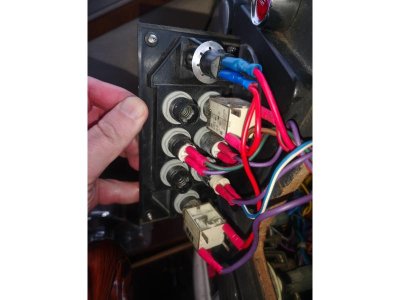
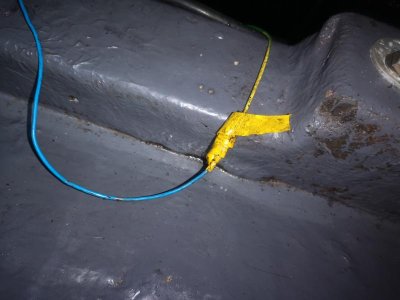
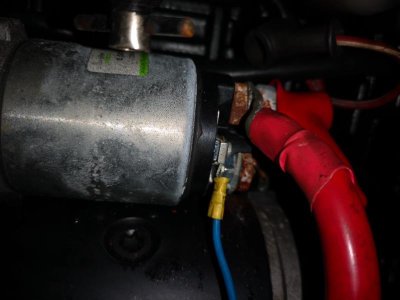
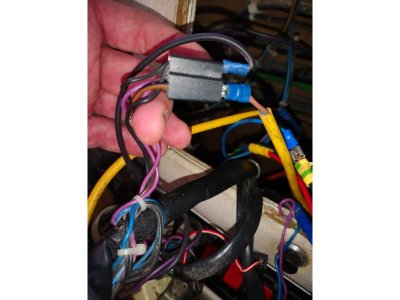
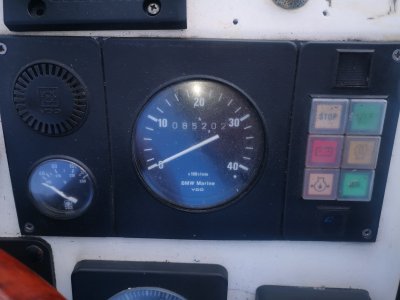
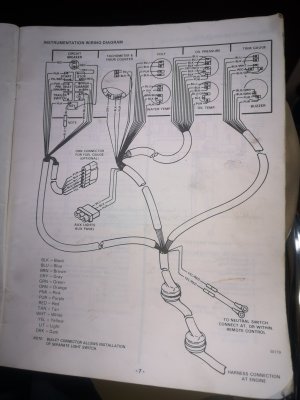
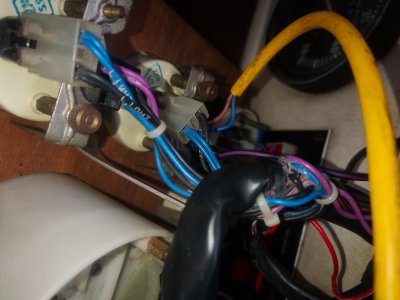
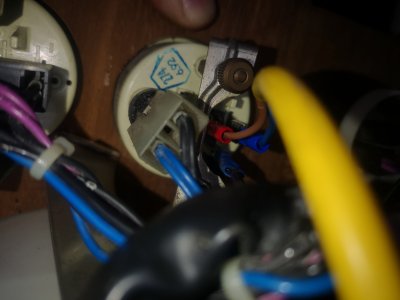
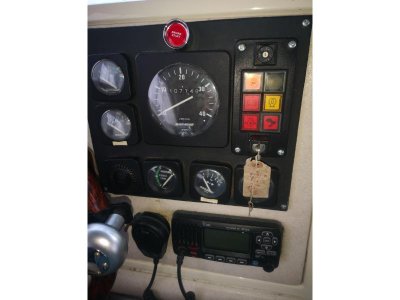
So after a little break I manged to get down to the boat and take some more pic. Looking at the setup and finding a the handbook its all been setup wrong and I think I need to scrap the wire on board for some of it and connect it up correctly. So with the photos you might be able to see that the temp gauge has been connected by odd wiring. In the handbook it says that it should be connected to the purple wire and brown/black etc. They have connected this to a unit then other odd wire from the unit to the switch and dial. The start button has 3 wires connecting from the button to the starter motor. I don't know why they just didn't connect 1 wire from the button to the starter motor. So which wire would I use to do this ie what mm etc. Also the Helm and F/B has wiring harness so same again i'm not to sure why its been connected up the way it has been. My plan also on the F/B is to insert a key and push re-kirk to have a it working on there. My only question is how would I connect the re-kirk to get electric working on the F/B. The image of the blue wire connecting to the yellow/green wire is then connected the a red wire on the start button. The picture of the rev counter is on the F/B
 

Attachments

  • IMG_20240210_093223.jpg
    IMG_20240210_093223.jpg
    43.9 KB · Views: 5
  • IMG_20240210_092800.jpg
    IMG_20240210_092800.jpg
    42.4 KB · Views: 5
  • IMG_20240210_092529.jpg
    IMG_20240210_092529.jpg
    40.7 KB · Views: 5
  • IMG_20240106_120353.jpg
    IMG_20240106_120353.jpg
    46.2 KB · Views: 5
  • IMG_20240210_105833.jpg
    IMG_20240210_105833.jpg
    1 MB · Views: 6
  • IMG_20240210_104656.jpg
    IMG_20240210_104656.jpg
    941.6 KB · Views: 6
  • IMG_20240210_103045.jpg
    IMG_20240210_103045.jpg
    1.8 MB · Views: 6
  • IMG_20240210_102930.jpg
    IMG_20240210_102930.jpg
    1.7 MB · Views: 3
  • IMG_20240210_093240.jpg
    IMG_20240210_093240.jpg
    38.8 KB · Views: 3
Top