Heat Exchanger Servicing

Fire99

Well-Known Member
Joined
11 Oct 2001
Messages
3,918
Location
Bangor NI
Visit site
Hi all,

Maybe a fairly simple question but one of my heat exchangers on my CAT engine has an unknown history and needs a strip-down / pressure test etc. When you have them pressure tested, do you normally give them the core to test or do you give them the whole heat exchanger for them to test with the caps on etc?
I was going to remove the core since I like to do a lot of the stuff myself and I like to inspect my own parts but obviously don't want to make the job any harder than it needs to be. :cool:

cheers in advance.
 
Hi all,

Maybe a fairly simple question but one of my heat exchangers on my CAT engine has an unknown history and needs a strip-down / pressure test etc. When you have them pressure tested, do you normally give them the core to test or do you give them the whole heat exchanger for them to test with the caps on etc?
I was going to remove the core since I like to do a lot of the stuff myself and I like to inspect my own parts but obviously don't want to make the job any harder than it needs to be. :cool:

cheers in advance.
If you prefer to do things yourself then I recommend you make your own pressure tester so you can pressure test with the core inside the housing with the end caps on which is the best way. You can then re-test the whole coolant system after the heat exchanger has been refitted and used at any time in the future to diagnose any coolant loss.

Www.solocoastalsailing.co.uk
 
If you prefer to do things yourself then I recommend you make your own pressure tester so you can pressure test with the core inside the housing with the end caps on which is the best way. You can then re-test the whole coolant system after the heat exchanger has been refitted and used at any time in the future to diagnose any coolant loss.

Www.solocoastalsailing.co.uk
That's certainly an idea. I like to do as much as I can myself so I understand what's going on with my own engines so this could be a route.. Thanks. :cool:
 
Expose the ends of the tube stack and rod through if necessary. The curly end of a wire coat hanger is ideal.
Thanks for that. I've read mixed opinions on rodding the cores. It will be interesting to see what condition they are in. There are no records of this one being taken apart.. :oops:
 
That's certainly an idea. I like to do as much as I can myself so I understand what's going on with my own engines so this could be a route.. Thanks. :cool:
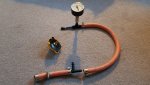
This picture shows my pressure tester. Basically a pressure gauge and a Schrader valve pumped with a bicycle pump to 15 or 20 psi depending on the engine manufacturer's manual. My kit can be connected with either a modified pressure cap or tee-d into an 8mm bore degas hose. You can just see the Schrader valve, with its dust cap, in the end of the piece of blue hose.
coolant pressure tester_resize_63.jpg

Www.solocoastalsailing.co.uk
 
Last edited:
If you prefer to do things yourself then I recommend you make your own pressure tester so you can pressure test with the core inside the housing with the end caps on which is the best way. You can then re-test the whole coolant system after the heat exchanger has been refitted and used at any time in the future to diagnose any coolant loss.

Www.solocoastalsailing.co.uk
I‘ve had success doing this. I had a coolant leak, but I couldn’t find where it was. When pressurised, the location was easily found. It was a pinhole, a flaw in a weld on a manifold.
 
If you decide not to do them yourself then give Abbey Heat Transfer in Hampshire a call, they did a good job for me on intercoolers and heat exchangers, they have a big ultrasonic bath that does a better job than using aggressive acids.
Thanks for that.. Unfortunately my boat is in Northern Ireland so it's quite a trek to Hampshire for exchanger work, unless I'm doing a family visit. :cool:
 
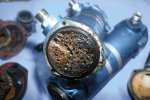
Well a quick status update. I've removed caps both ends and probably about 7 or 8 tubes were a little bunged up but nothing terrible. Two points of interest. At the seawater supply end the heat exchanger had a small O-Ring seal stuck in it. Now where did the seal come from??? Who knows?? Secondly the hard plastic Chinese diesel heater fuel pipe is near a perfect diameter (and plastic) to run down the tubes to clean them..

Do you guys replace the O-Ring seals on every strip down. I'm tempted to since I have no idea how long ago they were last changed..
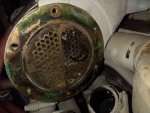
Here's a pic with the stuck o-ring. The end plate looks worse than it is. A quick wipe down and it looks very good to be honest..
 

Attachments

  • Heat Exchanger2.jpeg
    Heat Exchanger2.jpeg
    13.4 KB · Views: 37
Do you guys replace the O-Ring seals on every strip down. I'm tempted to since I have no idea how long ago they were last changed..
Here's a pic with the stuck o-ring. The end plate looks worse than it is. A quick wipe down and it looks very good to be honest..
Yes, absolutely change the O-rings, they suffer from compression set over time and the sealing force diminishes leading to leaks. try your nearby industrial bearing and seal stockist. If it's a Bowman you should find some info on the web about seal sizes or these people have parts https://www.flowtech.co.uk/category...d-heating/coolers/water-cooler/?category=1995
 
Yes, absolutely change the O-rings, they suffer from compression set over time and the sealing force diminishes leading to leaks. try your nearby industrial bearing and seal stockist. If it's a Bowman you should find some info on the web about seal sizes or these people have parts Water Cooler / Coolers / Accumulators, Coolers and Heating / Hydraulic - Flowtech
Thanks for that. I won't skimp on saving a few quid so I'll do a complete seal change. The exchangers are Caterpillar so I've not seen any non-OEM seals as of yet.
 
Top